
By Invitation
How to position your store in the jewellery market
Strategies for Success: Effectively Positioning Your Jewelry Store in a Competitive Market


Shivaram A is a much sought after mentor, consultant, trainer and speaker across multiple industry platforms. He founded Retail Gurukul in 2012 as a Consulting & Training company. Shivaram has since helped and continues to help retailers and manufacturers, significantly improve their business performance across various metrics.
Shivaram’s A Guide to Jewellery Retailing-Consumer facing operations is ultimate resource for jewellery store owners striving for success in today’s competitive market. Discover the secrets to making your jewellery retailing store succeed, draw in a steady flow of customers, and cultivate lasting loyalty. This comprehensive guide offers actionable advice and real-world examples to elevate your store’s aesthetics, service quality, and sales performance. This is an extract from A Guide to Jewellery Retailing-Consumer facing operations.
From the small corner-store goldsmith to the high-end boutique jeweller in their own high-rise building, jewellery retailers come in all forms and sizes. With the Indian jewellery market teeming with nearly 300,000 players, every jewellery retailer must position themselves uniquely to make their presence known in this competitive scenario.
As a jewellery retailer, you first have to decide whether you want to remain as just a “store” or create a “brand”. But what is the difference?
A “brand” has some definable qualities by which it can be uniquely identified. These qualities or features form a perception in the minds of the customer which is called its brand equity.
As a jeweller, you can project certain aspects of your jewellery merchandise or customer service as brand quality.
Look at how PC Chandra, the renowned Kolkata Jewellers are trying to position themselves with the help of the famous creative agency J Walter Thompson (JWT). Ayan Chakraborty, VP and executive business director, JWT Kolkata, said, “PC Chandra’s intricate craftsmanship and the brand’s unique image in the minds of Bengalis all over the world is something we kept in mind while working.”

Arjun Mukherjee, VP and ECD, JWT Kolkata, added, “The challenge was to create a philosophy for the brand which every modern woman will relate to. We went beyond the beauty space in jewellery and tried to find an emotion that will resonate with one and all.”
You too can position your jewellery outlet as a unique brand by defining its values and expressing your trade philosophy in the following ways.
Ways in which you can position your outlet
Jewellery stores fall into certain categories. First, try to identify which category you belong to, and then add value to it by defining your strengths. You may be a:
1. Personal Jeweller
When a customer looks for jewellery “tailor-made to his taste”, he comes to the personal jeweller. The Personal Jeweller highlights the uniqueness of design, exclusivity and personalization as his value points. Elite and royal families of illustrious lineage and social celebrities often prefer to have their own personal jewellers.
As a Personal Jeweller, you must vouch for your individuality in design and integrity in trust. If you possess Jewellery design software and have bagged Jewellery design awards, you really can boast of being a genuine Personal Jeweller.
2. Ethnic Jeweller
For people who have a taste for traditional and ethnic designs, the Ethnic Jeweller is the destination. As an Ethnic Jeweller, you must have profound knowledge in temple designs and must have the capacity to reproduce them without even the slightest difference. Polki, Jadau, Tanjore, Chettinad and Malabar designs feature as ethnic offerings.
3. Modern Jeweller
For the young and trendy, the Modern Jeweller is the person to call on. The Modern Jeweller must dabble in fusion and fashion. Rhodium, Rose gold, Platinum and 18k designs are part of the modern offerings.
4. Boutique Jeweller
The boutique Jeweller is the guy who prides himself on his jewellery range and exemplary service. These artistic showrooms offer an appealing ambience and a comfortable customer experience. Boutique Jewellers have several jewellery lines made by different designers.
5. Estate Jeweller
If you are looking for antique jewellery or vintage heirlooms, the Estate Jeweller is the guy to go to. As an Estate Jeweller, you must have the resourcefulness to seek and procure historic jewellery with sufficient proof. Estate jewellers are very expensive as they deal with high-end jewellery collectables.
6. Main Street Jeweller
The Main Street Jeweller has the sole objective of capturing the interest of the urban audience. He caters to them with an eclectic mix of traditional and modern jewellers with their latest preferences in mind.
7. Chain Store Jeweller
With branches at multiple locations, the Chain Store Jeweller prides itself on its wide geographical presence and popularity. His network of stores may be at diverse locations but portray the same brand image.

Steps to position your Jewellery store
1. First, identify yourself with a particular Jeweller category among the ones listed above.
2. Outline your strengths in stock, service, range, design etc. 3. Zero in on your “unique selling points” – is it affordability, service, repair facility, cost savings…
4. Crystallize your brand persona as a brand image with the help of expert consultants like Retail Gurukul who can bring to light the hidden values of your brand.
5. Position your brand with this persona by forming a unique brand image and taglines.
6. Popularize your brand using these brand messages and establish your brand.
Your brand is as precious as your jewellery. Position it with perfection to reach the pinnacle of success.










By Shivaram A
The Core Issue
The owner carries the entire risk of the business — investment, gold stock, working capital, loans, everything is in their name. The long-term asset also belongs to the owner — reputation, brand, the customer base built over years, often meant to pass to the next generation. But the moment that matters most — when the customer is standing at the counter, when trust is being built or broken — that moment is entirely controlled by the staff.
The person with the most risk is not present at the decisive moment. And the person with the least to lose holds the most power in that moment. This structural mismatch creates frustration on both sides — and it’s rarely discussed openly.
Making the Conflict Explicit
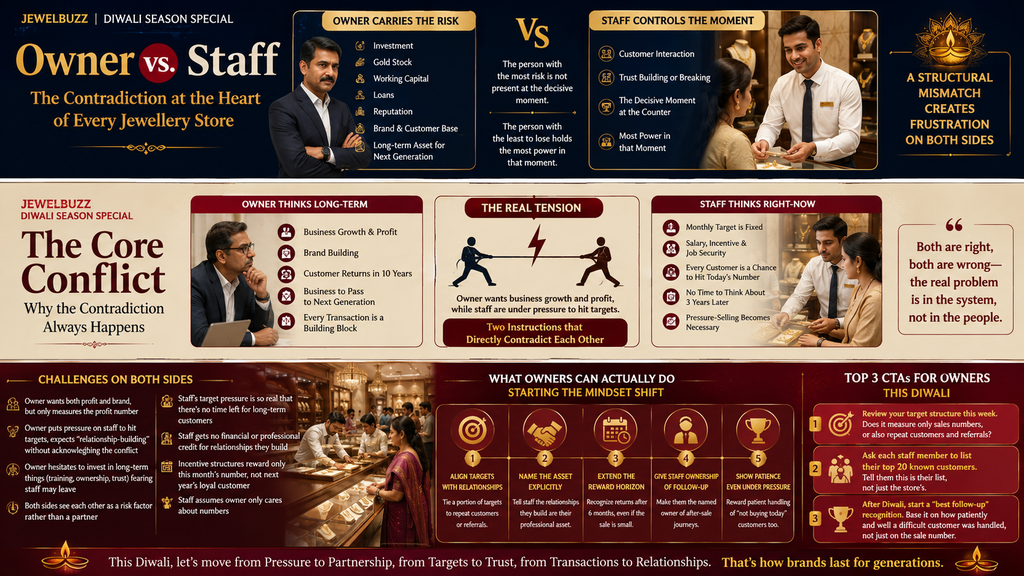
The real tension is this: the owner wants business growth and profit, while staff are under pressure to hit targets.
The owner thinks long-term — how does the brand grow, how does a customer come back after ten years, how does the business pass to the next generation. For the owner, every transaction is a building block toward something bigger.
The staff’s reality is completely different. Their monthly target is fixed. Their salary, incentive, and sometimes even job security depend on how much they sold this month, this Diwali. For staff, every customer is a chance to hit today’s number — right now, this moment. They cannot afford to think about whether this customer comes back in three years, because their performance is reviewed at month-end, not three years later.

So when the owner says “build the relationship, be patient,” and in the same breath increases the target by 20%, these two instructions directly contradict each other. Staff are not confused about what they should ideally do — they understand it perfectly. But they don’t have the choice. The target has to be met, so pressure-selling becomes necessary — even if it means pushing a customer slightly, or using lines like “buy today, rate will go up tomorrow” that create small cracks in trust.
These cracks don’t show up immediately. But after Diwali, when that customer doesn’t return a second time, the owner assumes it’s the staff’s fault. The staff believes the owner set an unrealistic target. Both are right, and both are wrong — because the real problem is in the system, not in the people.
The Challenges on Both Sides
- Owner wants both profit and brand, but only measures the profit number
- Owner puts pressure on staff to hit targets, then also expects “relationship-building” — without acknowledging the two often can’t coexist
- Owner hesitates to invest in long-term things (training, ownership, trust) due to fear that staff will leave anyway
- Staff’s target pressure is so real that there’s no time left to think about the long-term customer
- Staff gets no financial or professional credit for the relationships they build
- Incentive structures reward only this month’s number, not next year’s loyal customer
- Both sides see each other as a risk factor rather than a partner — the owner assumes staff will eventually leave, staff assumes the owner only cares about numbers
What Owners Can Actually Do — Starting the Mindset Shift
- Stop treating targets and relationships as separate — align them. Don’t set targets purely on sales numbers. Tie a small portion of the target to repeat customers or referrals, so staff know that long-term customers count too.
- Name the asset explicitly. Tell staff directly: the relationship you’re building with a customer is your professional asset, not just the store’s. This has to be shown in practice, not just said out loud.
- Extend the reward horizon. Don’t reward only Diwali-week sales — when a customer returns six months later and asks for that staff member by name, recognize that, even if the sale itself is small.
- Give staff ownership of the follow-up. Make each staff member the named owner of their customers’ after-sale journey — repairs, exchanges, the next occasion. This helps them feel the relationship is theirs, not just a transaction.
- Show patience even under pressure. If Diwali week only rewards closed sales, staff will only chase closing. If a staff member who handles a “not buying today” customer well is also appreciated, that’s when the mindset actually starts to shift — because staff notices what the owner actually rewards, not just what they say.
Top 3 CTAs for owners this Diwali
- Review your target structure this week. Does it only measure sales numbers, or does it also give weight to repeat customers and referrals? If not, try a small adjustment starting this Diwali.
- Ask each staff member to list their top 20 known customers. Tell them this is their list, not just the store’s. This builds a sense of ownership.
- After Diwali, start a “best follow-up” recognition. Base it not on the sale number, but on how patiently and well a difficult customer was handled. Staff need to see that patience is rewarded too, not just closing.
Shivaram A
Retail Gurukul


-

 TechBuzz9 hours ago
K. Srinivasan Unveils Doit Coimbatore Experience Centre
-

 GlamBuzz10 hours ago
Kalyan Jewellers’ Navratri Celebrations Bring Stars From All Industries To Thrissur
-

 National News9 hours ago
IFSCA Notifies India Good Delivery Gold Framework
-

 National News10 hours ago
World Gold Council Unveils Immersive Gold Experience At Phoenix Palladium, Lower Parel, Mumbai
