
By Invitation
TIMELESS ELEGANCE: How bridal jewellery trends are redefining Indian weddings in 2025
Redefining Tradition: How Modern Bridal Jewelry Trends Are Shaping Indian Weddings in 2025


Today’s brides are a bold, beautiful and thoughtful tribe. For them, ethical sourcing and sustainability are among the topmost priorities when it comes to purchasing jewels for their big day. The rapid technological advancements in the jewellery industry like the 3D printing have given way to more intricate and aesthetic designs to cater to shifting customer preferences. Designers are getting better at creativity, thanks to the encouragement by customers who are open to experimentation.
In 2024, brides opted for jewels which complimented their personality, and the same trend will follow suit this year too. While a section preferred heavy traditional pieces, others choose jewels which could be used for both special occasions and otherwise.
Weddings have always been an elaborate event in India and its dimensions are getting wider, day by day, driven more by the choices and personalities of the bride and the groom.
The pre-wedding and post-wedding events are properly planned and executed, and brides wish to adorn different varieties of jewels to match their attire. Hence, I expect personalised and bespoke creations to rule the roost this year too.


Not just brides, the family members also make gold and diamond purchases to look their best on the special day. While some opt for timeless classic jewel models, others want to experiment with creative new designs.
In a broader sense, bold geometric shapes and mixed-metal designs with vibrant gemstones and rich enamel are making a comeback and that trend is expected to soar.
At the same time, traditional craftsmanship is also being appreciated with a section of the brides opting for jewels that reflect their culture and heritage. VBJ is known for its legacy and will continue to use artisanal techniques and designs inspired by historical motifs to bring out products that will be loved by all.
The market for high-quality, timeless traditional jewellery will remain unshaken, as these are durable items that hold aesthetic and financial value.
Despite the noise about lab-grown diamonds, natural diamonds will remain much sought after and brides will want to possess diamonds that act as a medium of personal expression. The demand for contemporary and versatile designs that can be worn every day as well as for special occasions will rise. VBJ is all game to explore new possibilities in design, where tradition meets modernity, offering exceptional craftsmanship that is both timeless and relevant.
The brides of 2025 will opt for jewels that are a perfect blend of stunning aesthetics, advanced technology, and conscious luxury and the Indian Weddings will only get bigger and better, this year.










By Shivaram A
The Core Issue
The owner carries the entire risk of the business — investment, gold stock, working capital, loans, everything is in their name. The long-term asset also belongs to the owner — reputation, brand, the customer base built over years, often meant to pass to the next generation. But the moment that matters most — when the customer is standing at the counter, when trust is being built or broken — that moment is entirely controlled by the staff.
The person with the most risk is not present at the decisive moment. And the person with the least to lose holds the most power in that moment. This structural mismatch creates frustration on both sides — and it’s rarely discussed openly.
Making the Conflict Explicit
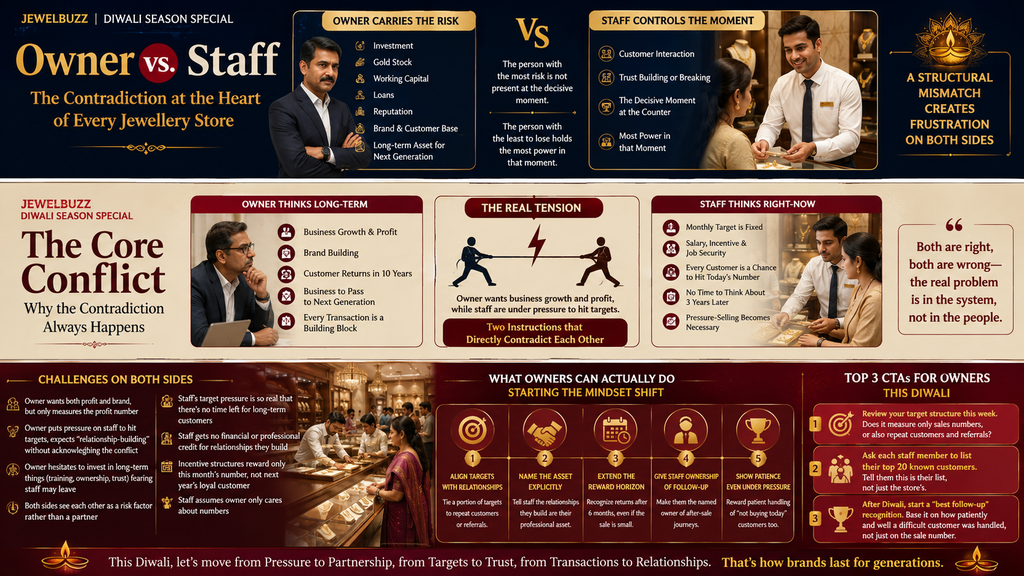
The real tension is this: the owner wants business growth and profit, while staff are under pressure to hit targets.
The owner thinks long-term — how does the brand grow, how does a customer come back after ten years, how does the business pass to the next generation. For the owner, every transaction is a building block toward something bigger.
The staff’s reality is completely different. Their monthly target is fixed. Their salary, incentive, and sometimes even job security depend on how much they sold this month, this Diwali. For staff, every customer is a chance to hit today’s number — right now, this moment. They cannot afford to think about whether this customer comes back in three years, because their performance is reviewed at month-end, not three years later.

So when the owner says “build the relationship, be patient,” and in the same breath increases the target by 20%, these two instructions directly contradict each other. Staff are not confused about what they should ideally do — they understand it perfectly. But they don’t have the choice. The target has to be met, so pressure-selling becomes necessary — even if it means pushing a customer slightly, or using lines like “buy today, rate will go up tomorrow” that create small cracks in trust.
These cracks don’t show up immediately. But after Diwali, when that customer doesn’t return a second time, the owner assumes it’s the staff’s fault. The staff believes the owner set an unrealistic target. Both are right, and both are wrong — because the real problem is in the system, not in the people.
The Challenges on Both Sides
- Owner wants both profit and brand, but only measures the profit number
- Owner puts pressure on staff to hit targets, then also expects “relationship-building” — without acknowledging the two often can’t coexist
- Owner hesitates to invest in long-term things (training, ownership, trust) due to fear that staff will leave anyway
- Staff’s target pressure is so real that there’s no time left to think about the long-term customer
- Staff gets no financial or professional credit for the relationships they build
- Incentive structures reward only this month’s number, not next year’s loyal customer
- Both sides see each other as a risk factor rather than a partner — the owner assumes staff will eventually leave, staff assumes the owner only cares about numbers
What Owners Can Actually Do — Starting the Mindset Shift
- Stop treating targets and relationships as separate — align them. Don’t set targets purely on sales numbers. Tie a small portion of the target to repeat customers or referrals, so staff know that long-term customers count too.
- Name the asset explicitly. Tell staff directly: the relationship you’re building with a customer is your professional asset, not just the store’s. This has to be shown in practice, not just said out loud.
- Extend the reward horizon. Don’t reward only Diwali-week sales — when a customer returns six months later and asks for that staff member by name, recognize that, even if the sale itself is small.
- Give staff ownership of the follow-up. Make each staff member the named owner of their customers’ after-sale journey — repairs, exchanges, the next occasion. This helps them feel the relationship is theirs, not just a transaction.
- Show patience even under pressure. If Diwali week only rewards closed sales, staff will only chase closing. If a staff member who handles a “not buying today” customer well is also appreciated, that’s when the mindset actually starts to shift — because staff notices what the owner actually rewards, not just what they say.
Top 3 CTAs for owners this Diwali
- Review your target structure this week. Does it only measure sales numbers, or does it also give weight to repeat customers and referrals? If not, try a small adjustment starting this Diwali.
- Ask each staff member to list their top 20 known customers. Tell them this is their list, not just the store’s. This builds a sense of ownership.
- After Diwali, start a “best follow-up” recognition. Base it not on the sale number, but on how patiently and well a difficult customer was handled. Staff need to see that patience is rewarded too, not just closing.
Shivaram A
Retail Gurukul



Tradition Meets Everyday Style: Mangalsutras For Karva Chauth From Candere By Kalyan Jewellers

So/Facet Raises ₹10 Crore Led By Sauce To Build The Diamond Brand That Young India Has Been Missing

Festive & Wedding Season Trade Outlook: Resilience, Innovation, and Growth
-

 National News9 hours ago
BHIMA Jewellery Receives Prestigious IAGES Accreditation
-

 New Premises14 hours ago
JGP Jewellers Opens Its 26th Store In Nipani, Marking Its Entry Into Karnataka
-
 JB Insights8 hours ago
Festive & Wedding Season Trade Outlook: Resilience, Innovation, and Growth
-
 National News8 hours ago
So/Facet Raises ₹10 Crore Led By Sauce To Build The Diamond Brand That Young India Has Been Missing
