By Invitation
Diamonds Reimagined: The Rise of Lab-Grown Elegance
By Akash Talesara
President : Sky Gold ltd.


Celebrity Endorsements of LGDs
Celebrity endorsements are pivotal in transforming ethical luxury from an idealistic concept to a mainstream trend. When well-known figures embrace lab-grown diamonds, they redefine luxury by blending style with responsibility. These endorsements break the notion that luxury is only about exclusivity and excess, shifting the narrative to one where ethics and beauty coexist. As consumers increasingly prioritize sustainability, celebrities make it easier for them to align their values with their purchases, normalizing lab-grown diamonds as the future of luxury. This shift is not just a trend—it’s a cultural movement led by those who hold significant influence.



Global jewellery brands leveraging celebrity stardom
Global jewellery brands are tapping into the power of celebrity to position lab-grown diamonds as the next big thing in luxury. Celebrities bring visibility, credibility, and aspirational value to these diamonds, helping brands reframe them as a symbol of modern luxury. Through collaborations and campaigns featuring stars, jewellery brands communicate that lab-grown diamonds are not only ethically sound but also high-end and exclusive. These celebrity endorsements connect luxury with conscious consumption, shifting consumer perceptions and setting a new standard in the luxury market. This strategic use of star power helps lab-grown diamonds carve a niche as the future of sustainable luxury.
Celebrity collaborations driving the popularity of LGDs
Celebrity collaborations are a game-changer in how lab-grown diamonds are perceived. When icons align themselves with these diamonds, they make the concept of sustainable luxury not just appealing but aspirational. Through their influence, celebrities turn lab-grown diamonds into a desirable, high-status item, making them relatable for the general public. By wearing and endorsing these sustainable gems, they make them accessible to a broader range of consumers. These partnerships not only elevate the diamonds’ appeal but also serve as a bridge between high-end luxury and everyday luxury, making it more attainable for a global audience.


Millennials and Gen Z driving the shift toward LGDs
The jewellery market is shifting gears, embracing sustainability, ethical practices, and personalized designs like never before. Millennials and Gen Z are leading the charge in the lab-grown diamond movement. These diamonds are made with minimal environmental impact, offering a more eco-friendly and responsible choice. It’s not just about the sparkle, it’s about supporting brands that stand for authenticity and integrity. This change is reshaping the jewellery industry, blending craftsmanship with conscience and redefining luxury as a perfect balance of elegance and ethics.










By Shivaram A
The Core Issue
The owner carries the entire risk of the business — investment, gold stock, working capital, loans, everything is in their name. The long-term asset also belongs to the owner — reputation, brand, the customer base built over years, often meant to pass to the next generation. But the moment that matters most — when the customer is standing at the counter, when trust is being built or broken — that moment is entirely controlled by the staff.
The person with the most risk is not present at the decisive moment. And the person with the least to lose holds the most power in that moment. This structural mismatch creates frustration on both sides — and it’s rarely discussed openly.
Making the Conflict Explicit
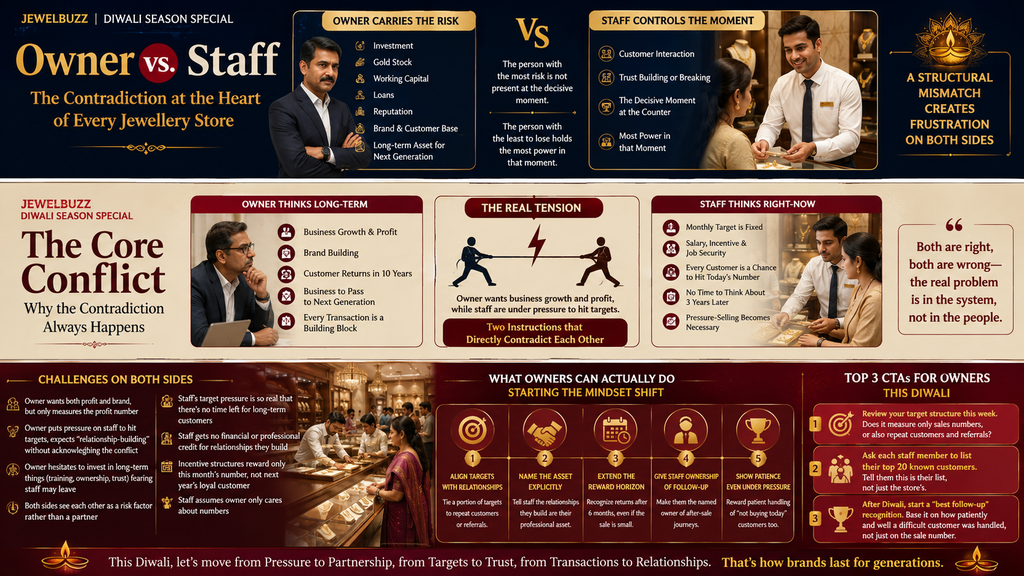
The real tension is this: the owner wants business growth and profit, while staff are under pressure to hit targets.
The owner thinks long-term — how does the brand grow, how does a customer come back after ten years, how does the business pass to the next generation. For the owner, every transaction is a building block toward something bigger.
The staff’s reality is completely different. Their monthly target is fixed. Their salary, incentive, and sometimes even job security depend on how much they sold this month, this Diwali. For staff, every customer is a chance to hit today’s number — right now, this moment. They cannot afford to think about whether this customer comes back in three years, because their performance is reviewed at month-end, not three years later.

So when the owner says “build the relationship, be patient,” and in the same breath increases the target by 20%, these two instructions directly contradict each other. Staff are not confused about what they should ideally do — they understand it perfectly. But they don’t have the choice. The target has to be met, so pressure-selling becomes necessary — even if it means pushing a customer slightly, or using lines like “buy today, rate will go up tomorrow” that create small cracks in trust.
These cracks don’t show up immediately. But after Diwali, when that customer doesn’t return a second time, the owner assumes it’s the staff’s fault. The staff believes the owner set an unrealistic target. Both are right, and both are wrong — because the real problem is in the system, not in the people.
The Challenges on Both Sides
- Owner wants both profit and brand, but only measures the profit number
- Owner puts pressure on staff to hit targets, then also expects “relationship-building” — without acknowledging the two often can’t coexist
- Owner hesitates to invest in long-term things (training, ownership, trust) due to fear that staff will leave anyway
- Staff’s target pressure is so real that there’s no time left to think about the long-term customer
- Staff gets no financial or professional credit for the relationships they build
- Incentive structures reward only this month’s number, not next year’s loyal customer
- Both sides see each other as a risk factor rather than a partner — the owner assumes staff will eventually leave, staff assumes the owner only cares about numbers
What Owners Can Actually Do — Starting the Mindset Shift
- Stop treating targets and relationships as separate — align them. Don’t set targets purely on sales numbers. Tie a small portion of the target to repeat customers or referrals, so staff know that long-term customers count too.
- Name the asset explicitly. Tell staff directly: the relationship you’re building with a customer is your professional asset, not just the store’s. This has to be shown in practice, not just said out loud.
- Extend the reward horizon. Don’t reward only Diwali-week sales — when a customer returns six months later and asks for that staff member by name, recognize that, even if the sale itself is small.
- Give staff ownership of the follow-up. Make each staff member the named owner of their customers’ after-sale journey — repairs, exchanges, the next occasion. This helps them feel the relationship is theirs, not just a transaction.
- Show patience even under pressure. If Diwali week only rewards closed sales, staff will only chase closing. If a staff member who handles a “not buying today” customer well is also appreciated, that’s when the mindset actually starts to shift — because staff notices what the owner actually rewards, not just what they say.
Top 3 CTAs for owners this Diwali
- Review your target structure this week. Does it only measure sales numbers, or does it also give weight to repeat customers and referrals? If not, try a small adjustment starting this Diwali.
- Ask each staff member to list their top 20 known customers. Tell them this is their list, not just the store’s. This builds a sense of ownership.
- After Diwali, start a “best follow-up” recognition. Base it not on the sale number, but on how patiently and well a difficult customer was handled. Staff need to see that patience is rewarded too, not just closing.
Shivaram A
Retail Gurukul



India Delegation Arrives In Paris For Three Days Of Learning, Business & Collaboration

BIS Introduces The Silver Refinery Certification Scheme; Framework Introduces “India Good Delivery For Silver”

Navratri Edit By DAIMANTÉ: 9 Pendants, 9 Expressions Of Intention
BIS Introduces The Silver Refinery Certification Scheme; Framework Introduces “India Good Delivery For Silver”

Aspect Bullion & Refinery Launches “India’s Biggest Gold Fest” With Zero Making Charges On Gold Coins and Bars

GJEPC, ECGC Programme Underlines Recent Changes In Export Credit Insurance For The GJ Sector.
-
 National News5 hours ago
BIS Introduces The Silver Refinery Certification Scheme; Framework Introduces “India Good Delivery For Silver”
-
 National News6 hours ago
Aspect Bullion & Refinery Launches “India’s Biggest Gold Fest” With Zero Making Charges On Gold Coins and Bars
-
 National News7 hours ago
GJEPC, ECGC Programme Underlines Recent Changes In Export Credit Insurance For The GJ Sector.
-
 International News4 hours ago
India Delegation Arrives In Paris For Three Days Of Learning, Business & Collaboration