
By Invitation
Everyday Elegance: Redefining Luxury Through MinimalismBy Akash Talesara
President – Sky Gold and Diamonds


In a world constantly racing toward more, minimalism is quietly becoming the new luxury. Today’s modern consumer is not just looking for jewellery that dazzles on wedding days and grand occasions—they’re seeking pieces that become a natural part of their everyday lives. At Sky Gold and Diamonds, we believe true luxury lies in jewellery that is not locked away, but lived in.
Gone are the days when gold and diamond jewellery was considered purely ceremonial or reserved for once-in-a-lifetime moments. A powerful shift is underway, especially among urban millennials and Gen Z. They are driving the demand for lightweight, functional, yet emotionally meaningful jewellery that can be worn at work, during travel, or over a cup of coffee with friends. This shift is not just a trend; it’s a transformation—and we at Sky Gold and Diamonds are designing right at the heart of it.
Our collections today are built on a clear philosophy: “Less is More. But Less must still be Luxurious.” Every piece we craft under our minimalist design line is meant to reflect elegance without excess—crafted with purpose, precision, and a story. Whether it’s a whisper-thin diamond bracelet, a subtle gold pendant with a hidden message, or stackable rings that evolve with your mood—our pieces aim to blend beauty with versatility.
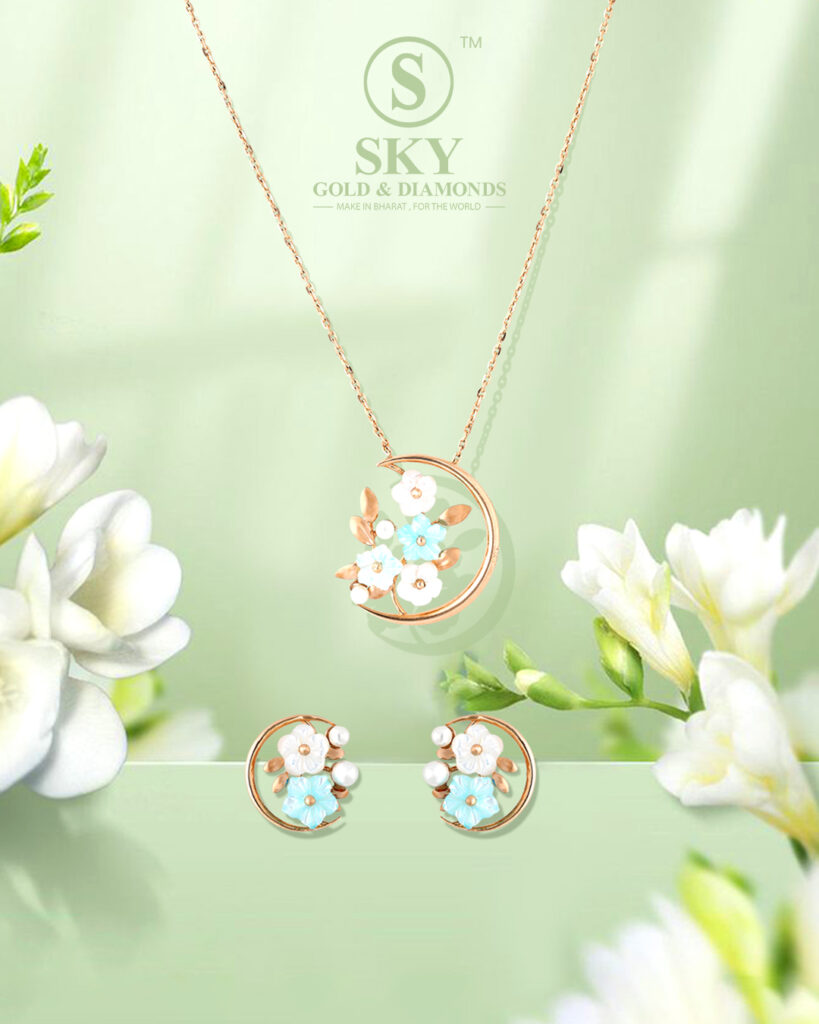
What makes our approach unique is theme-based design thinking. We study emotions, lifestyles, and occasions. For instance, our 9-5 collection is built for the modern working woman sleek, comfortable, and graceful enough to carry from office boardrooms to evening dinners. Our “Moods in Metal” collection reflects emotional minimalism tiny but thoughtful charms representing personal journeys, from graduation to motherhood.
We’ve also found success in collections inspired by contemporary architecture, poetry, and natural forms—designed not to scream, but to speak gently to the soul. This creative direction allows us to connect deeply with our customers, many of whom are first-time jewellery buyers looking for meaning, not just metal.
From a business lens, lightweight jewellery is also a smart market strategy. It aligns with the growing demand for affordability without compromising design excellence. Customers can now build a collection of real gold and diamonds over time, rather than saving for years to buy one heavy set.
At Sky Gold and Diamonds, we’re proud to lead this movement where jewellery is no longer stored—it’s styled. No longer bulky—it’s breathable. No longer passive—it’s personal.
As we look to the future, our goal remains to stay rooted in craftsmanship, but bold in imagination. With the right balance of minimalism, storytelling, and market intuition, we believe daily wear jewellery can become the most powerful segment of the jewellery industry.
After all, in a world chasing the extraordinary, it’s the simplicity of the everyday that often feels most precious.









By Shivaram A
The Core Issue
The owner carries the entire risk of the business — investment, gold stock, working capital, loans, everything is in their name. The long-term asset also belongs to the owner — reputation, brand, the customer base built over years, often meant to pass to the next generation. But the moment that matters most — when the customer is standing at the counter, when trust is being built or broken — that moment is entirely controlled by the staff.
The person with the most risk is not present at the decisive moment. And the person with the least to lose holds the most power in that moment. This structural mismatch creates frustration on both sides — and it’s rarely discussed openly.
Making the Conflict Explicit
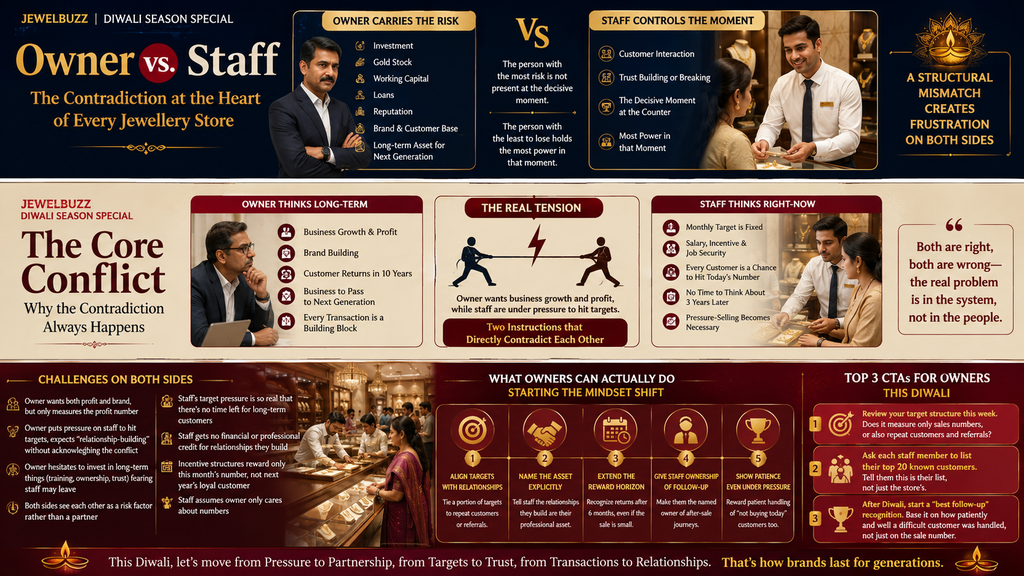
The real tension is this: the owner wants business growth and profit, while staff are under pressure to hit targets.
The owner thinks long-term — how does the brand grow, how does a customer come back after ten years, how does the business pass to the next generation. For the owner, every transaction is a building block toward something bigger.
The staff’s reality is completely different. Their monthly target is fixed. Their salary, incentive, and sometimes even job security depend on how much they sold this month, this Diwali. For staff, every customer is a chance to hit today’s number — right now, this moment. They cannot afford to think about whether this customer comes back in three years, because their performance is reviewed at month-end, not three years later.

So when the owner says “build the relationship, be patient,” and in the same breath increases the target by 20%, these two instructions directly contradict each other. Staff are not confused about what they should ideally do — they understand it perfectly. But they don’t have the choice. The target has to be met, so pressure-selling becomes necessary — even if it means pushing a customer slightly, or using lines like “buy today, rate will go up tomorrow” that create small cracks in trust.
These cracks don’t show up immediately. But after Diwali, when that customer doesn’t return a second time, the owner assumes it’s the staff’s fault. The staff believes the owner set an unrealistic target. Both are right, and both are wrong — because the real problem is in the system, not in the people.
The Challenges on Both Sides
- Owner wants both profit and brand, but only measures the profit number
- Owner puts pressure on staff to hit targets, then also expects “relationship-building” — without acknowledging the two often can’t coexist
- Owner hesitates to invest in long-term things (training, ownership, trust) due to fear that staff will leave anyway
- Staff’s target pressure is so real that there’s no time left to think about the long-term customer
- Staff gets no financial or professional credit for the relationships they build
- Incentive structures reward only this month’s number, not next year’s loyal customer
- Both sides see each other as a risk factor rather than a partner — the owner assumes staff will eventually leave, staff assumes the owner only cares about numbers
What Owners Can Actually Do — Starting the Mindset Shift
- Stop treating targets and relationships as separate — align them. Don’t set targets purely on sales numbers. Tie a small portion of the target to repeat customers or referrals, so staff know that long-term customers count too.
- Name the asset explicitly. Tell staff directly: the relationship you’re building with a customer is your professional asset, not just the store’s. This has to be shown in practice, not just said out loud.
- Extend the reward horizon. Don’t reward only Diwali-week sales — when a customer returns six months later and asks for that staff member by name, recognize that, even if the sale itself is small.
- Give staff ownership of the follow-up. Make each staff member the named owner of their customers’ after-sale journey — repairs, exchanges, the next occasion. This helps them feel the relationship is theirs, not just a transaction.
- Show patience even under pressure. If Diwali week only rewards closed sales, staff will only chase closing. If a staff member who handles a “not buying today” customer well is also appreciated, that’s when the mindset actually starts to shift — because staff notices what the owner actually rewards, not just what they say.
Top 3 CTAs for owners this Diwali
- Review your target structure this week. Does it only measure sales numbers, or does it also give weight to repeat customers and referrals? If not, try a small adjustment starting this Diwali.
- Ask each staff member to list their top 20 known customers. Tell them this is their list, not just the store’s. This builds a sense of ownership.
- After Diwali, start a “best follow-up” recognition. Base it not on the sale number, but on how patiently and well a difficult customer was handled. Staff need to see that patience is rewarded too, not just closing.
Shivaram A
Retail Gurukul



Festive Dressing, But Make It QWEEN: 10 Jewellery Pieces To Add To Your Festive Wardrobe

WGC Report-Digital Gold: Unlocking a $700bn Opportunity

Malabar Gold & Diamonds Unveils ‘SWAYE’, A Natural Diamond Collection Inspired By Spiral Forms and Modern Elegance

Limelight Lab Grown Diamonds Crosses 100 Stores Milestone This Dussehra: Targets 200 In 2027
Malabar Gold & Diamonds Unveils ‘SWAYE’, A Natural Diamond Collection Inspired By Spiral Forms and Modern Elegance
Festive Dressing, But Make It QWEEN: 10 Jewellery Pieces To Add To Your Festive Wardrobe
-
 National News2 days ago
Limelight Lab Grown Diamonds Crosses 100 Stores Milestone This Dussehra: Targets 200 In 2027
-
 BrandBuzz11 hours ago
Malabar Gold & Diamonds Unveils ‘SWAYE’, A Natural Diamond Collection Inspired By Spiral Forms and Modern Elegance
-
 National News7 hours ago
Festive Dressing, But Make It QWEEN: 10 Jewellery Pieces To Add To Your Festive Wardrobe
-
 International News8 hours ago
WGC Report-Digital Gold: Unlocking a $700bn Opportunity
