
By Invitation
Shaping gem enthusiasts for a global retail reality: Inside GSI’s Colored Stone Program
By Ramit Kapur, Managing Director GSI India

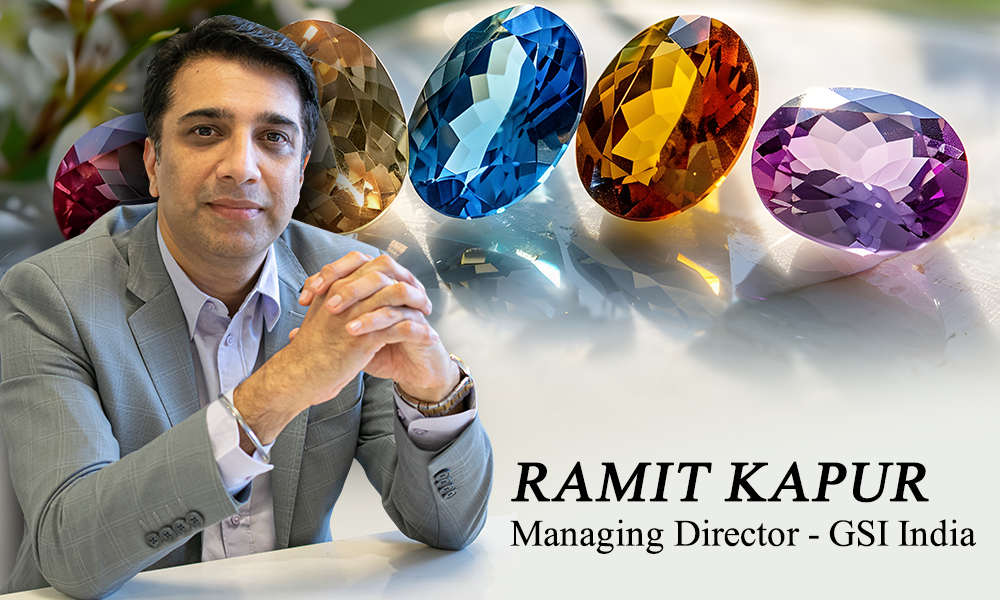
One of the recurring questions I hear from retailers, whether in the heart of Mumbai or in the luxury corridors of New York is this: Where do we find individuals who truly understand colored stones? Not just those who can name them or describe their appearance, but professionals who understand their essence. People who grasp quality, origin, treatments, pricing influences and most importantly, how all of it directly impacts customer trust and retail flow.
Too often, gemology education ends at surface-level theory. Students know the textbook answers but lack the confidence to apply that knowledge when faced with a real-world stone. That’s because being a gemological professional is never about just one thing; it’s a sum of many factors. Theory is essential, but without hands-on exposure, it stays abstract. Practical lab experience should be backed by a mindset that encourages critical thinking and pattern recognition. Add to that real-world exposure, problem-solving under pressure, and the ability to communicate insights clearly and you begin to shape someone truly capable.

A Lab-Driven Approach to Learning
That’s the exact gap GSI set out to address when we created the Colored Stone Professional (CSP) Diploma Program.
With our global expertise, advanced instrumentation, and access to live inventory, we are in a special position to build a course that doesn’t just skim the surface, but goes deeper, one that stands out in a sea of generic gemology programs. Our vision is to go beyond just another degree course and create professionals of the very standard we’d want to hire for our own labs: accurate, efficient, thoughtful. And once trained, whether they choose to become designers, sourcing leads, retail trainers, or full-time gemologists, the world becomes their oyster.
Our approach to this course is not purely academic. We built it from the inside out; as industry participants who live this work every day. GSI, as a global laboratory, examines gemstones daily from all major trading centers. Our experts are constantly updated; researching detection techniques, documenting treatment trends, and working with inventories that reflect the full range of market realities. With that vantage point, we are set to solve a real industry problem: the widening gap between gemological knowledge and real-world application.
The CSP Difference
I could write an entire book on why this course is different. And honestly, I can’t stress enough the value of learning from a global laboratory like GSI that is connected to daily realities across continents. That makes GSI a platform reflecting something much deeper than theory, it reflects practice, insight, and precision. So while I could list countless strengths of the Colored Stone Professional (CSP) Diploma, here are a few that I believe define its true character.
First, the practical exposure is unmatched. Students don’t just “learn” stones, they work with 800 gemstones across the span of the course. It’s a curriculum-integrated journey that helps them observe and identify inclusions, verify treatments, and understand what those treatments mean in real market conditions.
Then comes instrumentation. Students get the opportunity to attend advanced lab sessions, where they experience GSI’s state-of-the-art instrumentation firsthand, and understand its applicability. When they see how and why FTIR, UV-Vis, and advanced spectroscopy are used, they begin to appreciate the rigor behind every report.
We also take them to the source. Our mine visits aren’t just field trips. They’re reality checks. Students see rough material in its natural environment, understand how value begins at origin, and how supply chain complexities play out from mine to market. They grasp pricing at the root, not just from the price tag on a finished piece.
And finally, perspective. We bring in industry veterans for open sessions. These are not scripted lectures, they’re candid conversations. Students are encouraged to ask, challenge, and absorb insights from people who’ve spent decades in design, manufacturing, trading, and retail. The result is perspective rooted in reality.
International curriculum with a domestic blend.
The CSP diploma program has been carefully curated by some of the finest minds in the gem and jewelry world;not just in India, but globally. Our team includes global experts who ensure the curriculum remains current, rigorous, and industry-relevant across borders. It’s updated frequently to reflect the latest market realities, treatment discoveries, and sourcing challenges. The diploma itself is issued from our headquarters in New York, giving our graduates global credibility and recognition.
Through the CSP diploma program, we are building professionals who can sit across from a buyer and explain why two seemingly similar stones have a vast price difference, or why a particular origin commands a premium. That’s the kind of clarity that transforms retail experiences and builds trust. By the end of the program, every graduate stands at par with a fresher gemologist, equipped not only for technical positions but also to bring value in retail, sourcing, manufacturing, or design. In fact, designers who complete our program often find themselves pitching better, sourcing smarter, and delivering with far greater conviction.










By Shivaram A
The Core Issue
The owner carries the entire risk of the business — investment, gold stock, working capital, loans, everything is in their name. The long-term asset also belongs to the owner — reputation, brand, the customer base built over years, often meant to pass to the next generation. But the moment that matters most — when the customer is standing at the counter, when trust is being built or broken — that moment is entirely controlled by the staff.
The person with the most risk is not present at the decisive moment. And the person with the least to lose holds the most power in that moment. This structural mismatch creates frustration on both sides — and it’s rarely discussed openly.
Making the Conflict Explicit
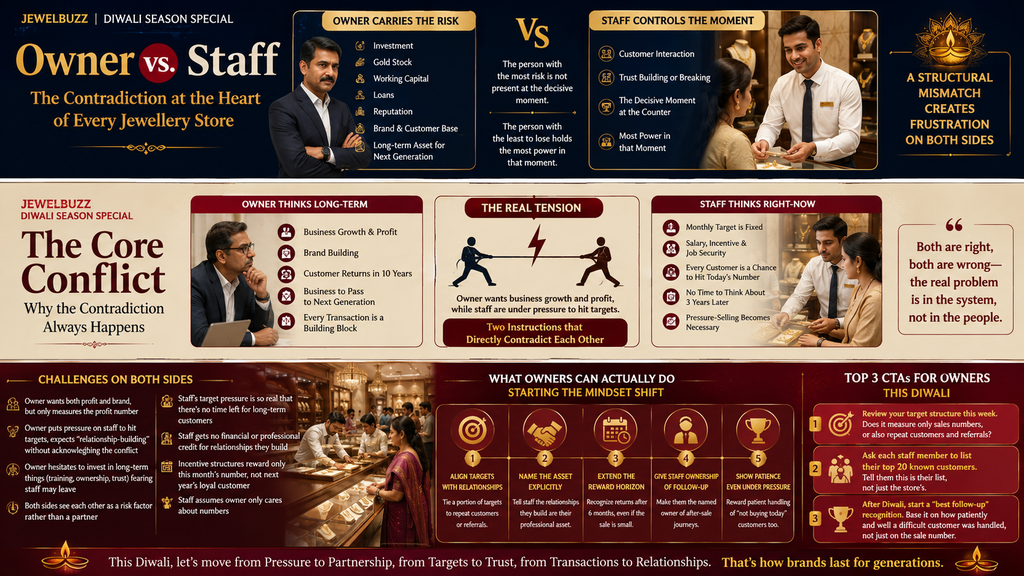
The real tension is this: the owner wants business growth and profit, while staff are under pressure to hit targets.
The owner thinks long-term — how does the brand grow, how does a customer come back after ten years, how does the business pass to the next generation. For the owner, every transaction is a building block toward something bigger.
The staff’s reality is completely different. Their monthly target is fixed. Their salary, incentive, and sometimes even job security depend on how much they sold this month, this Diwali. For staff, every customer is a chance to hit today’s number — right now, this moment. They cannot afford to think about whether this customer comes back in three years, because their performance is reviewed at month-end, not three years later.

So when the owner says “build the relationship, be patient,” and in the same breath increases the target by 20%, these two instructions directly contradict each other. Staff are not confused about what they should ideally do — they understand it perfectly. But they don’t have the choice. The target has to be met, so pressure-selling becomes necessary — even if it means pushing a customer slightly, or using lines like “buy today, rate will go up tomorrow” that create small cracks in trust.
These cracks don’t show up immediately. But after Diwali, when that customer doesn’t return a second time, the owner assumes it’s the staff’s fault. The staff believes the owner set an unrealistic target. Both are right, and both are wrong — because the real problem is in the system, not in the people.
The Challenges on Both Sides
- Owner wants both profit and brand, but only measures the profit number
- Owner puts pressure on staff to hit targets, then also expects “relationship-building” — without acknowledging the two often can’t coexist
- Owner hesitates to invest in long-term things (training, ownership, trust) due to fear that staff will leave anyway
- Staff’s target pressure is so real that there’s no time left to think about the long-term customer
- Staff gets no financial or professional credit for the relationships they build
- Incentive structures reward only this month’s number, not next year’s loyal customer
- Both sides see each other as a risk factor rather than a partner — the owner assumes staff will eventually leave, staff assumes the owner only cares about numbers
What Owners Can Actually Do — Starting the Mindset Shift
- Stop treating targets and relationships as separate — align them. Don’t set targets purely on sales numbers. Tie a small portion of the target to repeat customers or referrals, so staff know that long-term customers count too.
- Name the asset explicitly. Tell staff directly: the relationship you’re building with a customer is your professional asset, not just the store’s. This has to be shown in practice, not just said out loud.
- Extend the reward horizon. Don’t reward only Diwali-week sales — when a customer returns six months later and asks for that staff member by name, recognize that, even if the sale itself is small.
- Give staff ownership of the follow-up. Make each staff member the named owner of their customers’ after-sale journey — repairs, exchanges, the next occasion. This helps them feel the relationship is theirs, not just a transaction.
- Show patience even under pressure. If Diwali week only rewards closed sales, staff will only chase closing. If a staff member who handles a “not buying today” customer well is also appreciated, that’s when the mindset actually starts to shift — because staff notices what the owner actually rewards, not just what they say.
Top 3 CTAs for owners this Diwali
- Review your target structure this week. Does it only measure sales numbers, or does it also give weight to repeat customers and referrals? If not, try a small adjustment starting this Diwali.
- Ask each staff member to list their top 20 known customers. Tell them this is their list, not just the store’s. This builds a sense of ownership.
- After Diwali, start a “best follow-up” recognition. Base it not on the sale number, but on how patiently and well a difficult customer was handled. Staff need to see that patience is rewarded too, not just closing.
Shivaram A
Retail Gurukul



JGP Jewellers Opens Its 26th Store In Nipani, Marking Its Entry Into Karnataka

Festive Dressing, But Make It QWEEN: 10 Jewellery Pieces To Add To Your Festive Wardrobe

WGC Report-Digital Gold: Unlocking a $700bn Opportunity

Limelight Lab Grown Diamonds Crosses 100 Stores Milestone This Dussehra: Targets 200 In 2027

Malabar Gold & Diamonds Unveils ‘SWAYE’, A Natural Diamond Collection Inspired By Spiral Forms and Modern Elegance
JGP Jewellers Opens Its 26th Store In Nipani, Marking Its Entry Into Karnataka
-
 National News3 days ago
Limelight Lab Grown Diamonds Crosses 100 Stores Milestone This Dussehra: Targets 200 In 2027
-
 BrandBuzz20 hours ago
Malabar Gold & Diamonds Unveils ‘SWAYE’, A Natural Diamond Collection Inspired By Spiral Forms and Modern Elegance
-
 New Premises11 minutes ago
JGP Jewellers Opens Its 26th Store In Nipani, Marking Its Entry Into Karnataka
-
 National News16 hours ago
Festive Dressing, But Make It QWEEN: 10 Jewellery Pieces To Add To Your Festive Wardrobe
