
Education
Material Science Is A Critical Component Of Jewellery Education
By Stephen Fernandes
– Design Tells A Piece What To Look Like. Material Science Determines Whether It Can Actually Exist and Endure.


Jewellery education has long celebrated the visual: proportion, colour harmony, the poetry of form. But beneath every beautiful object lies a material reality that design alone cannot address. A ring may be conceived in sketches and rendered in digital light, yet it must ultimately exist as metal and stone in the physical world – subject to force, heat, chemical reaction, and time. It is material science, and specifically the disciplines of metallurgy and gemology, that equip students to navigate that reality with confidence and mastery.
This is not a peripheral concern. The structural decisions made at the bench – which alloy to choose, at what temperature to anneal, how to set a particular gemstone – are inseparable from the aesthetic ones. A jeweller who understands only visual composition is working half-blind.
Four Essential Pillars
Structural Integrity
Understanding ductility, hardness, and tensile strength is what separates a ring that endures from one that fails. The choice between 14k and 18k gold, for instance, is not merely economic – it is metallurgical. The higher copper content in 14k gold produces an alloy measurably harder and more resistant to the micro-deformations of daily wear, making it the practical choice for everyday pieces where an 18k ring might gradually lose its form.
Process Mastery
Annealing and work-hardening are not mere techniques – they are applied physics. Every time a jeweller draws wire through a draw plate, they are deliberately dislocating the metal’s crystalline structure to increase strength. Every time they introduce controlled heat, they are allowing those dislocations to resolve. Knowing exact alloy melting points, understanding eutectic behaviour in solder, and reading the colour of heated metal are skills that live entirely in the domain of materials science.
Gemstone Compatibility
A materials-informed approach transforms stone-setting from guesswork into precision. Sapphire, with a Mohs hardness of 9, demands a setting metal that will not score its girdle during bezel or prong work – typically platinum or a hardened gold alloy. Softer stones, conversely, may require specific burnishing tools and adjusted pressure. Without material knowledge, the setting process carries unnecessary risk to both the gem and mounting.
Sustainability & Innovation
The contemporary jeweller operates in an industry under increasing scrutiny. Modern education now encompasses recycled precious metals, ethically traceable stones, and experimental bio-based resins that challenge traditional making assumptions. Understanding the material properties of these alternatives – how recycled gold’s purity and grain structure may differ, how resins cure and age – is as technically demanding as working with conventional materials, and far more urgent.
The jeweller of the next decade will work across an increasingly complex material landscape, new alloys engineered for specific properties, lab-grown gems whose physical characteristics require fresh understanding, and sustainable alternatives that behave nothing like the conventional materials they replace. The studios and classrooms that treat material science as secondary – a footnote to design – are preparing students for a world that no longer exists.
Design is the language in which a jeweller speaks to the world. But material science is the grammar that makes the sentence hold together. Without it, the most beautiful concept remains just that – a concept, unable to survive contact with a hand, a prong, a hammer, or a decade of wear.
An education that integrates both is not splitting its attention between two disciplines. It is recognising that they were never truly separate to begin with.


Education
GIA To Open London Campus In August, Enrolling Students For Classes Beginning In August 2026
Campus in London’s Canary Wharf Will Place GIA Students In One Of The World’s Most Influential Centers For Luxury and Business.
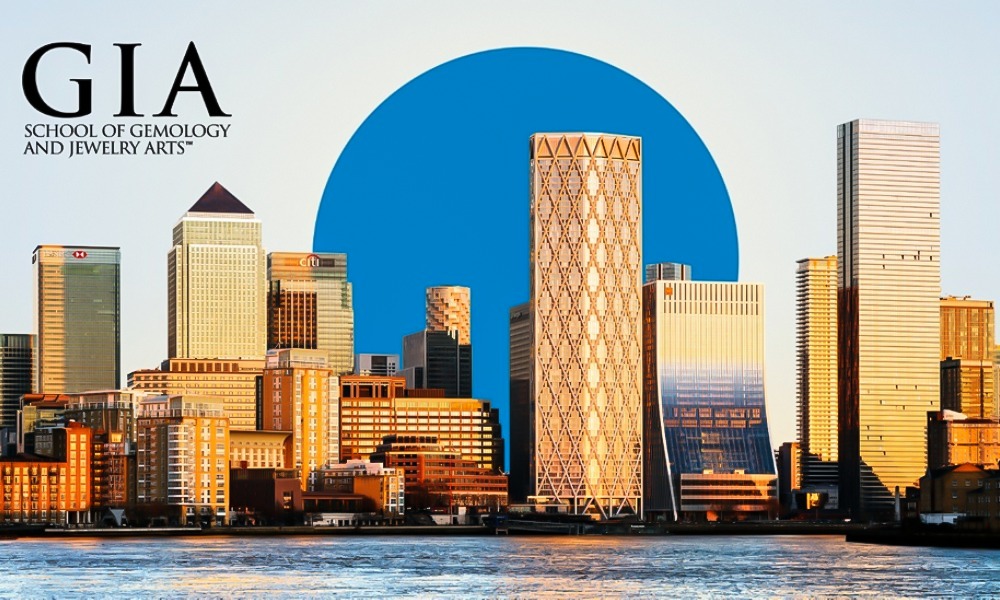
The soon-to-open GIA (Gemological Institute of America) campus in London is now enrolling students for classes beginning in August 2026. The new GIA School of Gemology and Jewelry Arts campus in London’s Canary Wharf will place GIA students in one of the world’s most influential centers for luxury and business.
The new London campus in the iconic and vibrant Canary Wharf district will offer increased capacity and, for the first time in London, the GIA Jewelry Design & Technology program. The campus will be conveniently located near transport, cultural and social attractions. Historically, enrolment at GIA’s London campus has included students from more than 50 countries with unique and diverse backgrounds.
GIA President and CEO, Pritesh Patel said:

“GIA takes great pride in providing premier education through our programs. Our new London campus will allow us to further advance our mission to ensure confidence in gems and jewelry by making education more globally accessible and offering the highest quality gem and jewelry education.”
GIA’s London school was established in 2002, providing education in gemmology and jewellery design. The school is accredited by the British Accreditation Council (BAC) and Independent Schools Inspectorate (ISI).


-

 International News10 hours ago
US Holiday Shopping Expected To Top $1 Trillion For The First Time: NRF
-

 National News3 hours ago
Belgian Consul General H. E. Mr. Pierre Stverlynck Graces BDB Annual Day
-

 National News4 hours ago
Limelight Lab Grown Diamonds Crosses 100 Stores Milestone This Dussehra: Targets 200 In 2027
-

 New Premises5 hours ago
Joyalukkas Opens Its 2nd Bengaluru Showroom in Jayanagar
