By Invitation
Artisan Perspectives: Rethinking Craft In The Age Of Lab-Grown Stones
Prapanjj S K Kota
Founder & CEO at Réia Diamonds


- Traditionally, diamond value was driven by rarity, origin, and size, with craftsmanship playing a secondary role.
- With the rise of lab-grown diamonds, abundance is shifting focus from rarity to design and craftsmanship.
- Jewellery-making is returning to a craft-first approach, placing artisans at the core of value creation.
- Skill, precision, and finishing quality are becoming primary differentiators.
The rarity of diamonds has historically dictated their market value, and most of the conversation surrounding a diamond’s value has revolved around where (and how rare) it came from, and how large it was. While craftsmanship has always been important, it has often remained secondary, simply supporting the diamond rather than receiving the buyer’s focus.
As lab-grown diamonds begin to enter the market in greater numbers, the conversation surrounding them is also changing. With an increasing supply of diamonds, being a differentiating factor in jewellery becomes much more about design, craftsmanship, and the quality of work than about rarity.
For artisans, this shift means that the focus of making jewellery has returned to the craft itself.
From a technical perspective, lab-grown diamonds do not affect the fundamentals of jewellery making. They will continue to have the same hardness, brilliance, and structural properties that natural diamonds do; therefore, using traditional setting techniques, including precision settings, pavé work, micro-setting, and polishing, will be just as essential. While the tools may be more modern, the knowledge to work with diamonds continues to be based on many years of training and experience.
The major change comes with the new opportunities presented by working with lab-created stones.



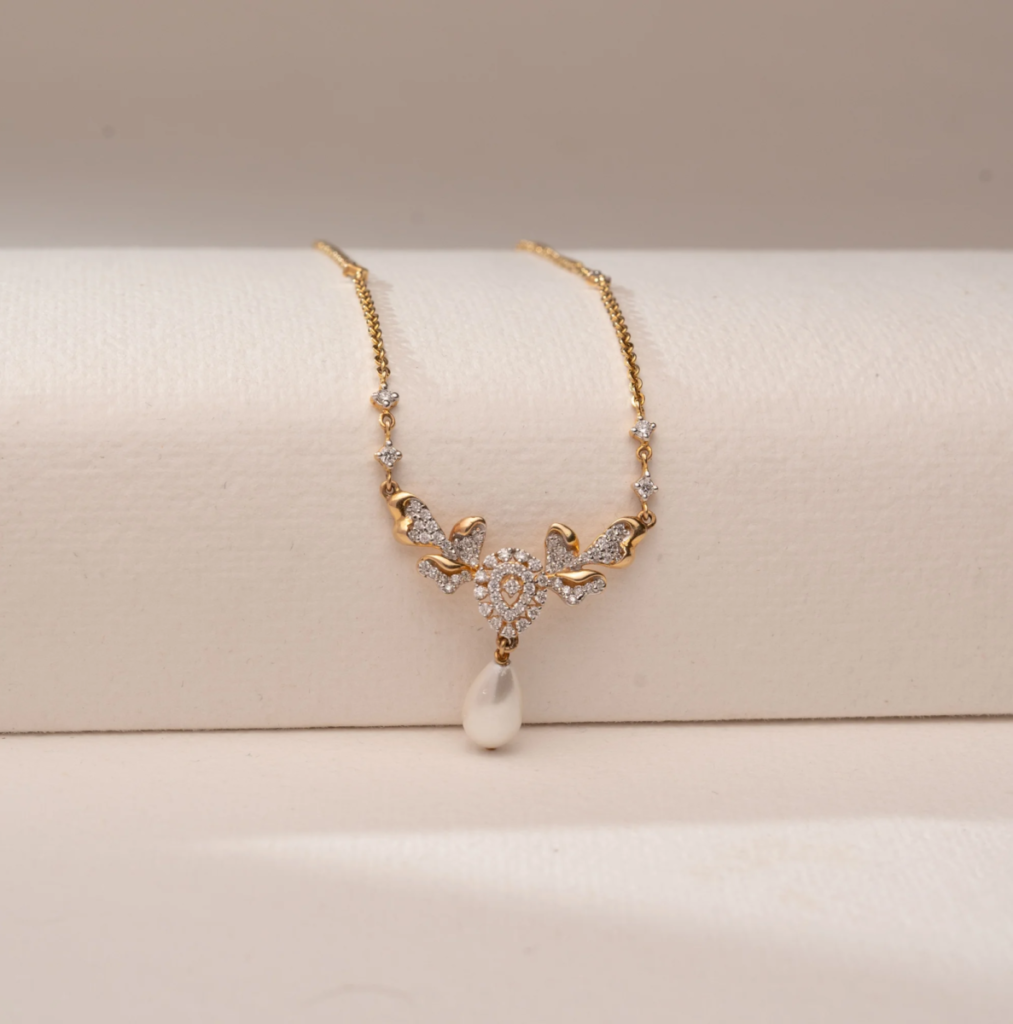
Designers are utilising the increased access to stones to try new layouts incorporating a greater focus on symmetry, scale and intricate detail. As jewellery changes, so does its craftsmanship. Today, with designs that involve numerous stones, layered settings, and modern silhouettes, artisans must have an intentional focus on the structural integrity and balance of the pieces being created, elevating their role more than ever before.
As we see craftsmanship play a supporting role to design when jewellery becomes design-centric, the specifics of how stones are aligned, how strong the setting is, and how well metal surfaces are finished will have an impact on how a piece looks, feels, and holds up over time; and therefore, they cannot be replicated with technology alone.
This change also highlights the importance of India’s historical craft traditions. Surat’s experience in the production of diamonds has established it as a leading force in the world of fine jewellery. This industry relies heavily on a team of talented craftsmen and manufacturing expertise, which plays a very important role in the overall development of jewellery that uses natural as well as lab-grown diamonds.




The introduction of lab-grown diamonds offers a fresh new direction for many artisans, as well as introducing something new into the world of fine jewellery. As it becomes less critical to know where a stone comes from, knowing the quality of the craftsmanship around a piece of jewellery will become increasingly essential. Design integrity, structural engineering, and finishing standards will all contribute to defining the real value of a finished piece.
Therefore, there is an opportunity for artisans; thoughtful design with precise execution requires a high level of technical proficiency. The better the craft, the more evident the difference is.
With the rise of lab-grown diamonds, the discussion about value will slowly evolve to include what has always been considered great jewellery: the skill, time, and craftsmanship it takes to create a piece of art from a design.



By Shivaram A
The Core Issue
The owner carries the entire risk of the business — investment, gold stock, working capital, loans, everything is in their name. The long-term asset also belongs to the owner — reputation, brand, the customer base built over years, often meant to pass to the next generation. But the moment that matters most — when the customer is standing at the counter, when trust is being built or broken — that moment is entirely controlled by the staff.
The person with the most risk is not present at the decisive moment. And the person with the least to lose holds the most power in that moment. This structural mismatch creates frustration on both sides — and it’s rarely discussed openly.
Making the Conflict Explicit
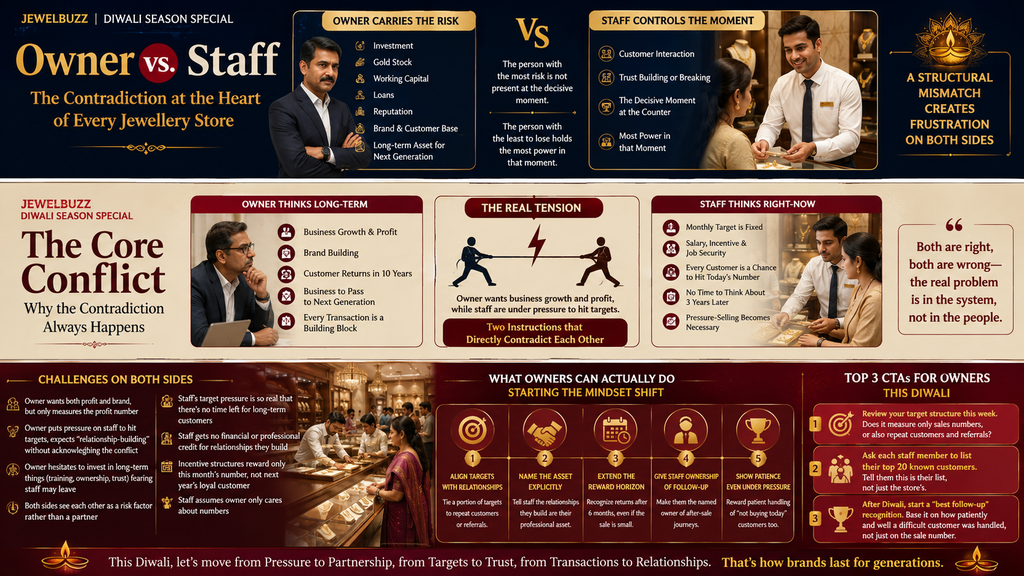
The real tension is this: the owner wants business growth and profit, while staff are under pressure to hit targets.
The owner thinks long-term — how does the brand grow, how does a customer come back after ten years, how does the business pass to the next generation. For the owner, every transaction is a building block toward something bigger.
The staff’s reality is completely different. Their monthly target is fixed. Their salary, incentive, and sometimes even job security depend on how much they sold this month, this Diwali. For staff, every customer is a chance to hit today’s number — right now, this moment. They cannot afford to think about whether this customer comes back in three years, because their performance is reviewed at month-end, not three years later.

So when the owner says “build the relationship, be patient,” and in the same breath increases the target by 20%, these two instructions directly contradict each other. Staff are not confused about what they should ideally do — they understand it perfectly. But they don’t have the choice. The target has to be met, so pressure-selling becomes necessary — even if it means pushing a customer slightly, or using lines like “buy today, rate will go up tomorrow” that create small cracks in trust.
These cracks don’t show up immediately. But after Diwali, when that customer doesn’t return a second time, the owner assumes it’s the staff’s fault. The staff believes the owner set an unrealistic target. Both are right, and both are wrong — because the real problem is in the system, not in the people.
The Challenges on Both Sides
- Owner wants both profit and brand, but only measures the profit number
- Owner puts pressure on staff to hit targets, then also expects “relationship-building” — without acknowledging the two often can’t coexist
- Owner hesitates to invest in long-term things (training, ownership, trust) due to fear that staff will leave anyway
- Staff’s target pressure is so real that there’s no time left to think about the long-term customer
- Staff gets no financial or professional credit for the relationships they build
- Incentive structures reward only this month’s number, not next year’s loyal customer
- Both sides see each other as a risk factor rather than a partner — the owner assumes staff will eventually leave, staff assumes the owner only cares about numbers
What Owners Can Actually Do — Starting the Mindset Shift
- Stop treating targets and relationships as separate — align them. Don’t set targets purely on sales numbers. Tie a small portion of the target to repeat customers or referrals, so staff know that long-term customers count too.
- Name the asset explicitly. Tell staff directly: the relationship you’re building with a customer is your professional asset, not just the store’s. This has to be shown in practice, not just said out loud.
- Extend the reward horizon. Don’t reward only Diwali-week sales — when a customer returns six months later and asks for that staff member by name, recognize that, even if the sale itself is small.
- Give staff ownership of the follow-up. Make each staff member the named owner of their customers’ after-sale journey — repairs, exchanges, the next occasion. This helps them feel the relationship is theirs, not just a transaction.
- Show patience even under pressure. If Diwali week only rewards closed sales, staff will only chase closing. If a staff member who handles a “not buying today” customer well is also appreciated, that’s when the mindset actually starts to shift — because staff notices what the owner actually rewards, not just what they say.
Top 3 CTAs for owners this Diwali
- Review your target structure this week. Does it only measure sales numbers, or does it also give weight to repeat customers and referrals? If not, try a small adjustment starting this Diwali.
- Ask each staff member to list their top 20 known customers. Tell them this is their list, not just the store’s. This builds a sense of ownership.
- After Diwali, start a “best follow-up” recognition. Base it not on the sale number, but on how patiently and well a difficult customer was handled. Staff need to see that patience is rewarded too, not just closing.
Shivaram A
Retail Gurukul


-

 TechBuzz17 hours ago
K. Srinivasan Unveils Doit Coimbatore Experience Centre
-

 GlamBuzz18 hours ago
Kalyan Jewellers’ Navratri Celebrations Bring Stars From All Industries To Thrissur
-

 National News17 hours ago
IFSCA Notifies India Good Delivery Gold Framework
-

 National News18 hours ago
World Gold Council Unveils Immersive Gold Experience At Phoenix Palladium, Lower Parel, Mumbai