
JB Insights
Hallmarking for silver jewellery and artefacts will enter HUID regime from September 1, 2025
From September 1, 2025, BIS will mandate HUID-based hallmarking for silver jewellery and artefacts, replacing the old purity mark system, with the transition period ending August 31, 2025.


The Bureau of Indian Standards (BIS) has announced that hallmarking for silver jewellery and artefacts will enter the Hallmark Unique Identification (HUID) regime – instead of the old purity marks – starting from September 1, 2025. HUID-based hallmarking of silver had been introduced by the BIS from August 1, 2025 on a voluntary basis. Now, while hallmarking itself still remains voluntary, the marking system has been officially changed. Marking as per the old system (four marks) for silver articles will be allowed until August 31, 2025.
Until recently, silver hallmarking remained a voluntary practice. However, at the 78th BIS Foundation Day in New Delhi this January, Minister for New and Renewable Energy, Consumer Affairs, Food and Public Distribution, Pralhad Joshi, urged the Bureau of Indian Standards (BIS) to expedite the process of making it mandatory. The move was driven by feedback from both consumers and industry stakeholders seeking greater regulation in the silver segment.
The decision to bring silver into the HUID regime was shaped by inputs from both consumers and industry stakeholders. Many consumers had reported uncertainty in assessing the authenticity of silver articles, while retailers and manufacturers acknowledged the need for more robust verification mechanisms to maintain market credibility.
The decision to bring silver into the HUID regime was shaped by inputs from both consumers and industry stakeholders. Many consumers had reported uncertainty in assessing the authenticity of silver articles, while retailers and manufacturers acknowledged the need for more robust verification mechanisms to maintain market credibility.
While the adoption of the HUID-based hallmarking system for silver is a welcome move for traceability and consumer assurance, industry voices have highlighted the practical difficulties of hallmarking large and heavy silver items, including furniture, decorative swings (jhoolas), large trays, and other substantial artefacts.
Such pieces often have intricate designs, uneven surfaces, or multiple joined sections, making it challenging to apply the hallmark in a visible, durable, and aesthetically acceptable manner. The physical size and weight of these items can also pose logistical issues for transporting them to and from hallmarking centres, especially in the case of one-of-a-kind pieces or custom commissions.




JB Insights
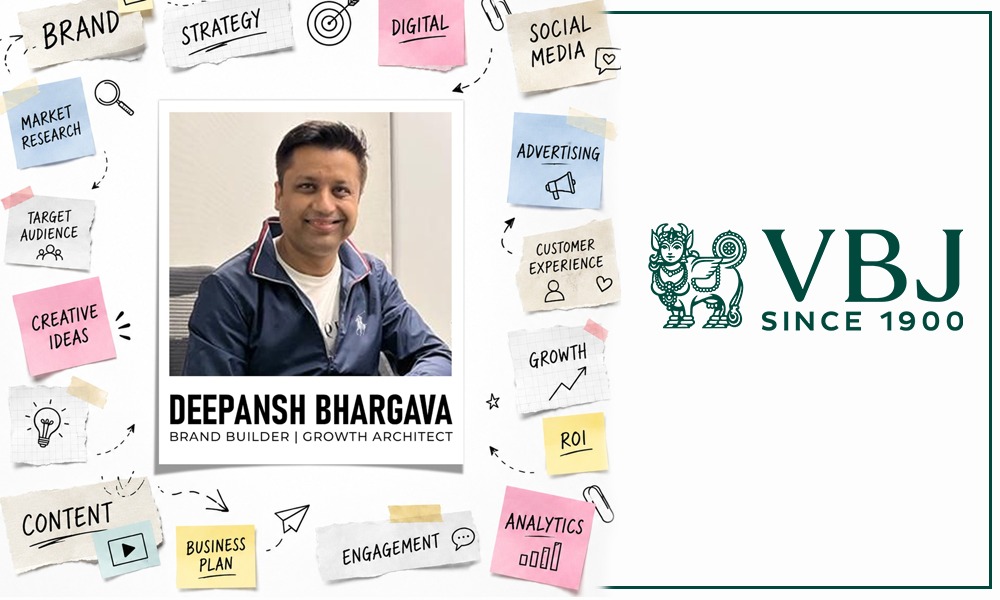
From Customer Intelligence To Autonomous Growth Intelligence: Deepansh Bhargava Senior Vice President & Head Marketing at VBJ
From Customer Intelligence To AI-powered Growth Decisions, The Next-Gen CDP Is Built To Create Measurable Incremental Value.

For the last 6 years, Customer Data Platforms have transformed how brands understand their customers. They have brought fragmented data together, created unified customer profiles, enabled segmentation and made personalisation more intelligent. But the next evolution of CDPs will not be defined by how much customer data they can organise. It will be defined by how intelligently AI can convert that data into consumer value and incremental business outcomes.
The shift is from Customer Intelligence to Growth Intelligence.
Businesses today know more about their existing customers than ever before their purchase history, frequency, preferences, lifetime value and likelihood of buying again. Yet the larger opportunity lies in moving beyond what customers did to understanding what they need next, where their behaviour is changing and where the next phase of growth will come from. This also requires a sharper focus on incrementality.
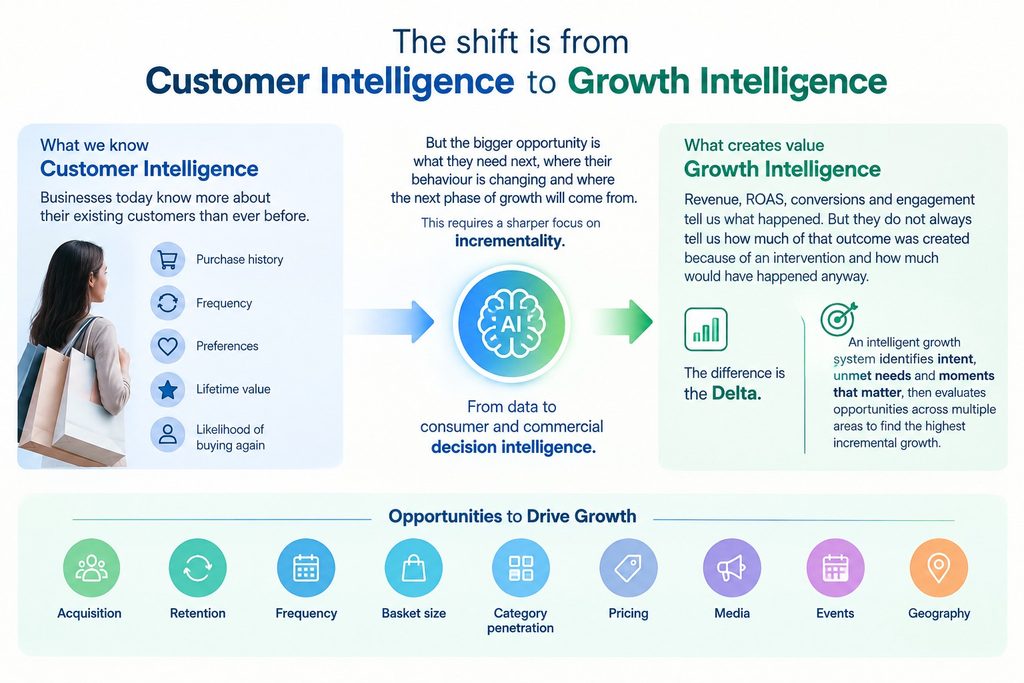
Revenue, ROAS, conversions and engagement tell us what happened. But they do not always tell us how much of that outcome was created because of an intervention and how much would have happened anyway.
That difference is the Delta. AI can help take CDPs beyond systems of customer intelligence and turn them into systems of consumer and commercial decision intelligence. Instead of simply identifying customers with a high propensity to purchase, an intelligent growth system could identify intent, unmet needs and moments that matter then evaluate opportunities across acquisition, retention, frequency, basket size, category penetration, pricing, media, events and geography to identify where the highest incremental growth opportunity lies.
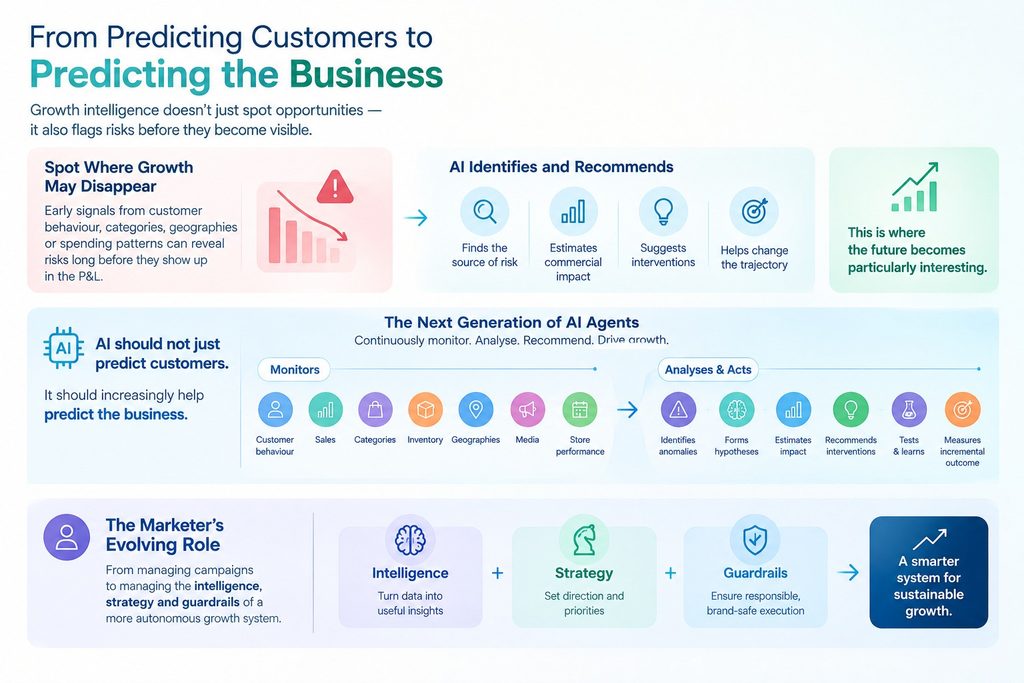
Growth intelligence should also help businesses identify where growth is likely to disappear. Early signals from customer behaviour, categories, geographies or spending patterns could reveal risks long before they become visible in the P&L. AI could identify the source of the risk, estimate its potential commercial impact and recommend interventions to change the trajectory. This is where the future becomes particularly interesting.
AI should not just predict customers. It should increasingly help predict the business.
The next generation of AI agents could continuously monitor customer behaviour, sales, categories, inventory, geographies, media and store performance. They could identify anomalies, form hypotheses, estimate commercial impact, recommend interventions, test them and measure the incremental outcome.
The role of the marketer would evolve from simply managing campaigns to managing the intelligence, strategy and guardrails around a more autonomous growth system.
This evolution can be built around three principles: Anticipate, Act and Account.
1. Anticipate where consumer needs and growth will emerge and where they may disappear.
2. Act by identifying and eventually executing the most relevant intervention for the consumer and the business.
3. Account for whether that intervention genuinely created incremental value.
The CDP of the future, therefore, should move beyond being a platform that simply manages customer data. It should become a Growth Decision Platform one that helps businesses understand consumers better, identify opportunities, detect risks, recommend actions, measure incrementality and continuously learn from every intervention. The ultimate measure of such a platform should not be the volume of data it manages.
It should be much simpler:
Show me the Delta you create.
Because ultimately, consumer centricity is not the opposite of growth. It is where sustainable growth begins.



Belgian Prime Minister Bart De Wever opens expanded HRD Antwerp laboratory in Mumbai

Verlas Introduces the ‘Alyssa’ Collection in India, Bringing Modern Luxe Floral-Inspired Design to Lab-Grown Diamond Jewelry Crafted in Fine Gold

Gold rebounds,Silver reclaims Rs 2.33 lakh mark

Limelight Lab Grown Diamonds Inaugurates Showroom In Kalyan, Its 8th Exclusive Store MMR
Verlas Introduces the ‘Alyssa’ Collection in India, Bringing Modern Luxe Floral-Inspired Design to Lab-Grown Diamond Jewelry Crafted in Fine Gold
Belgian Prime Minister Bart De Wever opens expanded HRD Antwerp laboratory in Mumbai
-
 National News3 days ago
Limelight Lab Grown Diamonds Inaugurates Showroom In Kalyan, Its 8th Exclusive Store MMR
-
 BrandBuzz2 days ago
Verlas Introduces the ‘Alyssa’ Collection in India, Bringing Modern Luxe Floral-Inspired Design to Lab-Grown Diamond Jewelry Crafted in Fine Gold
-
 DiamondBuzz2 days ago
Belgian Prime Minister Bart De Wever opens expanded HRD Antwerp laboratory in Mumbai
-
 National News2 days ago
Gold rebounds,Silver reclaims Rs 2.33 lakh mark
