
JB Insights
Fancy Color Diamonds are rewriting the rules of luxury investing


In a year when the traditional diamond market is under pressure, a dazzling niche is quietly rewriting the rules of luxury investing: fancy color diamonds. From the cerulean depths of the “Mediterranean Blue” to the rarest blushes of pink, these gems are captivating collectors, connoisseurs, and investors alike—proving that true beauty, especially when rare, never goes out of style.
A Market Apart: The Allure of Rarity
While white diamonds are facing plummeting prices and dwindling demand, fancy color diamonds are enjoying a renaissance. Just last week, Sotheby’s sold the 10-carat “The Mediterranean Blue” diamond for a staggering $21 million, underscoring the robust appetite for these vibrant stones.
With fewer diamonds being mined every year, access—not just choice—is becoming the new luxury. Investors are increasingly turning to fancy colors because fewer and fewer diamonds are being mined today. We are approaching a point where acquiring a fancy color diamond will no longer be about choice, but about having accessThese diamonds continue to stand out as the ultimate way to preserve and protect wealth. They have always been a remarkable investment, and as time goes on, this asset class only proves its stability and long-term value.
Pink Diamonds: The Ultimate Trophy
Among fancy colors, pink diamonds are the uncontested queens. Their supply has been dramatically reduced in recent years. The legendary Argyle mine, once the world’s largest source of pink diamonds, closed in 2020. Sanctions on Russian diamonds have further squeezed the market, particularly for purples and other rare hues from the Sakha Republic.
A recent GIA survey of 90,000 certified fancy color diamonds revealed that a mere quarter of pinks possess the coveted Type IIa purity—diamonds virtually free of nitrogen, often with an ethereal glow. The rarest pinks, like those from India’s Golconda mines, owe their color to nitrogen, while the vast majority—99.5%—are colored by “plastic deformation,” a phenomenon where immense subterranean pressure creates those signature graining lines and breathtaking shades.
The Investment Case: Beauty, Rarity, and Resilience
As global uncertainty grows, fancy color diamonds are emerging as a new safe haven for wealth. Their price performance, scarcity, and timeless glamour make them irresistible. Auction houses are seeing healthy, stable demand, and private sales are thriving. The urgency to secure these gems is palpable, with buyers increasingly viewing them as both wearable art and a shield against volatility.
The Verdict
In an era where rarity reigns supreme and beauty is an asset class, fancy color diamonds are more than just jewels—they’re a statement, an investment, and a legacy. For those seeking the ultimate in exclusivity, the message is clear: the time to fall in love with color is now.







JB Insights
From Customer Intelligence To Autonomous Growth Intelligence: Deepansh Bhargava Senior Vice President & Head Marketing at VBJ
From Customer Intelligence To AI-powered Growth Decisions, The Next-Gen CDP Is Built To Create Measurable Incremental Value.

For the last 6 years, Customer Data Platforms have transformed how brands understand their customers. They have brought fragmented data together, created unified customer profiles, enabled segmentation and made personalisation more intelligent. But the next evolution of CDPs will not be defined by how much customer data they can organise. It will be defined by how intelligently AI can convert that data into consumer value and incremental business outcomes.
The shift is from Customer Intelligence to Growth Intelligence.
Businesses today know more about their existing customers than ever before their purchase history, frequency, preferences, lifetime value and likelihood of buying again. Yet the larger opportunity lies in moving beyond what customers did to understanding what they need next, where their behaviour is changing and where the next phase of growth will come from. This also requires a sharper focus on incrementality.
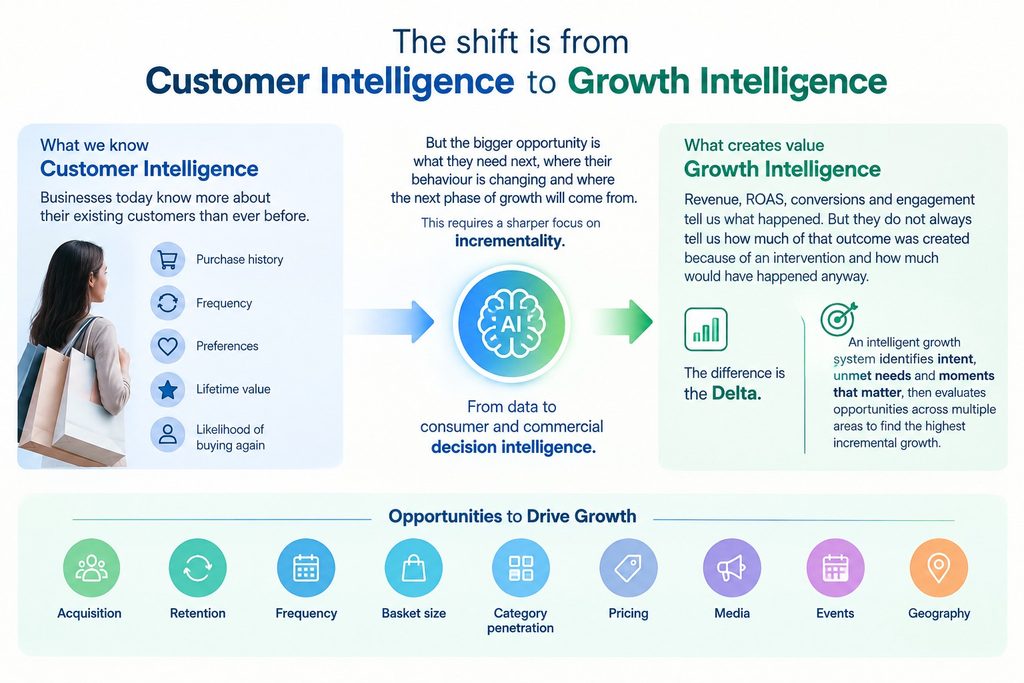
Revenue, ROAS, conversions and engagement tell us what happened. But they do not always tell us how much of that outcome was created because of an intervention and how much would have happened anyway.
That difference is the Delta. AI can help take CDPs beyond systems of customer intelligence and turn them into systems of consumer and commercial decision intelligence. Instead of simply identifying customers with a high propensity to purchase, an intelligent growth system could identify intent, unmet needs and moments that matter then evaluate opportunities across acquisition, retention, frequency, basket size, category penetration, pricing, media, events and geography to identify where the highest incremental growth opportunity lies.
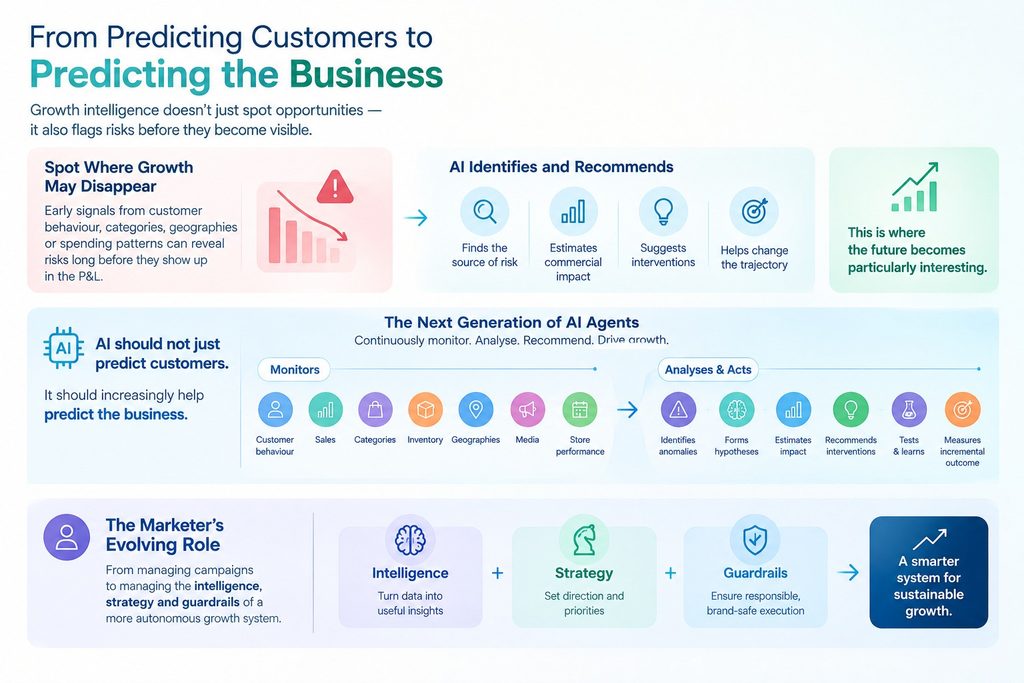
Growth intelligence should also help businesses identify where growth is likely to disappear. Early signals from customer behaviour, categories, geographies or spending patterns could reveal risks long before they become visible in the P&L. AI could identify the source of the risk, estimate its potential commercial impact and recommend interventions to change the trajectory. This is where the future becomes particularly interesting.
AI should not just predict customers. It should increasingly help predict the business.
The next generation of AI agents could continuously monitor customer behaviour, sales, categories, inventory, geographies, media and store performance. They could identify anomalies, form hypotheses, estimate commercial impact, recommend interventions, test them and measure the incremental outcome.
The role of the marketer would evolve from simply managing campaigns to managing the intelligence, strategy and guardrails around a more autonomous growth system.
This evolution can be built around three principles: Anticipate, Act and Account.
1. Anticipate where consumer needs and growth will emerge and where they may disappear.
2. Act by identifying and eventually executing the most relevant intervention for the consumer and the business.
3. Account for whether that intervention genuinely created incremental value.
The CDP of the future, therefore, should move beyond being a platform that simply manages customer data. It should become a Growth Decision Platform one that helps businesses understand consumers better, identify opportunities, detect risks, recommend actions, measure incrementality and continuously learn from every intervention. The ultimate measure of such a platform should not be the volume of data it manages.
It should be much simpler:
Show me the Delta you create.
Because ultimately, consumer centricity is not the opposite of growth. It is where sustainable growth begins.



Belgian Prime Minister Bart De Wever opens expanded HRD Antwerp laboratory in Mumbai

Verlas Introduces the ‘Alyssa’ Collection in India, Bringing Modern Luxe Floral-Inspired Design to Lab-Grown Diamond Jewelry Crafted in Fine Gold

Gold rebounds,Silver reclaims Rs 2.33 lakh mark

Limelight Lab Grown Diamonds Inaugurates Showroom In Kalyan, Its 8th Exclusive Store MMR
Verlas Introduces the ‘Alyssa’ Collection in India, Bringing Modern Luxe Floral-Inspired Design to Lab-Grown Diamond Jewelry Crafted in Fine Gold
Belgian Prime Minister Bart De Wever opens expanded HRD Antwerp laboratory in Mumbai
-
 National News2 days ago
Limelight Lab Grown Diamonds Inaugurates Showroom In Kalyan, Its 8th Exclusive Store MMR
-
 BrandBuzz1 day ago
Verlas Introduces the ‘Alyssa’ Collection in India, Bringing Modern Luxe Floral-Inspired Design to Lab-Grown Diamond Jewelry Crafted in Fine Gold
-
 DiamondBuzz1 day ago
Belgian Prime Minister Bart De Wever opens expanded HRD Antwerp laboratory in Mumbai
-
 National News1 day ago
Gold rebounds,Silver reclaims Rs 2.33 lakh mark
