By Invitation
Arayian Jewellery: Weaving Heritage, Craftsmanship, and Modern Elegance into Every Gemstone
By Shivaram A


Arayian Jewellery, a distinguished name in the world of fine coloured gemstone jewellery, is redefining elegance through a rare blend of legacy, craftsmanship, and modern design.

Spearheaded by Ayushi Khandelwal, the brand draws from generations of expertise in gemstone trading and jewellery making. With a commitment to authenticity, vertical integration, and a deep respect for cultural roots, Arayian offers more than just jewellery—it offers heirlooms crafted with heart, history, and a forward-looking vision.
Here’s what Ayushi Khandelwal, Creative Director of Arayian Jewellery, has to say about the brand’s journey, philosophy, and vision for the future.

1. How do you define the legacy of Arayian Jewellery?
Arayian Jewellery is built on a legacy of generations deeply rooted in the world of fine jewellery and gemstone trading. Surrounded by exquisite stones and craftsmanship from a young age, we channel this heritage, passion, and knowledge into creating timeless pieces for our clients—offering not just jewellery, but a legacy of love and refinement.
2. Explain the USP of your brand.
We are involved in the entire journey—from sourcing rough gemstones and cutting them in-house to crafting fine jewellery. This unique vertical integration allows us to offer bespoke, high-end pieces with unmatched precision and quality, all under one roof.
3. What is your design philosophy?
Our designs revolve around the natural beauty of precious gemstones. We aim to create modern, elegant, and everlasting pieces that highlight the uniqueness of each stone while maintaining a timeless aesthetic.
4. Kindly provide details of your product offerings—bridal & jewellery collections or others.
We specialize in exclusive fine jewellery crafted with natural, coloured gemstones. Every piece is one-of-a-kind, celebrating individuality with authenticity and certified provenance. Our offerings include bridal collections, statement jewellery, and heirloom-worthy pieces.

5. How do you ensure that your jewellery designs reflect cultural heritage while appealing to the evolving tastes of younger generations?
By embracing clean, contemporary aesthetics while honouring the intrinsic elegance of traditional gemstones, we create designs that resonate with modern sensibilities without losing their cultural soul. The coloured stones remain the centrepiece of our creations, offering a bridge between heritage and innovation.
6. What role does sustainability play in your sourcing and crafting processes?
We source our gemstones responsibly, primarily via auctions from the likes of Gemfields. Our in-house cutting of rough stones not only reduces environmental impact but also ensures every layout is distinctive and responsibly crafted.
7. How does your brand differentiate itself from traditional jewellery makers in Jaipur in terms of craftsmanship and innovation?
Our commitment to international standards of craftsmanship sets us apart. Each piece is designed for enduring comfort, precision, and wearability, combining traditional artistry with cutting-edge techniques for global appeal.
8. What specific measures have you taken to make your jewellery accessible to a global audience without compromising cultural authenticity?
We actively participate in prestigious international exhibitions, making our work accessible to clients across the globe while staying true to our roots in artisanal gemstone craftsmanship.
9. How do you incorporate modern technology, such as AI, in jewellery designing?
Our design process is grounded in hand-sketching and personal inspiration drawn from travel and surroundings. While we honour traditional design methods, we remain
open to integrating modern tools, including AI, to enhance precision and creativity in future collections.
10. Where does Arayian Jewellery see itself in the coming years? What is the roadmap?
We envision Arayian Jewellery becoming a globally recognized name in fine coloured gemstone jewellery—synonymous with excellence, authenticity, and innovation. Our roadmap includes global expansion, increased visibility through exhibitions, and continuously elevating our craftsmanship.
11. Where is Arayian Jewellery’s presence beyond the Indian market?
Arayian Jewellery has an international footprint through exhibitions and showcases in key global markets including Bangkok, Qatar, Turkey, Hong Kong, Las Vegas, and Singapore, allowing us to connect with a discerning global clientele.








By Shivaram A
The Core Issue
The owner carries the entire risk of the business — investment, gold stock, working capital, loans, everything is in their name. The long-term asset also belongs to the owner — reputation, brand, the customer base built over years, often meant to pass to the next generation. But the moment that matters most — when the customer is standing at the counter, when trust is being built or broken — that moment is entirely controlled by the staff.
The person with the most risk is not present at the decisive moment. And the person with the least to lose holds the most power in that moment. This structural mismatch creates frustration on both sides — and it’s rarely discussed openly.
Making the Conflict Explicit
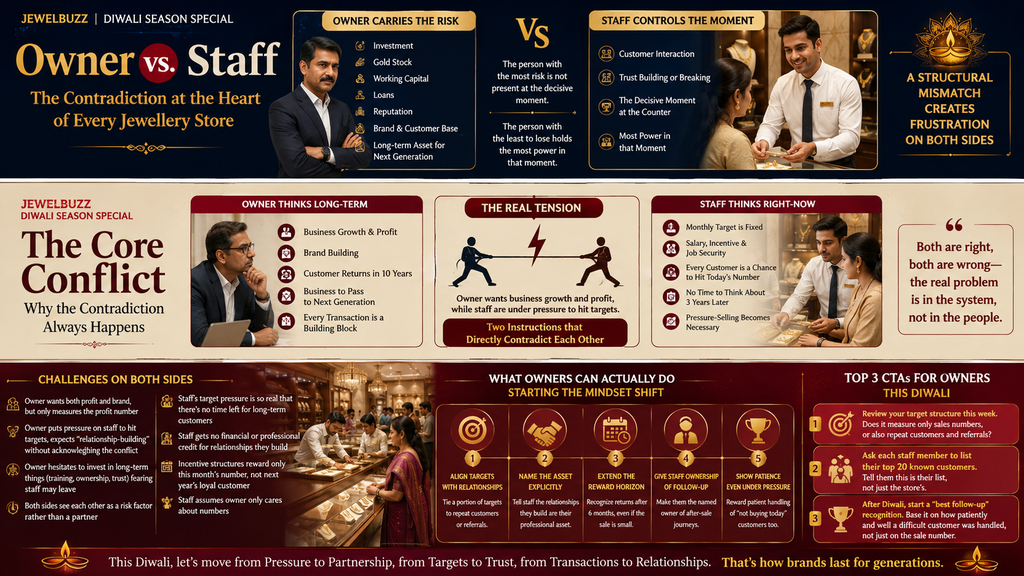
The real tension is this: the owner wants business growth and profit, while staff are under pressure to hit targets.
The owner thinks long-term — how does the brand grow, how does a customer come back after ten years, how does the business pass to the next generation. For the owner, every transaction is a building block toward something bigger.
The staff’s reality is completely different. Their monthly target is fixed. Their salary, incentive, and sometimes even job security depend on how much they sold this month, this Diwali. For staff, every customer is a chance to hit today’s number — right now, this moment. They cannot afford to think about whether this customer comes back in three years, because their performance is reviewed at month-end, not three years later.
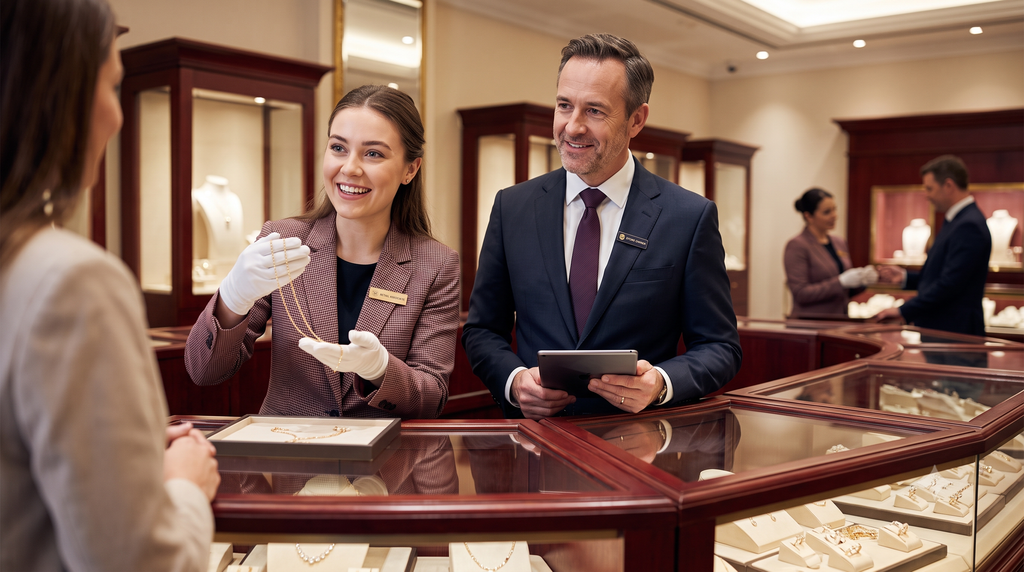
So when the owner says “build the relationship, be patient,” and in the same breath increases the target by 20%, these two instructions directly contradict each other. Staff are not confused about what they should ideally do — they understand it perfectly. But they don’t have the choice. The target has to be met, so pressure-selling becomes necessary — even if it means pushing a customer slightly, or using lines like “buy today, rate will go up tomorrow” that create small cracks in trust.
These cracks don’t show up immediately. But after Diwali, when that customer doesn’t return a second time, the owner assumes it’s the staff’s fault. The staff believes the owner set an unrealistic target. Both are right, and both are wrong — because the real problem is in the system, not in the people.
The Challenges on Both Sides
- Owner wants both profit and brand, but only measures the profit number
- Owner puts pressure on staff to hit targets, then also expects “relationship-building” — without acknowledging the two often can’t coexist
- Owner hesitates to invest in long-term things (training, ownership, trust) due to fear that staff will leave anyway
- Staff’s target pressure is so real that there’s no time left to think about the long-term customer
- Staff gets no financial or professional credit for the relationships they build
- Incentive structures reward only this month’s number, not next year’s loyal customer
- Both sides see each other as a risk factor rather than a partner — the owner assumes staff will eventually leave, staff assumes the owner only cares about numbers
What Owners Can Actually Do — Starting the Mindset Shift
- Stop treating targets and relationships as separate — align them. Don’t set targets purely on sales numbers. Tie a small portion of the target to repeat customers or referrals, so staff know that long-term customers count too.
- Name the asset explicitly. Tell staff directly: the relationship you’re building with a customer is your professional asset, not just the store’s. This has to be shown in practice, not just said out loud.
- Extend the reward horizon. Don’t reward only Diwali-week sales — when a customer returns six months later and asks for that staff member by name, recognize that, even if the sale itself is small.
- Give staff ownership of the follow-up. Make each staff member the named owner of their customers’ after-sale journey — repairs, exchanges, the next occasion. This helps them feel the relationship is theirs, not just a transaction.
- Show patience even under pressure. If Diwali week only rewards closed sales, staff will only chase closing. If a staff member who handles a “not buying today” customer well is also appreciated, that’s when the mindset actually starts to shift — because staff notices what the owner actually rewards, not just what they say.
Top 3 CTAs for owners this Diwali
- Review your target structure this week. Does it only measure sales numbers, or does it also give weight to repeat customers and referrals? If not, try a small adjustment starting this Diwali.
- Ask each staff member to list their top 20 known customers. Tell them this is their list, not just the store’s. This builds a sense of ownership.
- After Diwali, start a “best follow-up” recognition. Base it not on the sale number, but on how patiently and well a difficult customer was handled. Staff need to see that patience is rewarded too, not just closing.
Shivaram A
Retail Gurukul


-
 New Premises3 hours ago
JGP Jewellers Opens Its 26th Store In Nipani, Marking Its Entry Into Karnataka
-

 New Premises2 hours ago
ICA | GemLab India Inaugurates Gemological Laboratory In Surat
-

 GlamBuzz2 hours ago
The Art Of Festive Dressing: Celebrity Jewellery Moments From Kalyan Navaratri
-

 National News1 hour ago
Global and Domestic Precious Metals Trading Under Pressure