
By Invitation
From Prompt To Pendant: How AI Is Turning Jewellery Buyers Into Designers
By Dr Sandip P. Dhurat

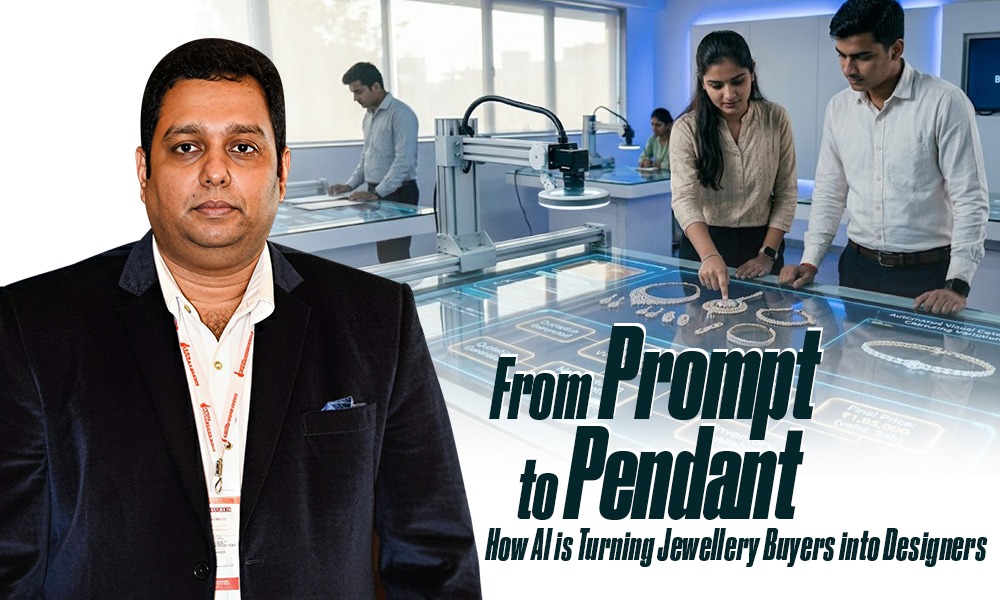
Not long ago, jewellery design was largely a one-way conversation. Consumers browsed catalogues, visited stores, or selected pieces from showcases. If they wanted something custom-made, they relied on the jeweller’s sketches, imagination, and expertise.
Today, a new collaborator has entered the room: Artificial Intelligence.
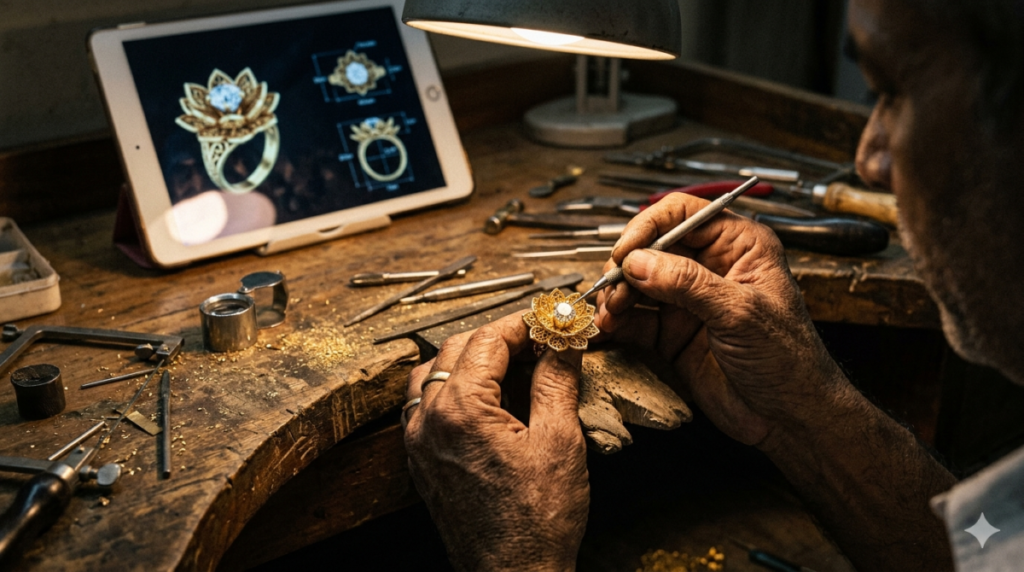
Across age groups, consumers are experimenting with AI-powered image generators and design applications to create jewellery concepts that reflect their personal tastes. A few words typed into a prompt—”an emerald engagement ring inspired by lotus petals” or “a contemporary mangalsutra with geometric motifs”—can generate multiple design possibilities within seconds.
What happens next is perhaps the most interesting part of the story.Instead of ordering these pieces online, many consumers are taking their AI-generated designs to the one person they trust most: their family jeweller.
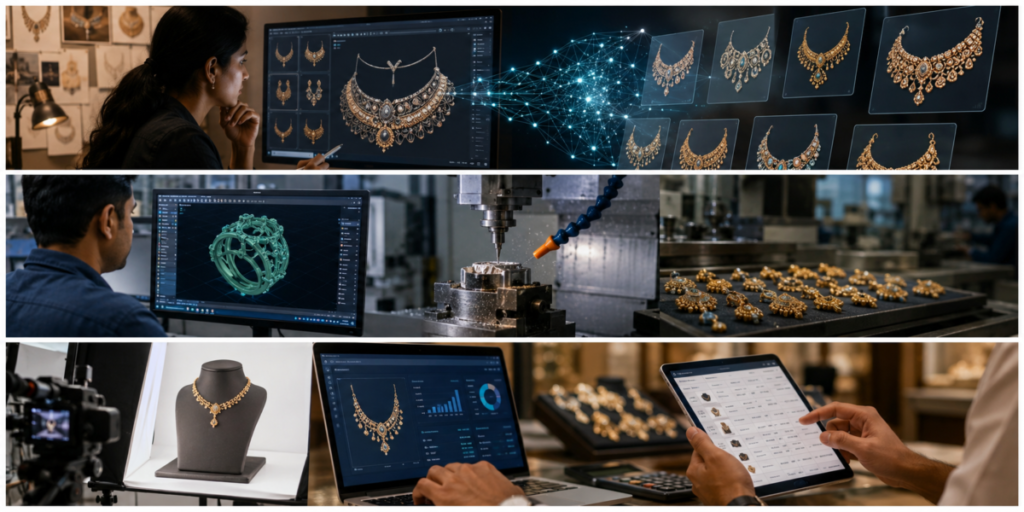
The new wave of customisation
For decades, customization in jewellery was often limited to engraving names, changing gemstones, or making minor design alterations. AI is expanding that possibility dramatically.
Consumers are no longer arriving at jewellery stores with vague ideas. They are walking in with detailed visual references generated on their smartphones. Some have experimented with dozens of versions before settling on a favourite. Others blend elements from different designs to create something entirely unique.
In a sense, AI is democratizing the design process. It allows consumers to participate creatively, even if they have no formal design background.
For younger buyers especially, this level of involvement is appealing. They want jewellery that feels personal, expressive, and different from what everyone else is wearing. AI gives them a playground where they can explore possibilities before making a purchase.
Role of traditional family jeweller
If AI can generate designs so easily, does that diminish the role of the jeweller?Quite the opposite.
While AI can create attractive images, it cannot determine whether a design is structurally sound, comfortable to wear, practical to manufacture, or durable enough for daily use. A ring that looks spectacular on a screen may be impossible to cast. A delicate bracelet generated by AI may not withstand regular wear.
This is where the expertise of the jeweller becomes invaluable.
Family jewellers are increasingly acting as interpreters between digital imagination and physical reality. They assess AI-generated concepts, refine proportions, suggest technical modifications, and ensure that the final piece balances aesthetics with craftsmanship.
Many jewellers describe the process as similar to working with a client-provided sketch—except the sketch is now more sophisticated and visually detailed.
The trust factor remains unchanged. Consumers may discover designs through AI, but they still want someone they know to guide the process and stand behind the finished product.
New collaboration trend
The relationship between customer and jeweller is evolving from buyer-and-seller to co-creators.
Consider a young couple designing an engagement ring. Instead of selecting from existing collections, they use AI to explore various combinations of settings, gemstones, and motifs. They then sit down with their jeweller to discuss feasibility, budget, stone availability, and craftsmanship.
The final piece is neither entirely AI-designed nor solely jeweller-designed. It is the outcome of a collaborative journey.
This shift creates opportunities for jewellers to engage customers more deeply. Conversations become richer because customers arrive with visual ideas rather than abstract descriptions.
In many cases, the design process becomes part of the emotional value of the jewellery itself.
The opportunity
The trend presents several advantages for jewellers willing to embrace it.
First, AI-generated concepts can serve as conversation starters. Instead of spending significant time understanding a customer’s vision from scratch, jewellers can begin with a visual reference and refine it together.
Second, it can increase demand for bespoke jewellery. Consumers who might never have considered custom design are discovering how accessible it has become.
Third, it opens the door to a new generation of buyers who value individuality over mass-produced designs.
Rather than competing with AI, jewellers can position themselves as the experts who transform digital concepts into heirloom-worthy creations.
Despite all the excitement around AI, jewellery remains an intensely human product.
A necklace gifted on a wedding day, a ring marking an engagement, or a bracelet passed down through generations carries emotions that no algorithm can replicate. AI may help generate ideas, but it cannot understand family traditions, cultural significance, sentimental stories, or the subtle nuances of personal taste.
Consumers are discovering designs through technology, but they are still seeking reassurance, expertise, and craftsmanship from people they trust.
Perhaps that is the real story behind this trend.
AI is not replacing the jeweller. It is empowering consumers to participate in the creative process while making the jeweller’s role even more valuable. The screen may provide the inspiration, but it is the skilled hand of the jeweller that transforms a digital concept into a treasured piece of jewellery.
In the years ahead, the most successful jewellers may not be those who resist AI, but those who embrace it as another tool in the ongoing art of personalization—where technology sparks the idea, and craftsmanship gives it life.


A Case Study Of Gupta Jewellers
The names, location and characters in this case study are fictional. However, the situation reflects the realities faced by many family-run jewellery businesses across India.
On a busy Saturday evening in Moradabad, customers continued to walk into Gupta Jewellers just as they had for the past forty years.
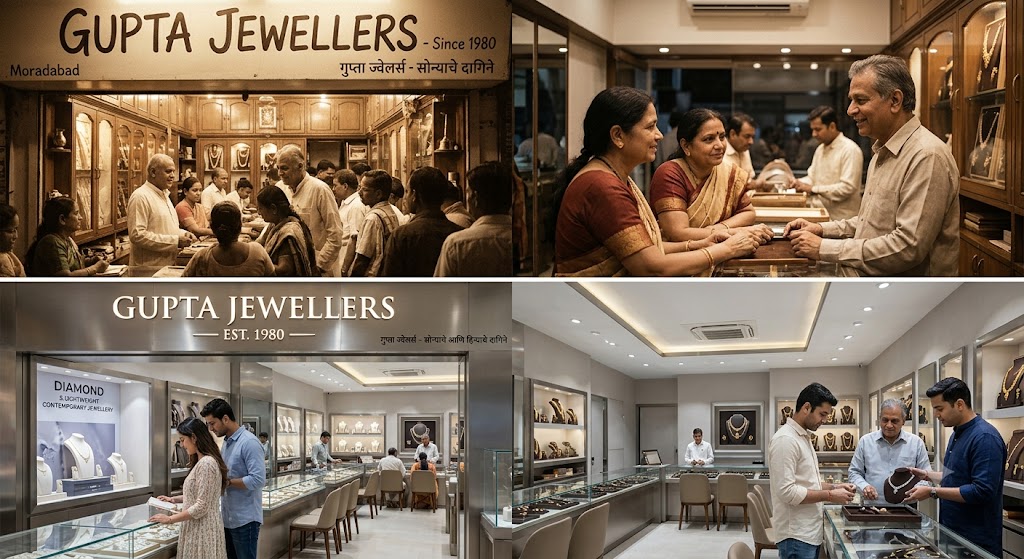
The showroom looked much the same as it always had. Familiar faces greeted customers by name. Old clients still spoke fondly of “Gupta Ji”, who had built the business from a small 300 sq. ft. shop into one of the town’s most respected jewellery stores.
To every customer, Gupta Jewellers represented stability.To the family, however, the future looked far less certain.
Now in his mid-sixties, Gupta Ji had begun handing over the business to his two sons.
Both were capable.Both were hardworking.Both genuinely wanted the business to succeed.
Yet almost every important business discussion ended in disagreement.
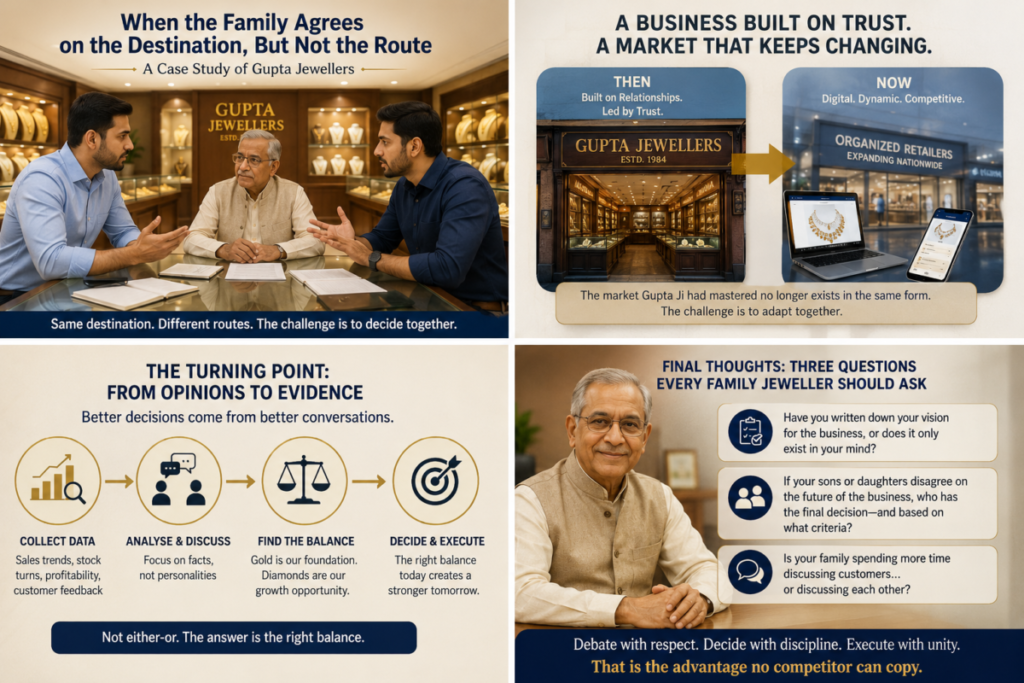
The elder son believed the family should continue strengthening its leadership in gold jewellery.
“Gold has survived every economic cycle,” he would often say. “Customers may experiment with fashion, but when families invest their savings, they still buy gold.”
His younger brother had a different view.
“The customer is changing,” he argued. “Young buyers want lighter jewellery, contemporary designs and diamonds. If we don’t build that business today, someone else will.”
Neither opinion lacked logic.Yet every strategy meeting seemed to become a debate.
The discussions soon expanded beyond products.
Should Gupta Jewellers open another showroom before larger competitors entered nearby cities?
Or should they first modernise the existing showroom?
Should they invest heavily in digital marketing?Or preserve cash until the market became more predictable?
Gupta Ji often found himself sitting quietly at the end of these meetings.
Years earlier, such decisions had taken minutes.Now they took weeks.Sometimes months.
A Business Built on Trust
Like many first-generation entrepreneurs, Gupta Ji had built his business without management books or consultants.
His principles were simple.Sell honestly.Keep your word.Treat customers like family.Never overextend financially.
Those principles had served him exceptionally well.
Relationships created loyal customers.Loyal customers created referrals.Referrals created growth.
For almost four decades, the formula had worked.
But the business environment around Gupta Jewellers had changed dramatically.
Customers compared designs online before entering a store.Social media influenced buying decisions.
Young couples often preferred lightweight jewellery over heavy traditional sets.
Diamond jewellery, once reserved for special occasions, had become an everyday purchase for many professionals.
Meanwhile, organised retailers continued expanding across India.Competition was no longer limited to the jeweller across the street.
It could arrive from another city with a recognised brand, sophisticated marketing and deeper financial resources.
The market Gupta Ji had mastered no longer existed in the same form.
His sons understood this.The challenge was that they disagreed on how to respond.
When Different Opinions Become Personal
One evening, after another lengthy discussion, Gupta Ji asked a simple question.
“Do both of you want this business to succeed?”Both sons answered immediately.
“Of course.”
Then Gupta Ji smiled.”If both of you want the same destination, why are you fighting over the route?”
Silence filled the room.
It was perhaps the first time everyone realised the disagreement wasn’t about gold, diamonds, expansion or marketing.It was about decision-making.
The business had grown.Its governance had not.For years, experience and intuition were enough.
Today, the business required something more.Structured planning.Clear responsibilities.
Objective evaluation.A process for making difficult decisions.
Without these, every strategic discussion risked becoming an emotional one.
The Turning Point
Over the following months, the family decided to change not their vision, but the way they made decisions.
Instead of defending opinions, they began collecting data.
They studied sales trends.Analysed stock turns.
Measured category profitability.Spoke to customers about changing preferences.
Reviewed competitor activity.Rather than asking, “Who is right?” they began asking, “What does the evidence suggest?”
The conversations gradually became less emotional.
Not because everyone suddenly agreed, but because the discussion shifted from personalities to facts.
Interestingly, they discovered that both brothers had valid concerns.
Gold remained the foundation of the business. Diamonds represented an important growth opportunity.
Expansion could create long-term value—but only if supported by adequate systems, capital and leadership.
The answer was never either-or.It was deciding the right balance.
Lessons for Every Family Jeweller
Whether your business is in Uttar Pradesh, Gujarat, Tamil Nadu or Karnataka, this story may sound familiar.
Family businesses rarely struggle because people care too much.
They struggle because capable people see different futures.
That is perfectly normal.
The real test of leadership is not eliminating differences.
It is creating a system that allows those differences to produce better decisions.
Families that survive across generations usually follow a few simple principles.
They agree on a long-term vision before debating short-term strategies.
They define roles clearly.
They separate business meetings from family gatherings.
They rely on facts more than assumptions.
And when discussions reach a deadlock, they are not afraid to seek guidance from an experienced external advisor.
A Question Worth Asking
As jewellery retailers, we spend enormous effort understanding our customers.
Perhaps it is equally important to understand our own decision-making process.
Because in the coming decade, the greatest competitive advantage may not be a better location, a larger inventory or even stronger marketing.
It may simply be a family that has learnt how to make decisions together.
History shows that businesses rarely fail because family members hold different opinions.
They fail because the family never develops a healthy way to resolve them.
The future may belong to gold.
It may belong to diamonds.
Most likely, it will belong to businesses that are agile enough to succeed with both.
But one thing is certain.
A family that learns to debate with respect, decide with discipline and execute with unity will always have an advantage that no competitor can easily copy.
Final thoughts
Gupta Ji thought he had prepared the next generation.
But would you be able to answer these three questions honestly?
✓ Have you written down your vision for the business, or does it only exist in your mind?
✓ If your sons or daughters disagree on the future of the business, who has the final decision—and based on what criteria?
✓ Is your family spending more time discussing customers… or discussing each other?
Helping jewellery businesses build stronger systems, stronger leadership and stronger family enterprises.



Adv. S. Abdul Nazar, State General Secretary Of KGSMA, Met With Chief Minister Sri V.D. Satheesan

MCX Gold Futures Traded Flat,Silver Prices Decline

Union Home Minister Shri Amit Shah Graces 52nd India Gems & Jewellery Awards; GJEPC Charts US$100 Billion Export Vision For Indian Gem & Jewellery Industry
Union Home Minister Shri Amit Shah Graces 52nd India Gems & Jewellery Awards; GJEPC Charts US$100 Billion Export Vision For Indian Gem & Jewellery Industry
Adv. S. Abdul Nazar, State General Secretary Of KGSMA, Met With Chief Minister Sri V.D. Satheesan

Limelight Lab Grown Diamonds Inaugurates Showroom In Kalyan, Its 8th Exclusive Store MMR
-
 National News11 hours ago
Union Home Minister Shri Amit Shah Graces 52nd India Gems & Jewellery Awards; GJEPC Charts US$100 Billion Export Vision For Indian Gem & Jewellery Industry
-
 National News9 hours ago
Adv. S. Abdul Nazar, State General Secretary Of KGSMA, Met With Chief Minister Sri V.D. Satheesan
-
 National News4 days ago
Limelight Lab Grown Diamonds Inaugurates Showroom In Kalyan, Its 8th Exclusive Store MMR
-
 National News10 hours ago
MCX Gold Futures Traded Flat,Silver Prices Decline
