By Invitation
The new 4 C’s of Jewellery Retailing
By Shivaram A


Jewellery is a precious commodity to purchase, and every customer wishes to take a cautious decision. Most of the purchase decisions of the jewellery customer is dependent on her “perception” of the brand or the jeweller. Keeping this in mind, certain parameters can be defined to help the customer make a quick and correct decision. For example, while buying diamond jewellery, 4 factors were considered as the “C”s- cut, carat, colour and clarity of the diamonds.
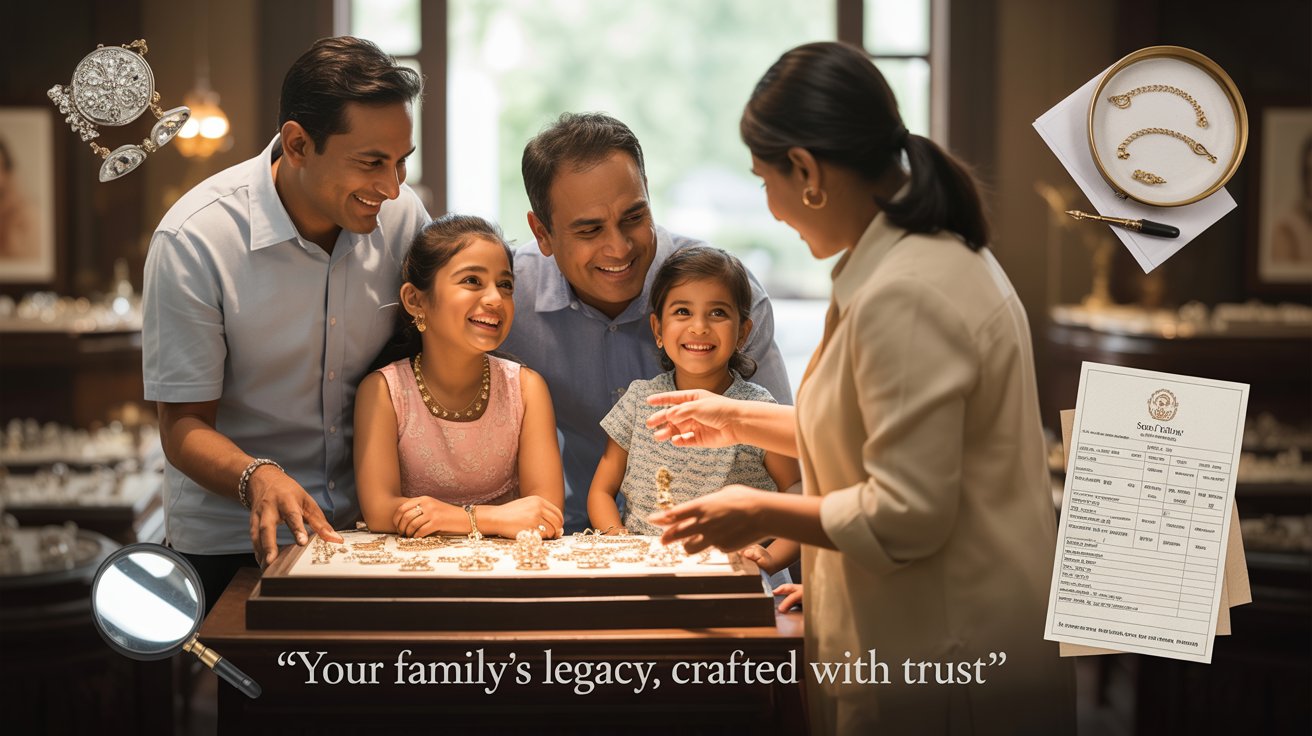
Likewise, the present customer’s buying behaviour rests on the 4 new “C”s of Jewellery Retail. What are these 4 new “C”s? Let us take a look.
The 4 new “C”s
Today’s customer’s mindset has undergone a huge transformation due to the accessibility to international trends and markets (maybe due to travel or just social media) and a wide range of designs and services are now available at jewellery stores. The buying behaviour of the current customers is governed by certain factors which are depicted below.
Observing the rankings (see Figure “Factors considered while selecting a Brand”), we can conclude that a jewellery customer’s purchase decision is based on the 4 new “C” s – Cost, Confidence, Convenience and Customer Service.

1. Cost- the first “C”
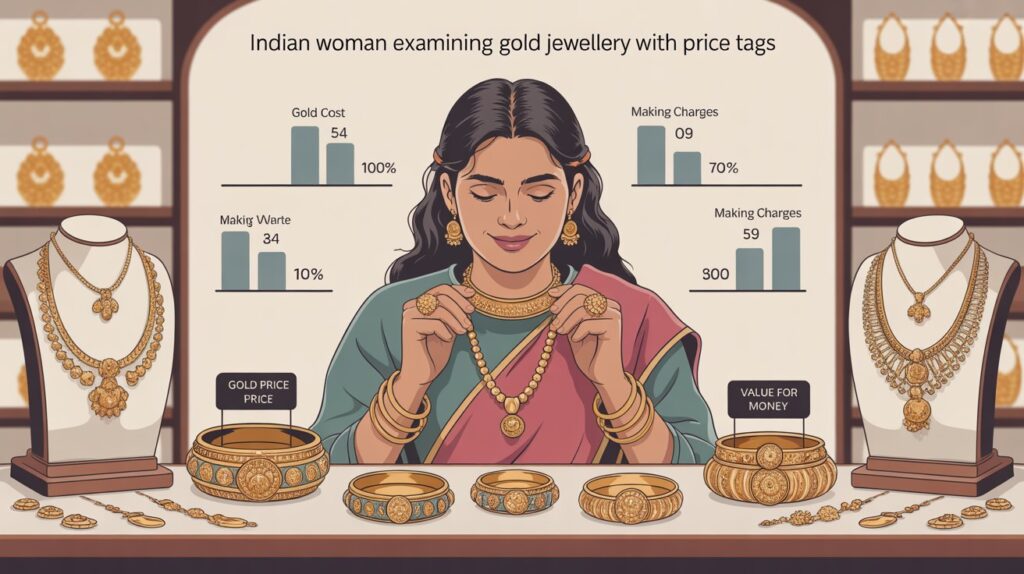
Let us face it. You, me and almost every Indian is very price conscious. Thus every customer wants to have the full value for her money- “Full paisa vasool / Good Deal” This is more so in the case of jewellery retail due to the high costs involved in the purchase. Cost is thus the dominating factor in the purchase decision of a jewellery customer. This cost of jewellery includes the making charges and the cost of the gold paid out as wastage. If this final cost looks affordable and justified to the customer, you, the retailer can make a sale.
So, the first “C” in the purchase decision is COST and as a jewellery retailer, you must position your brand rightly with respect to “cost”.
There are brands where the Making Charges / Value Addition is advertised in Bold while there are other brands like Malabar Gold or Tanishq, which may not be the cheapest in pricing but will want to still offer “Value for Money” for their set of customers. These customers might be very different from the customers for say a price warrior brand, but their customers also believe that the cost is worth it.
2. Confidence- the second “C”
A customer’s confidence in the jewellery brand starts with how the brand meets her expectations right from her first interaction during say marketing communication, her first purchase and goes on to maintain that confidence that is reflected in her repeat purchases and referrals. Word-of-mouth referrals and relatives’ recommendations still form some of the influencing factors of jewellery purchases.
Trustworthiness of a brand is a mark of the confidence the customer has in the jewellery retailer and this is an aggregate of several factors which include purity, pricing, discounts, shopping experience, after-sales service etc. A customer, who feels that the jeweller can give her
the best in all the above factors, has typically won her confidence.
This clearly shows that the “confidence” of the customer in the brand is emerging as the second “C” and it is the most important factor in brand perception and purchase decision.

3. Convenience- the third “C”
Jewellery is still a “touch and feel” market where purchases are made in person. But of late, convenience in jewellery shopping is emerging as one of the decisive factors in jewellery purchase.
Today’s customers are well-informed about the price fluctuations, making charges, wastage, and design options etc. even prior to the actual physical purchase at the shop. The presence of a website or social media like Instagram/ Facebook etc. with a design gallery and price estimates are often appreciated by customers as it helps them in planning their purchase. Such a convenience-driven model of business with knowledge-empowerment is the call of today for jewellery retailers.
This is why Convenience is emerging as the third C in brand positioning or purchase decisions.
Customers look at “customization” as part of the convenience offered by a jeweller. The convenience of customization is an added benefit offered by jewellers. Convenience also means service benefits that the jewellery outlet offers like “home delivery” or”gifting options”.
4. Customer service – the 4th C
A jewellery purchase is an emotional decision for most buyers as they attach great sentimental and personal value to the jewellery they purchase. This is why customers look for a “positive shopping experience” when they come to buy jewellery. This positive shopping experience is founded on the 4th C -customer service.
Customer service involves not only hospitality and friendly greetings but also expertise from the staff. Customers expect well informed staff to guide and advise them on their jewellery choices.
Ganesh Jewellers of Mumbai wish to position themselves with respect to their customer service. Look at what they say –
Right from the marketing communication, the entry to the store/ website, the warm welcome, the store atmosphere, the hospitality gestures, the offers on the merchandise including the range, the price, the design etc. to the customer-handling, everything in your jewellery outlet should enrich the 4th C – the customer service.
The Jewellery industry may see its ups and down regularly, but if you keep these 4 Cs in mind and position your brand or jewellery outlet, you are sure to be the champion of jewellery retail in your market and beyond.










By Shivaram A
The Core Issue
The owner carries the entire risk of the business — investment, gold stock, working capital, loans, everything is in their name. The long-term asset also belongs to the owner — reputation, brand, the customer base built over years, often meant to pass to the next generation. But the moment that matters most — when the customer is standing at the counter, when trust is being built or broken — that moment is entirely controlled by the staff.
The person with the most risk is not present at the decisive moment. And the person with the least to lose holds the most power in that moment. This structural mismatch creates frustration on both sides — and it’s rarely discussed openly.
Making the Conflict Explicit
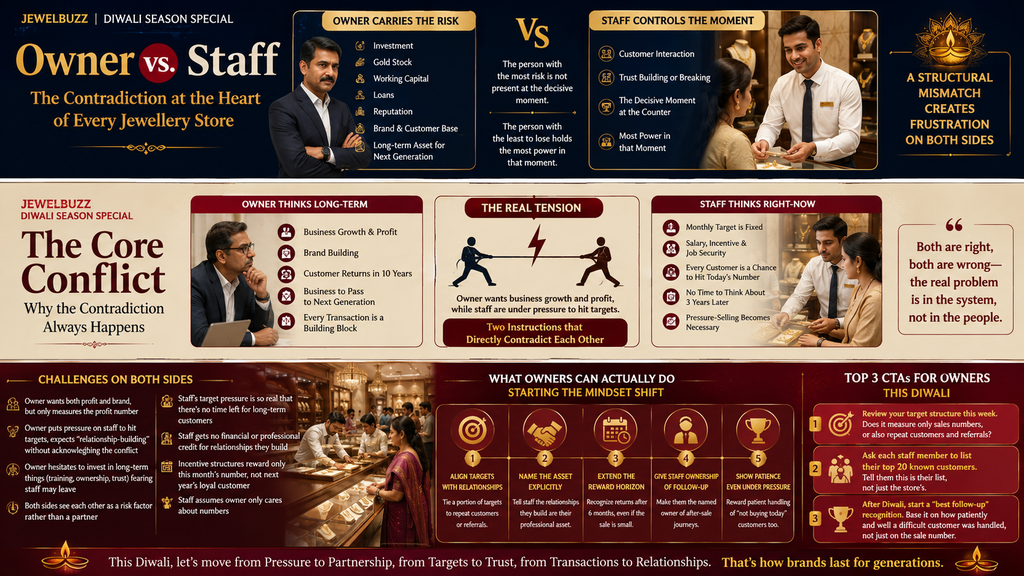
The real tension is this: the owner wants business growth and profit, while staff are under pressure to hit targets.
The owner thinks long-term — how does the brand grow, how does a customer come back after ten years, how does the business pass to the next generation. For the owner, every transaction is a building block toward something bigger.
The staff’s reality is completely different. Their monthly target is fixed. Their salary, incentive, and sometimes even job security depend on how much they sold this month, this Diwali. For staff, every customer is a chance to hit today’s number — right now, this moment. They cannot afford to think about whether this customer comes back in three years, because their performance is reviewed at month-end, not three years later.

So when the owner says “build the relationship, be patient,” and in the same breath increases the target by 20%, these two instructions directly contradict each other. Staff are not confused about what they should ideally do — they understand it perfectly. But they don’t have the choice. The target has to be met, so pressure-selling becomes necessary — even if it means pushing a customer slightly, or using lines like “buy today, rate will go up tomorrow” that create small cracks in trust.
These cracks don’t show up immediately. But after Diwali, when that customer doesn’t return a second time, the owner assumes it’s the staff’s fault. The staff believes the owner set an unrealistic target. Both are right, and both are wrong — because the real problem is in the system, not in the people.
The Challenges on Both Sides
- Owner wants both profit and brand, but only measures the profit number
- Owner puts pressure on staff to hit targets, then also expects “relationship-building” — without acknowledging the two often can’t coexist
- Owner hesitates to invest in long-term things (training, ownership, trust) due to fear that staff will leave anyway
- Staff’s target pressure is so real that there’s no time left to think about the long-term customer
- Staff gets no financial or professional credit for the relationships they build
- Incentive structures reward only this month’s number, not next year’s loyal customer
- Both sides see each other as a risk factor rather than a partner — the owner assumes staff will eventually leave, staff assumes the owner only cares about numbers
What Owners Can Actually Do — Starting the Mindset Shift
- Stop treating targets and relationships as separate — align them. Don’t set targets purely on sales numbers. Tie a small portion of the target to repeat customers or referrals, so staff know that long-term customers count too.
- Name the asset explicitly. Tell staff directly: the relationship you’re building with a customer is your professional asset, not just the store’s. This has to be shown in practice, not just said out loud.
- Extend the reward horizon. Don’t reward only Diwali-week sales — when a customer returns six months later and asks for that staff member by name, recognize that, even if the sale itself is small.
- Give staff ownership of the follow-up. Make each staff member the named owner of their customers’ after-sale journey — repairs, exchanges, the next occasion. This helps them feel the relationship is theirs, not just a transaction.
- Show patience even under pressure. If Diwali week only rewards closed sales, staff will only chase closing. If a staff member who handles a “not buying today” customer well is also appreciated, that’s when the mindset actually starts to shift — because staff notices what the owner actually rewards, not just what they say.
Top 3 CTAs for owners this Diwali
- Review your target structure this week. Does it only measure sales numbers, or does it also give weight to repeat customers and referrals? If not, try a small adjustment starting this Diwali.
- Ask each staff member to list their top 20 known customers. Tell them this is their list, not just the store’s. This builds a sense of ownership.
- After Diwali, start a “best follow-up” recognition. Base it not on the sale number, but on how patiently and well a difficult customer was handled. Staff need to see that patience is rewarded too, not just closing.
Shivaram A
Retail Gurukul



-

 New Premises2 hours ago
JGP Jewellers Opens Its 26th Store In Nipani, Marking Its Entry Into Karnataka
-

 New Premises55 minutes ago
ICA | GemLab India Inaugurates Gemological Laboratory In Surat
-

 GlamBuzz1 hour ago
The Art Of Festive Dressing: Celebrity Jewellery Moments From Kalyan Navaratri
-

 National News27 minutes ago
Global and Domestic Precious Metals Trading Under Pressure