
JB Insights
Unleashing creativity: the design freedom offered by lab-grown diamonds
By Lisa Mukhedkar-Founder and CEO Aukera- Lab Grown Diamond Jewellery


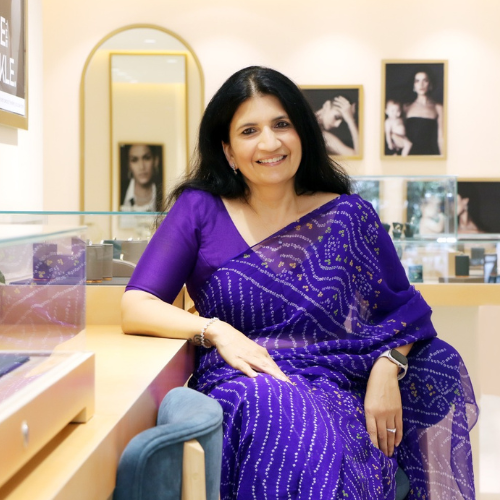
Lisa Mukhedkar is the Founder of Aukera- Lab Grown Diamond Jeweller
Lab-grown diamonds are emerging as a compelling alternative to traditionally mined stones in the dynamic world of fine jewellery. As dazzling as their natural counterparts in brilliance, durability, and composition, these lab-made marvels are not just rewriting the rules of luxury but also redefining what it means to wear jewellery, with conscience and creativity.
What truly sets lab-grown diamonds apart, however, is the extraordinary design freedom they offer. With greater availability and more accessible price points—nearly 30-40% lower than mined diamonds—designers and consumers alike are no longer restricted by cost when it comes to scale, setting, or innovation. Larger, high-quality stones can be incorporated into custom designs, allowing bold artistic visions to flourish without compromise.
India’s lab-grown diamond jewellery market, pegged at $264.5 million in 2022, will grow at 14.8% CAGR, reaching $1,192.3 million by 2033, as per an ET Retail report. This explains the shift in consumer mindset, particularly evident among younger buyers, who are seeking jewellery that reflects their values and personal stories. Engagement rings, in particular, have become deeply personal artefacts—designed not just to symbolise love but to express individuality. Many couples are veering away from the conventional solitaire and opting for coloured stones, unique cuts, asymmetry, and mixed metal bands. From astrological motifs and birthstones to rings that incorporate the story of a couple’s journey, the emphasis is on crafting a ring that speaks of individuality.
Designers are responding to this demand with greater creative freedom, made possible by the versatility and easy availability of lab-grown diamonds. These diamonds enable quick customisation with technical precision, allowing customers to bring their unique visions to life, without the steep price tag or ethical ambiguity of mined stones.
This creative liberation is fuelling a wave of experimentation in contemporary jewellery design. There’s a noticeable move toward mixing metals—pairing white and yellow gold or combining rose gold with platinum—to create unique, expressive pieces. Asymmetrical settings, bold colour contrasts, and unorthodox stone placements are also on the rise, making each piece a true reflection of the wearer’s personality.
Even men’s jewellery is seeing a shift, with lab-grown diamonds being used in refined, minimalist styles like cufflinks, bands, and bracelets. These modern pieces reflect not just personal style but also an alignment with sustainable and ethical values—key concerns for today’s consumer.
With a far lower price tag but the same clarity, brilliance, and sparkle, lab-grown diamonds stand out for their sheer versatility. You no longer have to burn a hole in your finances to own jewellery that’s both trendy and just as dazzling as mined diamonds.
Moreover, lab-grown diamonds are ushering in a more democratic era of bespoke design. Thanks to advances in production and design technology, custom creations can now be brought to life rapidly and with exacting detail. This opens doors for more people to own jewellery that is not only beautiful but also meaningful and responsibly sourced.
Ultimately, lab-grown diamonds are not just about sustainability or savings—they are about creative freedom. As the boundaries of jewellery design expand, these stones enable consumers and designers to dream bigger, bolder, and express more freely.






JB Insights
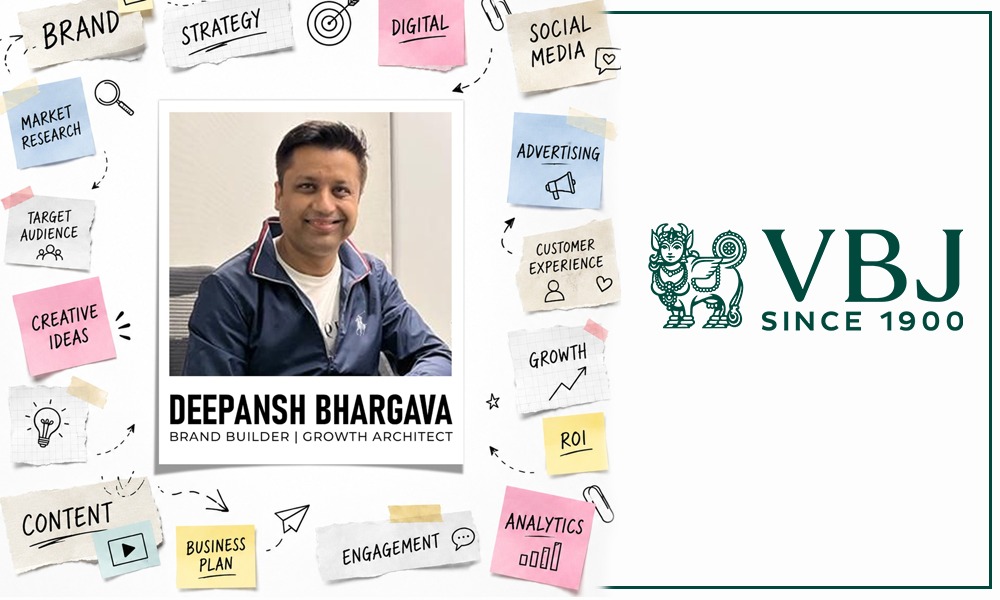
From Customer Intelligence To Autonomous Growth Intelligence: Deepansh Bhargava Senior Vice President & Head Marketing at VBJ
From Customer Intelligence To AI-powered Growth Decisions, The Next-Gen CDP Is Built To Create Measurable Incremental Value.

For the last 6 years, Customer Data Platforms have transformed how brands understand their customers. They have brought fragmented data together, created unified customer profiles, enabled segmentation and made personalisation more intelligent. But the next evolution of CDPs will not be defined by how much customer data they can organise. It will be defined by how intelligently AI can convert that data into consumer value and incremental business outcomes.
The shift is from Customer Intelligence to Growth Intelligence.
Businesses today know more about their existing customers than ever before their purchase history, frequency, preferences, lifetime value and likelihood of buying again. Yet the larger opportunity lies in moving beyond what customers did to understanding what they need next, where their behaviour is changing and where the next phase of growth will come from. This also requires a sharper focus on incrementality.
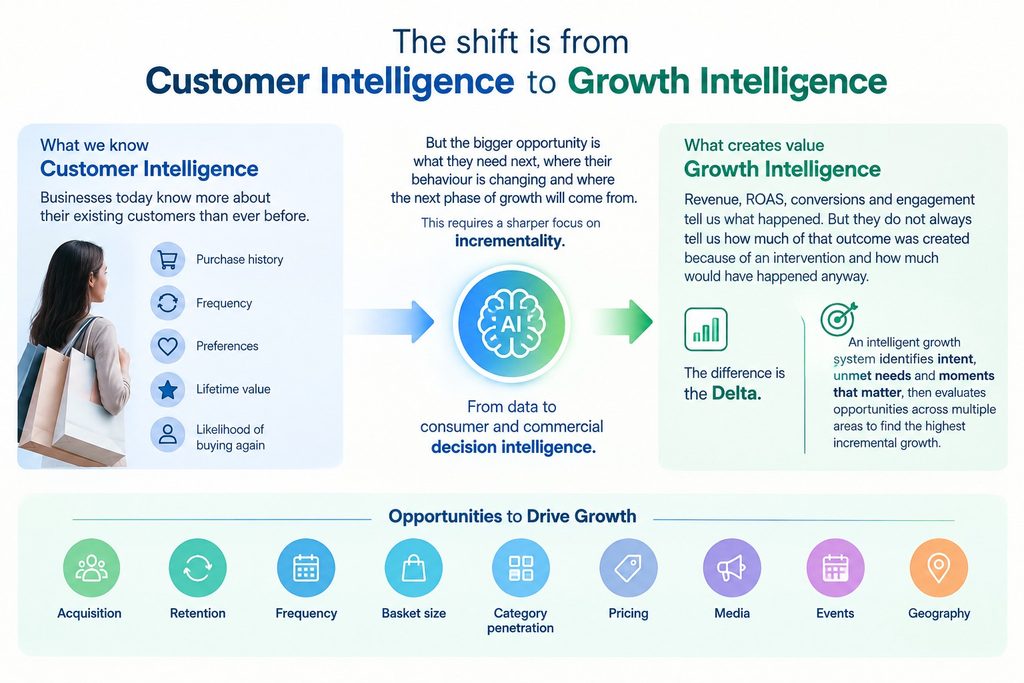
Revenue, ROAS, conversions and engagement tell us what happened. But they do not always tell us how much of that outcome was created because of an intervention and how much would have happened anyway.
That difference is the Delta. AI can help take CDPs beyond systems of customer intelligence and turn them into systems of consumer and commercial decision intelligence. Instead of simply identifying customers with a high propensity to purchase, an intelligent growth system could identify intent, unmet needs and moments that matter then evaluate opportunities across acquisition, retention, frequency, basket size, category penetration, pricing, media, events and geography to identify where the highest incremental growth opportunity lies.
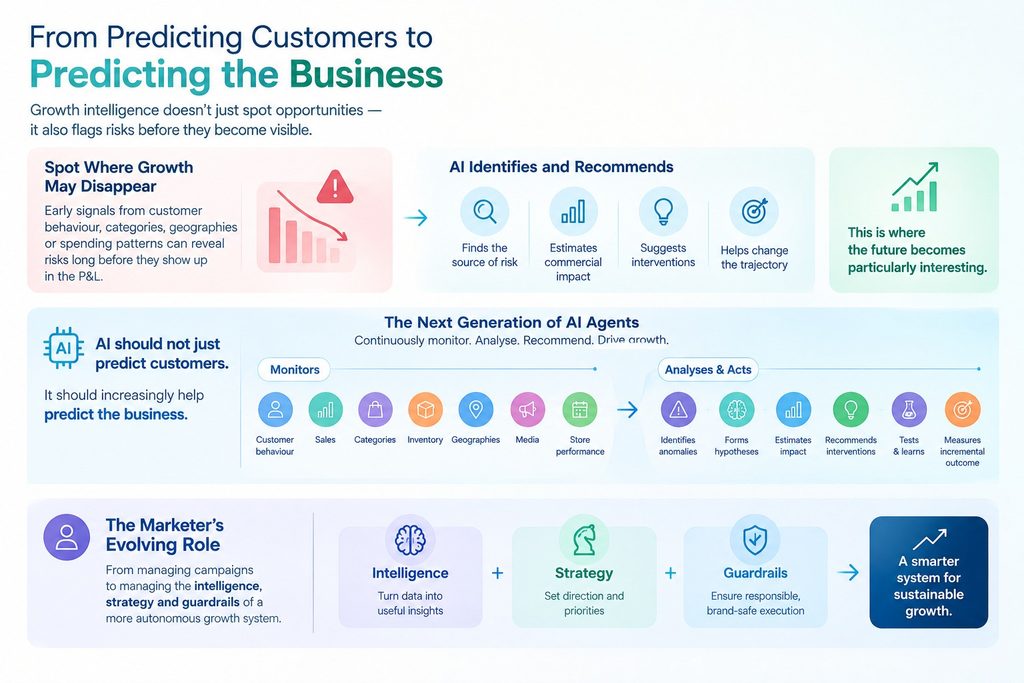
Growth intelligence should also help businesses identify where growth is likely to disappear. Early signals from customer behaviour, categories, geographies or spending patterns could reveal risks long before they become visible in the P&L. AI could identify the source of the risk, estimate its potential commercial impact and recommend interventions to change the trajectory. This is where the future becomes particularly interesting.
AI should not just predict customers. It should increasingly help predict the business.
The next generation of AI agents could continuously monitor customer behaviour, sales, categories, inventory, geographies, media and store performance. They could identify anomalies, form hypotheses, estimate commercial impact, recommend interventions, test them and measure the incremental outcome.
The role of the marketer would evolve from simply managing campaigns to managing the intelligence, strategy and guardrails around a more autonomous growth system.
This evolution can be built around three principles: Anticipate, Act and Account.
1. Anticipate where consumer needs and growth will emerge and where they may disappear.
2. Act by identifying and eventually executing the most relevant intervention for the consumer and the business.
3. Account for whether that intervention genuinely created incremental value.
The CDP of the future, therefore, should move beyond being a platform that simply manages customer data. It should become a Growth Decision Platform one that helps businesses understand consumers better, identify opportunities, detect risks, recommend actions, measure incrementality and continuously learn from every intervention. The ultimate measure of such a platform should not be the volume of data it manages.
It should be much simpler:
Show me the Delta you create.
Because ultimately, consumer centricity is not the opposite of growth. It is where sustainable growth begins.



Belgian Prime Minister Bart De Wever opens expanded HRD Antwerp laboratory in Mumbai

Verlas Introduces the ‘Alyssa’ Collection in India, Bringing Modern Luxe Floral-Inspired Design to Lab-Grown Diamond Jewelry Crafted in Fine Gold

Gold rebounds,Silver reclaims Rs 2.33 lakh mark

Limelight Lab Grown Diamonds Inaugurates Showroom In Kalyan, Its 8th Exclusive Store MMR
Verlas Introduces the ‘Alyssa’ Collection in India, Bringing Modern Luxe Floral-Inspired Design to Lab-Grown Diamond Jewelry Crafted in Fine Gold
Belgian Prime Minister Bart De Wever opens expanded HRD Antwerp laboratory in Mumbai
-
 National News4 days ago
Limelight Lab Grown Diamonds Inaugurates Showroom In Kalyan, Its 8th Exclusive Store MMR
-
 BrandBuzz3 days ago
Verlas Introduces the ‘Alyssa’ Collection in India, Bringing Modern Luxe Floral-Inspired Design to Lab-Grown Diamond Jewelry Crafted in Fine Gold
-
 DiamondBuzz2 days ago
Belgian Prime Minister Bart De Wever opens expanded HRD Antwerp laboratory in Mumbai
-

 National News3 days ago
Value Addition Drives August Jewellery Exports as Studded Gold Jewellery Rises 51.22% to US$642.85 Million
