By Invitation
The Rise Of Everyday Milestone Gifting:Why Natural Diamond Solitaires Are No Longer Reserved For Weddings


For decades, natural diamond solitaires have been associated with engagements, weddings and landmark anniversaries. They represented life’s biggest celebrations and were often viewed as aspirational purchases reserved for a select few occasions. Today, however, consumer behaviour is evolving. More people are choosing to celebrate personal milestones, professional achievements and meaningful life moments with jewellery that carries lasting emotional value.
Across urban India, consumers are increasingly purchasing natural diamond solitaires for occasions such as promotions, first salaries, business launches, milestone birthdays, graduations, parenthood and personal accomplishments. The decision is no longer driven solely by tradition, it is driven by emotion. This shift is redefining the role of solitaires from occasion-led purchases to symbols of self-celebration and personal growth.
For the jewellery industry, this evolution presents a significant opportunity. Instead of engaging consumers only during wedding seasons, brands can now connect with them across multiple life stages. Every achievement, whether personal or professional, has the potential to become a meaningful jewellery purchase. This broadens the consumer journey and creates new avenues for growth beyond the traditional bridal category.


At Divine Solitaires, this changing mindset is seen as a reflection of how modern luxury is becoming more personal and intentional. While the brand is synonymous with the world’s finest natural solitaire diamonds, it also recognises that today’s consumers want jewellery that becomes part of their everyday story, not just their wedding album. A solitaire is increasingly being viewed as a timeless piece that can be worn regularly while continuing to represent a deeply meaningful memory.
The growing preference for everyday milestone gifting is also changing what consumers expect from jewellery brands. Buyers today are researching more, asking more questions and seeking greater transparency before making a purchase. They want assurance about certification, quality, craftsmanship and long-term value. These expectations are redefining trust in the natural diamond category.
This philosophy has always been central to Divine Solitaires. The brand has consistently focused on bringing greater transparency to the natural diamond category through stringent quality benchmarks, transparent pricing and industry-leading consumer assurance programmes. Every Divine Solitaire undergoes multiple quality parameters that far exceed conventional diamond grading standards, ensuring consumers receive only the world’s finest natural solitaire diamonds. Along with lifetime upgrade, exchange and buyback programmes, supported through its digital verification ecosystem, the brand continues to reinforce confidence long after the purchase is made.
As India’s jewellery market matures, consumers are no longer making decisions based solely on design or price. They are increasingly evaluating emotional significance, authenticity, long-term value and future flexibility. The ability to invest in a certified natural solitaire diamond that celebrates a personal milestone represents a meaningful and enduring choice, particularly among younger buyers who seek purchases that combine aspiration with substance. This evolution is helping redefine luxury as something that is not only beautiful, but also deeply personal.
The broader industry stands to benefit as well. The rise of self-gifting and milestone-led purchases is expanding the natural diamond category beyond traditional wedding occasions and encouraging stronger consumer engagement throughout the year. It is also creating greater demand for certified natural diamonds and driving higher standards of transparency, education and trust across India’s jewellery retail ecosystem.
As the industry prepares for this next phase of growth, there is also increasing momentum around celebrating and strengthening consumer confidence in natural diamond solitaires. This vision is reflected in the upcoming Solitaire Festival of India (TSFI), an industry-first initiative by Divine Solitaires that aims to bring together consumers, retailers and the larger jewellery fraternity in a nationwide celebration of natural diamond solitaires. By creating new conversations around aspiration, achievement and everyday milestones, TSFI seeks to further expand the relevance of solitaires beyond weddings and into every meaningful stage of modern life.
Speaking on this evolving consumer behaviour, Jignesh Mehta, Founder and Managing Director, Divine Solitaires, said:

“The definition of luxury is becoming deeply personal. Consumers today are no longer buying natural diamond solitaires only because tradition tells them to, they are buying them because a moment in their life feels worthy of being remembered forever. We are witnessing a significant shift from occasion-led purchases to emotion-led purchases, where promotions, entrepreneurial successes, personal achievements and everyday milestones are becoming solitaire moments.
At Divine Solitaires, we believe this evolution reflects a more confident and intentional consumer mindset, one that values transparency, quality and long-term meaning. Through initiatives like the Solitaire Festival of India, our endeavour is to celebrate these changing consumer journeys while strengthening trust and appreciation for natural diamond solitaires across the country.”
The future of India’s natural diamond market will not be shaped solely by weddings, but by the many milestones that define modern life. As everyday milestone gifting continues to rise, brands that combine emotional relevance with transparency and enduring value will lead the next phase of growth. For Divine Solitaires, this represents not just a consumer trend, but a meaningful shift towards a more personal, consumer-centric and future-ready jewellery ecosystem.





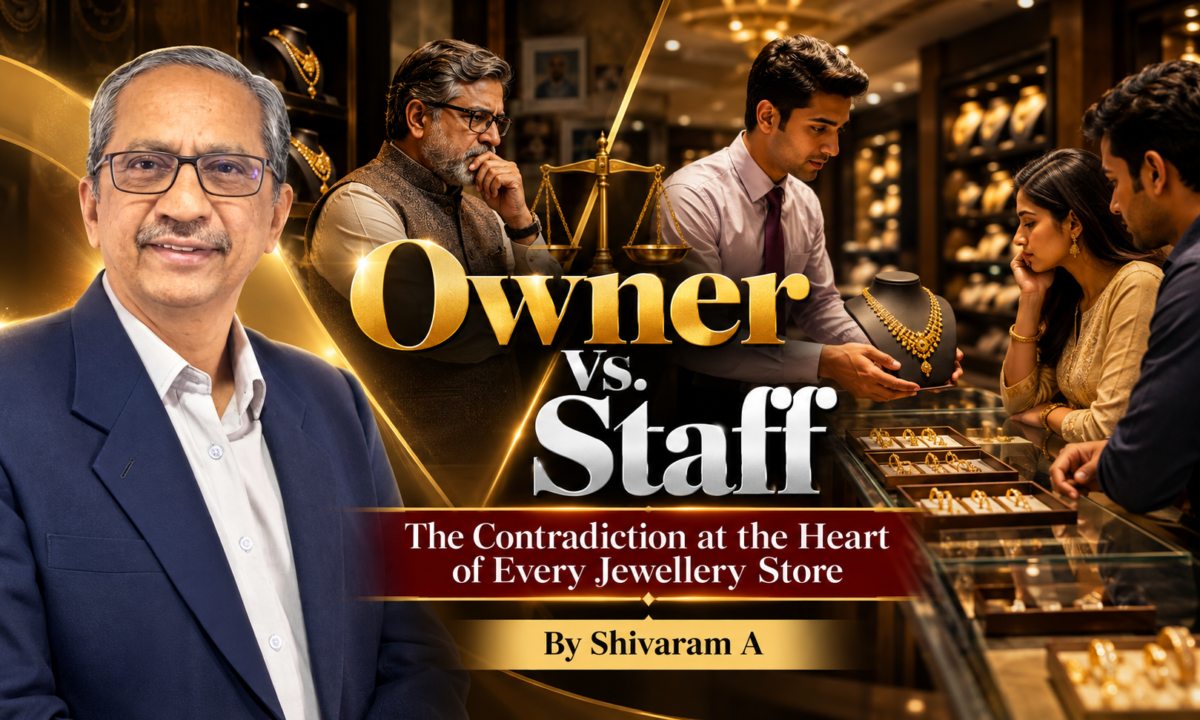
By Shivaram A
The Core Issue
The owner carries the entire risk of the business — investment, gold stock, working capital, loans, everything is in their name. The long-term asset also belongs to the owner — reputation, brand, the customer base built over years, often meant to pass to the next generation. But the moment that matters most — when the customer is standing at the counter, when trust is being built or broken — that moment is entirely controlled by the staff.
The person with the most risk is not present at the decisive moment. And the person with the least to lose holds the most power in that moment. This structural mismatch creates frustration on both sides — and it’s rarely discussed openly.
Making the Conflict Explicit
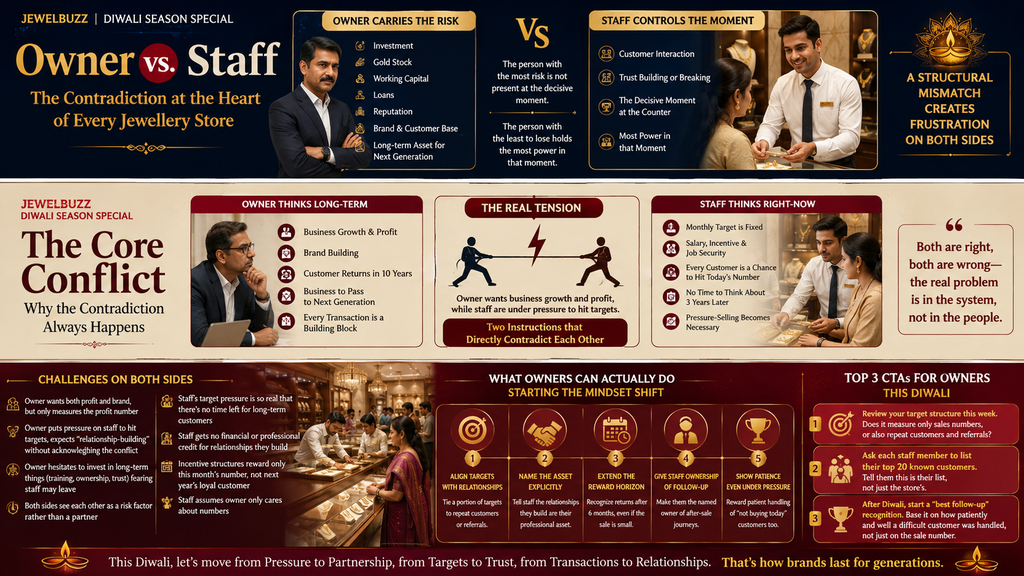
The real tension is this: the owner wants business growth and profit, while staff are under pressure to hit targets.
The owner thinks long-term — how does the brand grow, how does a customer come back after ten years, how does the business pass to the next generation. For the owner, every transaction is a building block toward something bigger.
The staff’s reality is completely different. Their monthly target is fixed. Their salary, incentive, and sometimes even job security depend on how much they sold this month, this Diwali. For staff, every customer is a chance to hit today’s number — right now, this moment. They cannot afford to think about whether this customer comes back in three years, because their performance is reviewed at month-end, not three years later.

So when the owner says “build the relationship, be patient,” and in the same breath increases the target by 20%, these two instructions directly contradict each other. Staff are not confused about what they should ideally do — they understand it perfectly. But they don’t have the choice. The target has to be met, so pressure-selling becomes necessary — even if it means pushing a customer slightly, or using lines like “buy today, rate will go up tomorrow” that create small cracks in trust.
These cracks don’t show up immediately. But after Diwali, when that customer doesn’t return a second time, the owner assumes it’s the staff’s fault. The staff believes the owner set an unrealistic target. Both are right, and both are wrong — because the real problem is in the system, not in the people.
The Challenges on Both Sides
- Owner wants both profit and brand, but only measures the profit number
- Owner puts pressure on staff to hit targets, then also expects “relationship-building” — without acknowledging the two often can’t coexist
- Owner hesitates to invest in long-term things (training, ownership, trust) due to fear that staff will leave anyway
- Staff’s target pressure is so real that there’s no time left to think about the long-term customer
- Staff gets no financial or professional credit for the relationships they build
- Incentive structures reward only this month’s number, not next year’s loyal customer
- Both sides see each other as a risk factor rather than a partner — the owner assumes staff will eventually leave, staff assumes the owner only cares about numbers
What Owners Can Actually Do — Starting the Mindset Shift
- Stop treating targets and relationships as separate — align them. Don’t set targets purely on sales numbers. Tie a small portion of the target to repeat customers or referrals, so staff know that long-term customers count too.
- Name the asset explicitly. Tell staff directly: the relationship you’re building with a customer is your professional asset, not just the store’s. This has to be shown in practice, not just said out loud.
- Extend the reward horizon. Don’t reward only Diwali-week sales — when a customer returns six months later and asks for that staff member by name, recognize that, even if the sale itself is small.
- Give staff ownership of the follow-up. Make each staff member the named owner of their customers’ after-sale journey — repairs, exchanges, the next occasion. This helps them feel the relationship is theirs, not just a transaction.
- Show patience even under pressure. If Diwali week only rewards closed sales, staff will only chase closing. If a staff member who handles a “not buying today” customer well is also appreciated, that’s when the mindset actually starts to shift — because staff notices what the owner actually rewards, not just what they say.
Top 3 CTAs for owners this Diwali
- Review your target structure this week. Does it only measure sales numbers, or does it also give weight to repeat customers and referrals? If not, try a small adjustment starting this Diwali.
- Ask each staff member to list their top 20 known customers. Tell them this is their list, not just the store’s. This builds a sense of ownership.
- After Diwali, start a “best follow-up” recognition. Base it not on the sale number, but on how patiently and well a difficult customer was handled. Staff need to see that patience is rewarded too, not just closing.
Shivaram A
Retail Gurukul



IGM’s RamMudra : Kuberdev Ka Sona Lights Up The Festive Gold Market

The Festive Shopper 2026: How Indian Jewellery Consumers Are Rewriting The Rules

P N Gadgil Jewellers Delivers Q2 FY27 Revenue Of 26,663.8 Mn; With 22.4% Revenue Growth, 57.1% EBITDA Growth & 52.7% PAT Growth; You

Dhanteras Shopping Guide 2026:Gold, Silver, Diamonds & Festive Jewellery Trends To Watch

From Diya Puja To Diwali Soirées: Jewellery Designed To Go Beyond The Festive Season

The Solenne Collection: A Celebration Of Diwali By Bharti Bangur Fine Jewels
-
 JB Insights1 week ago
Dhanteras Shopping Guide 2026:Gold, Silver, Diamonds & Festive Jewellery Trends To Watch
-
 BrandBuzz1 week ago
From Diya Puja To Diwali Soirées: Jewellery Designed To Go Beyond The Festive Season
-
 BrandBuzz1 week ago
The Solenne Collection: A Celebration Of Diwali By Bharti Bangur Fine Jewels
-

 National News1 week ago
Indriya, Aditya Birla Jewellery Unveiled India’s Largest Sustainable Jewellery Rangavalli