

By Invitation
Professional Guidelines for Training Jewellery Retail Sales Staff
By Shivaram A, Founder – Retail Gurukul


Selling jewellery requires a distinct approach from other retail sectors. Customers in this environment anticipate a higher level of service and expertise than they might expect at a grocery or clothing store. To achieve success, staff must possess specialized skills tailored to jewellery sales. The following guide outlines key training principles for jewellery sales associates, complemented by practical examples for each area.
1. Appearance
• All employees should maintain impeccable grooming and attire.
• Example: Associates arrive in pressed shirts and polished shoes daily.
• Where possible, provide uniforms; otherwise, ensure personal clothing is clean, ironed, and understated.
• Example: Staff without uniforms wear plain, well-ironed garments, avoiding prominent logos.
• Hair must be neatly styled and footwear kept clean for all staff members.
• Example: Management conducts pre-shift checks to confirm proper grooming standards.
• Dress codes apply universally, including to security personnel.
• Example: Security staff participate in regular dress code reviews and grooming inspections.
2. Attitude
• Encourage staff to display consistent friendliness and positivity throughout the workday.
• Example: Every customer is welcomed with a genuine smile and warm greeting.
• Staff should maintain courteous engagement, even if customers do not reciprocate.
• Example: In cases where a customer appears upset, the associate still offers a friendly introduction and assistance.
• Staff are expected to compartmentalize personal issues during shifts, remaining constructive and solution-oriented.
• Example: Employees adopt a focused mindset before starting their shift to prioritise exemplary customer service.
3. Communication
• Employees must uphold polite, respectful dialogue at all times.
• Example: Use courteous phrases such as “May I assist you, Sir?” or “Thank you, Madam” consistently.
• Appropriate titles or respectful terms in local languages should be used when addressing clientele.
• Example: “Good afternoon, Sir. Is there something special you are searching for today?”
• Professional etiquette should permeate every interaction.
• Example: Regularly incorporating “please” and “thank you” in conversations.
• Indifference must be strictly avoided.
• Example: If an employee is occupied, they acknowledge waiting customers with assurances of prompt attention.
• Multilingual abilities are advantageous in serving a diverse customer base.
• Example: Staff transition to Hindi when necessary to make customers feel comfortable.
• Demonstrate extra patience and care with elderly patrons.
• Example: Spend time clearly outlining details for older customers who may require additional support.
• Engage children hospitably so adults can shop undistracted.
• Example: Offer small toys or converse briefly with children while adults browse.
• Ensure equal treatment for all visitors, irrespective of appearance or attire.
• Example: Give consistent attention to both casually and formally dressed customers.
4. Hospitality
• Begin interactions by welcoming guests and offering seating.
• Example: “Please have a seat while I present our newest collection.”
• Provide complimentary refreshments as a hospitality gesture.
• Example: Serve water or tea to customers as they view products.
• All team members should be prepared to assist customers, regardless of primary responsibilities.
• Example: If the primary salesperson is occupied, another employee steps in seamlessly.
• Owners should occasionally interact directly with clients to lead by example.
• Example: The owner personally thanks loyal customers for their continued patronage.
• Always offer proactive and attentive service.
• Example: Assist customers with carrying purchases or parking arrangements when needed.
5. Product Knowledge
• Deliver thorough training to ensure staff are knowledgeable about inventory.
• Example: Monthly training sessions update employees on new designs and materials.
• Define clear guidelines regarding which product details and certifications to share.
• Example: Staff are informed about certifications relevant to gold purity inquiries.
• Team members should confidently describe product features, fabrication methods, and distinctive qualities.
• Example: Discuss differences between handcrafted pieces and machine-made jewellery.
• Educating customers is integral to the sales role.
• Example: Clearly explain gemstone properties or style benefits to interested shoppers.
• Counter personnel must answer queries knowledgeably or direct customers to appropriate experts.
• Example: Junior associates promptly consult senior colleagues when complex questions arise.
• New hires should discreetly seek supervisory guidance rather than stating uncertainty.• Example: “Let me verify that information with my manager to provide you with an accurate response.”





By Invitation
A fun, practical New Year note for jewellery business owners
Wishing You a Healthier, Happier & Wiser 2026 – By Shivaram A

A new year arrives with a new set of—what else—New Year resolutions. And 2026 is no different.
Resolution makers, beware. Research says nearly 80% of New Year resolutions collapse by mid-February. There’s even a name for it: the second Friday of January is officially called Quitters’ Day.
So, here’s the uncomfortable question: Do you want 2026 to be any different, or should we just block your calendar till Quitters’ Day?
If your answer is a serious yes, then it boils down to two things:
- What exactly do you want?
- How badly do you want it?
Because let’s be honest intentions are cheap. Discipline is expensive.
If you’re still reading, congratulations. You haven’t quit yet.
Most business resolutions sound familiar: higher sales, higher profits (or much higher profits), more stores, more customers. And yes—higher gold and silver prices too. On that one, we have very little control… though prayers are always welcome!
But for 2026, let’s look beyond only business numbers and focus on three areas that quietly decide your long-term success.
1. A Healthier You in 2026
A typical day before 2025 (you may recognise this): Late wake-up. Late breakfast. Reaching the store by 11 am—or noon on a “busy” day. Vendor meetings. Lunch at 3 pm. Evening snacks at 6 pm. Endless cups of chai. Store closes at 9 pm. Dinner at 10:30 pm. Netflix or phone scrolling. Sleep well past midnight.
Not everything applies—but enough of it does to make you uncomfortable.
The result? Low energy, rising health reports, and a body that protests quietly… until it doesn’t.
Resolution for a Healthier 2026
Start with a complete health check-up. Think of it as your personal P&L statement—it shows your condition on one specific day.
Identify what I like to call “golden furniture” in the body—parts that have stopped moving but still occupy space.
Then act:
- Better food (not fancy diets)
- Regular movement (not heroic gym resolutions)
- Better sleep (yes, even for business owners)
Warning: Change will be uncomfortable. But so is ignoring the problem.
Set SMART health goals—Specific, Measurable, Achievable, Realistic, Time-bound.
2. A Happier You in 2026
Let’s admit it—becoming happier has rarely featured on a jeweller’s resolution list.

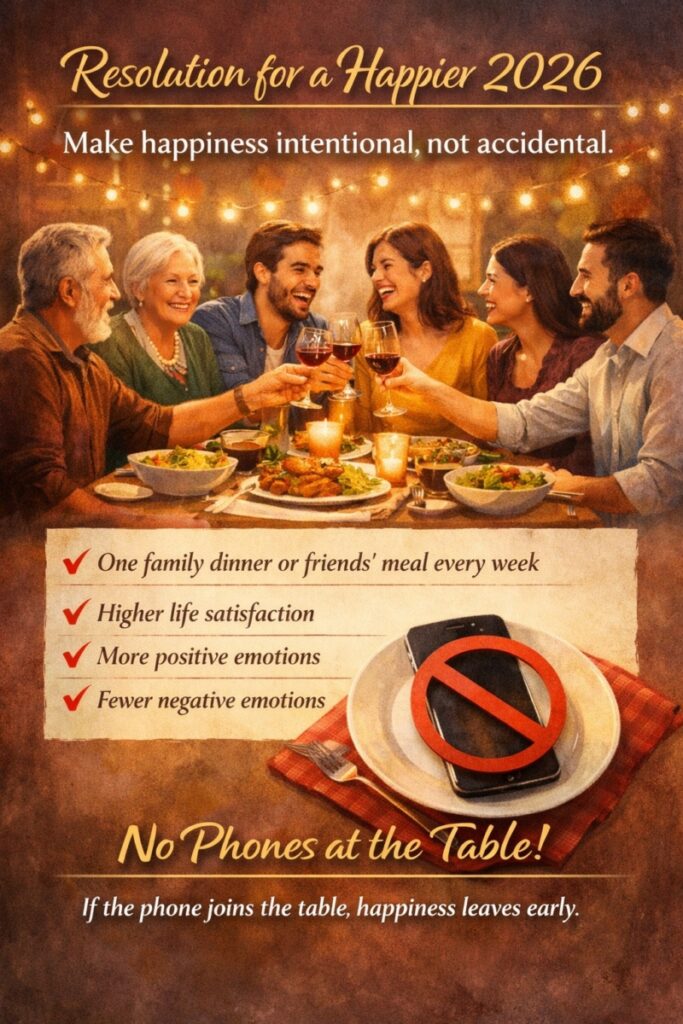
Resolution for a Happier 2026
Make happiness intentional, not accidental.
Start with something simple: one family dinner or friends’ meal every week.
According to the World Happiness Report (based on over 1,50,000 people), those who regularly eat with others report:
- Higher life satisfaction
- More positive emotions
- Fewer negative emotions
One strict rule: phones stay away. If the phone joins the table, happiness leaves early.
3. A Wiser You in 2026
You’ve built a successful business. The numbers prove it. Experience, instinct, and industry knowledge have served you well.
But the world is shifting—fast.
AI. Agentic AI. AI Agents. (And yes, everyone is still figuring out the difference.)
People deep in this space believe AI may have a bigger impact than the internet itself.
The real question is not whether AI will affect jewellery retail—but whether you’ll learn early or catch up late.
For traditional business owners, the willingness to learn and apply new tools is the new unfair advantage.
A Simple 2026 Resolution Action Plan
| Action Area | Example | Final Status – 31.12.2026 |
| Healthier | 30 minutes movement daily | Achieved / Not Achieved |
| Happier | Weekly family dinner | Achieved / Not Achieved |
| Wiser | One AI implementation | Achieved / Not Achieved |
No overthinking. No complex dashboards. Just honest tracking.
Ready to make 2026 different?
If you want help converting good intentions into clear action plans—for health, happiness, or business wisdom—I’m happy to help you think it through.
Let’s ensure you’re still on track after Quitters’ Day.
Here’s wishing you a Healthier, Happier & Wiser 2026.
Call or WhatsApp on 90360 36524
Email: RetailGurukul.com
Jb Exclusive : Digital View



Indriya, Aditya Birla Jewellery, crosses 50 Stores Nationwide

Candere expands Karnataka presence with Kengeri store opening

Priority Jewels Raises ₹15.67 Crore in Pre-IPO Placement; Invictus Continuum Fund I Leads Investment
-

 International News4 days ago
Oroarezzo 2026, with Italian Exhibition Group, Manufacturing Explores New Markets
-

 National News4 days ago
IIBS-11: Navigating the ‘New Gold Rush’ in a fragmenting global economy
-
 International News4 days ago
Gemfields nets $53m in Bangkok ruby auction
-

 New Premises4 days ago
Limelight Diamonds Unveils Exclusive Visakhapatnam Store in the Presence of Union Minister of Civil Aviation Shri Kinjarapu Ram Mohan Naidu
