By Invitation
A fun, practical New Year note for jewellery business owners
Wishing You a Healthier, Happier & Wiser 2026 – By Shivaram A


A new year arrives with a new set of—what else—New Year resolutions. And 2026 is no different.
Resolution makers, beware. Research says nearly 80% of New Year resolutions collapse by mid-February. There’s even a name for it: the second Friday of January is officially called Quitters’ Day.
So, here’s the uncomfortable question: Do you want 2026 to be any different, or should we just block your calendar till Quitters’ Day?
If your answer is a serious yes, then it boils down to two things:
- What exactly do you want?
- How badly do you want it?
Because let’s be honest intentions are cheap. Discipline is expensive.
If you’re still reading, congratulations. You haven’t quit yet.
Most business resolutions sound familiar: higher sales, higher profits (or much higher profits), more stores, more customers. And yes—higher gold and silver prices too. On that one, we have very little control… though prayers are always welcome!
But for 2026, let’s look beyond only business numbers and focus on three areas that quietly decide your long-term success.
1. A Healthier You in 2026
A typical day before 2025 (you may recognise this): Late wake-up. Late breakfast. Reaching the store by 11 am—or noon on a “busy” day. Vendor meetings. Lunch at 3 pm. Evening snacks at 6 pm. Endless cups of chai. Store closes at 9 pm. Dinner at 10:30 pm. Netflix or phone scrolling. Sleep well past midnight.
Not everything applies—but enough of it does to make you uncomfortable.
The result? Low energy, rising health reports, and a body that protests quietly… until it doesn’t.
Resolution for a Healthier 2026
Start with a complete health check-up. Think of it as your personal P&L statement—it shows your condition on one specific day.
Identify what I like to call “golden furniture” in the body—parts that have stopped moving but still occupy space.
Then act:
- Better food (not fancy diets)
- Regular movement (not heroic gym resolutions)
- Better sleep (yes, even for business owners)
Warning: Change will be uncomfortable. But so is ignoring the problem.
Set SMART health goals—Specific, Measurable, Achievable, Realistic, Time-bound.
2. A Happier You in 2026
Let’s admit it—becoming happier has rarely featured on a jeweller’s resolution list.

Resolution for a Happier 2026
Make happiness intentional, not accidental.
Start with something simple: one family dinner or friends’ meal every week.
According to the World Happiness Report (based on over 1,50,000 people), those who regularly eat with others report:
- Higher life satisfaction
- More positive emotions
- Fewer negative emotions
One strict rule: phones stay away. If the phone joins the table, happiness leaves early.
3. A Wiser You in 2026
You’ve built a successful business. The numbers prove it. Experience, instinct, and industry knowledge have served you well.
But the world is shifting—fast.
AI. Agentic AI. AI Agents. (And yes, everyone is still figuring out the difference.)

People deep in this space believe AI may have a bigger impact than the internet itself.
The real question is not whether AI will affect jewellery retail—but whether you’ll learn early or catch up late.
For traditional business owners, the willingness to learn and apply new tools is the new unfair advantage.
A Simple 2026 Resolution Action Plan
| Action Area | Example | Final Status – 31.12.2026 |
| Healthier | 30 minutes movement daily | Achieved / Not Achieved |
| Happier | Weekly family dinner | Achieved / Not Achieved |
| Wiser | One AI implementation | Achieved / Not Achieved |
No overthinking. No complex dashboards. Just honest tracking.
Ready to make 2026 different?
If you want help converting good intentions into clear action plans—for health, happiness, or business wisdom—I’m happy to help you think it through.
Let’s ensure you’re still on track after Quitters’ Day.
Here’s wishing you a Healthier, Happier & Wiser 2026.
Call or WhatsApp on 90360 36524
Email: RetailGurukul.com
Jb Exclusive : Digital View






By Shivaram A
The Core Issue
The owner carries the entire risk of the business — investment, gold stock, working capital, loans, everything is in their name. The long-term asset also belongs to the owner — reputation, brand, the customer base built over years, often meant to pass to the next generation. But the moment that matters most — when the customer is standing at the counter, when trust is being built or broken — that moment is entirely controlled by the staff.
The person with the most risk is not present at the decisive moment. And the person with the least to lose holds the most power in that moment. This structural mismatch creates frustration on both sides — and it’s rarely discussed openly.
Making the Conflict Explicit
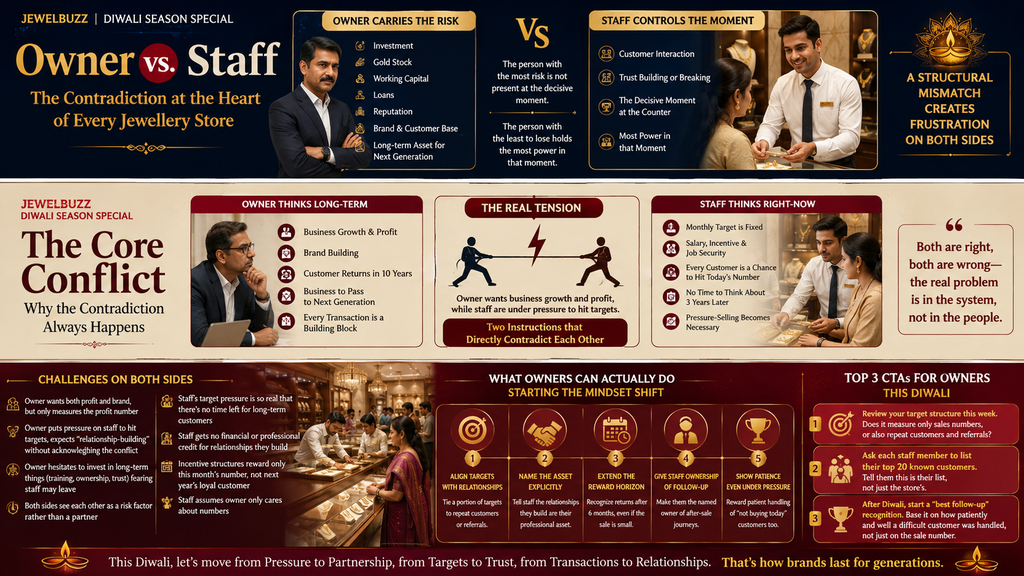
The real tension is this: the owner wants business growth and profit, while staff are under pressure to hit targets.
The owner thinks long-term — how does the brand grow, how does a customer come back after ten years, how does the business pass to the next generation. For the owner, every transaction is a building block toward something bigger.
The staff’s reality is completely different. Their monthly target is fixed. Their salary, incentive, and sometimes even job security depend on how much they sold this month, this Diwali. For staff, every customer is a chance to hit today’s number — right now, this moment. They cannot afford to think about whether this customer comes back in three years, because their performance is reviewed at month-end, not three years later.

So when the owner says “build the relationship, be patient,” and in the same breath increases the target by 20%, these two instructions directly contradict each other. Staff are not confused about what they should ideally do — they understand it perfectly. But they don’t have the choice. The target has to be met, so pressure-selling becomes necessary — even if it means pushing a customer slightly, or using lines like “buy today, rate will go up tomorrow” that create small cracks in trust.
These cracks don’t show up immediately. But after Diwali, when that customer doesn’t return a second time, the owner assumes it’s the staff’s fault. The staff believes the owner set an unrealistic target. Both are right, and both are wrong — because the real problem is in the system, not in the people.
The Challenges on Both Sides
- Owner wants both profit and brand, but only measures the profit number
- Owner puts pressure on staff to hit targets, then also expects “relationship-building” — without acknowledging the two often can’t coexist
- Owner hesitates to invest in long-term things (training, ownership, trust) due to fear that staff will leave anyway
- Staff’s target pressure is so real that there’s no time left to think about the long-term customer
- Staff gets no financial or professional credit for the relationships they build
- Incentive structures reward only this month’s number, not next year’s loyal customer
- Both sides see each other as a risk factor rather than a partner — the owner assumes staff will eventually leave, staff assumes the owner only cares about numbers
What Owners Can Actually Do — Starting the Mindset Shift
- Stop treating targets and relationships as separate — align them. Don’t set targets purely on sales numbers. Tie a small portion of the target to repeat customers or referrals, so staff know that long-term customers count too.
- Name the asset explicitly. Tell staff directly: the relationship you’re building with a customer is your professional asset, not just the store’s. This has to be shown in practice, not just said out loud.
- Extend the reward horizon. Don’t reward only Diwali-week sales — when a customer returns six months later and asks for that staff member by name, recognize that, even if the sale itself is small.
- Give staff ownership of the follow-up. Make each staff member the named owner of their customers’ after-sale journey — repairs, exchanges, the next occasion. This helps them feel the relationship is theirs, not just a transaction.
- Show patience even under pressure. If Diwali week only rewards closed sales, staff will only chase closing. If a staff member who handles a “not buying today” customer well is also appreciated, that’s when the mindset actually starts to shift — because staff notices what the owner actually rewards, not just what they say.
Top 3 CTAs for owners this Diwali
- Review your target structure this week. Does it only measure sales numbers, or does it also give weight to repeat customers and referrals? If not, try a small adjustment starting this Diwali.
- Ask each staff member to list their top 20 known customers. Tell them this is their list, not just the store’s. This builds a sense of ownership.
- After Diwali, start a “best follow-up” recognition. Base it not on the sale number, but on how patiently and well a difficult customer was handled. Staff need to see that patience is rewarded too, not just closing.
Shivaram A
Retail Gurukul



NPCI Defers Rollout Of UPI Merchant Discount Rate Until After Diwali

Mutual Engagement Ring-Wearing On The Rise, Insurance Lagging: Jewelers Mutual Group 2026 Engagement Ring Study

GJEPC Partners With The Leela To Offer Exclusive Hospitality Benefits To Members
-
 National News18 hours ago
GJEPC Partners With The Leela To Offer Exclusive Hospitality Benefits To Members
-

 JB Insights18 hours ago
CIBIL Score Plays A Key Role In Festive Financing
-

 DiamondBuzz18 hours ago
Richemont and Signet Jewelers Could Join Global Diamond Consortium In Bid For De Beers
-

 National News18 hours ago
MCX Gold, Silver Surge Ahead On US Inflation Data, Crude Price Dip