
By Invitation
A New Palette: How Color Gemstones Are Redefining Jewelry Buying Trends Across Generations
By Ramit Kapur, Managing Director, GSI

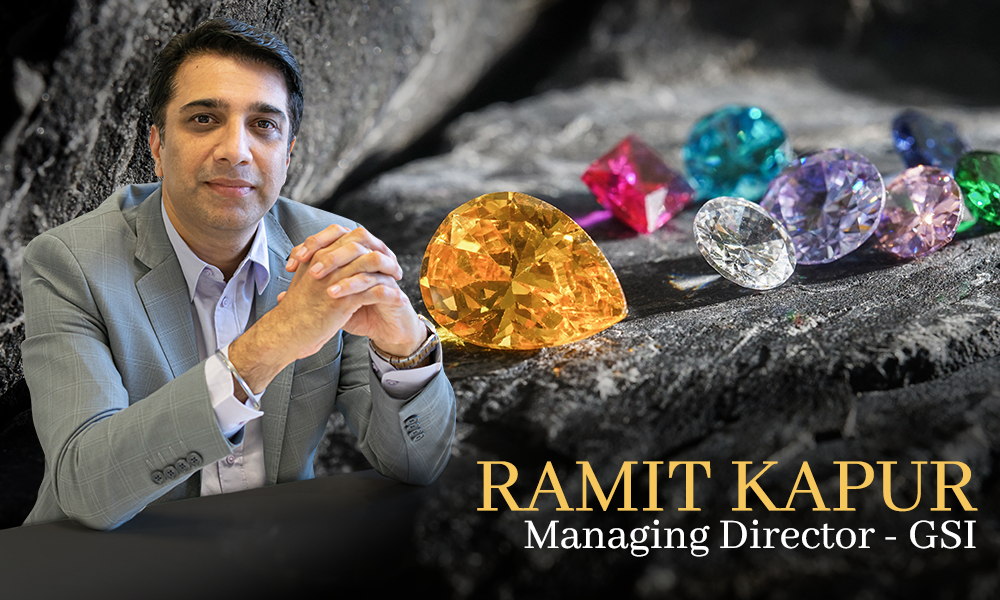
Once upon a time, fine jewelry revolved around the brilliance of diamonds and the sheen of pure gold, symbols of aspiration and status. Color, if present, was limited to the classic red of rubies, blue of sapphires, or green of emeralds.
Today, color has become the story of jewelry. From statement cocktail rings to everyday stackables, color defines how consumers express luxury and personal style, marking milestones in ways that feel authentic and individual.
What’s particularly exciting is how this color revolution is expanding beyond the traditional favorites. Buyers are embracing tanzanites, tourmalines, spinels, opals, garnets, malachite, jadeite and more for their individuality and versatility. These gemstones are stepping confidently into the spotlight, attracting those who want jewelry that stands out and tells a personal story.

Color: A Story of Heritage and Identity
Throughout history, gemstones have adorned palaces and crowns, each hue signifying power, protection, and heritage. This connection remains but has evolved into a personal form of expression. Today’s buyers, especially Gen Z and young millennials, seek jewelry that aligns with their style and adds variety to their collections. They want pieces that complement different looks in their wardrobes and reflect their evolving tastes, transforming jewelry from a mere investment into a marker of identity and conversation.
The New Stars of Color
At GSI, we see this shift daily in the gemstones we evaluate. Tourmalines in soft greens and vibrant pinks, spinels with a brilliance that rival rubies and garnets, revealing warm oranges and reds, are captivating buyers who want their jewelry to make a statement. Tanzanite, with its striking violet-blue hues, is increasingly becoming the gemstone of choice for those seeking rare yet wearable luxury.
This embrace of color isn’t limited to younger buyers. Collectors across age groups are adding colored gemstones to their collections, marking milestones with pieces that hold emotional significance beyond carat count.
Conscious Luxury and Storytelling
Today’s buyers are also more mindful about what they add to their collections. They look for pieces that come with a story, whether it’s the inspiration behind a design, the geographic origin of a gemstone, or the quality of craftsmanship involved. They value precision and artistry as much as beauty, seeking jewelry that is meaningful, well-made, and reflective of their personal style.
This is not a passing trend but a redefinition of luxury. It calls on jewelers to understand the individuality of each gemstone and curate collections that celebrate color with intention and authenticity. At GSI, we are at the forefront of this evolution, ensuring that every gemstone we certify, whether a vivid spinel or a lush garnet, retains its integrity and value in the marketplace.
Color is not just a preference; it is a return to the essence of why humanity has always adorned itself with gemstones: connection, meaning, and beauty. The world is more colorful than ever, and it’s time the industry embraced this shift with the same passion as the consumers leading it.




By Shivaram A
The Core Issue
The owner carries the entire risk of the business — investment, gold stock, working capital, loans, everything is in their name. The long-term asset also belongs to the owner — reputation, brand, the customer base built over years, often meant to pass to the next generation. But the moment that matters most — when the customer is standing at the counter, when trust is being built or broken — that moment is entirely controlled by the staff.
The person with the most risk is not present at the decisive moment. And the person with the least to lose holds the most power in that moment. This structural mismatch creates frustration on both sides — and it’s rarely discussed openly.
Making the Conflict Explicit
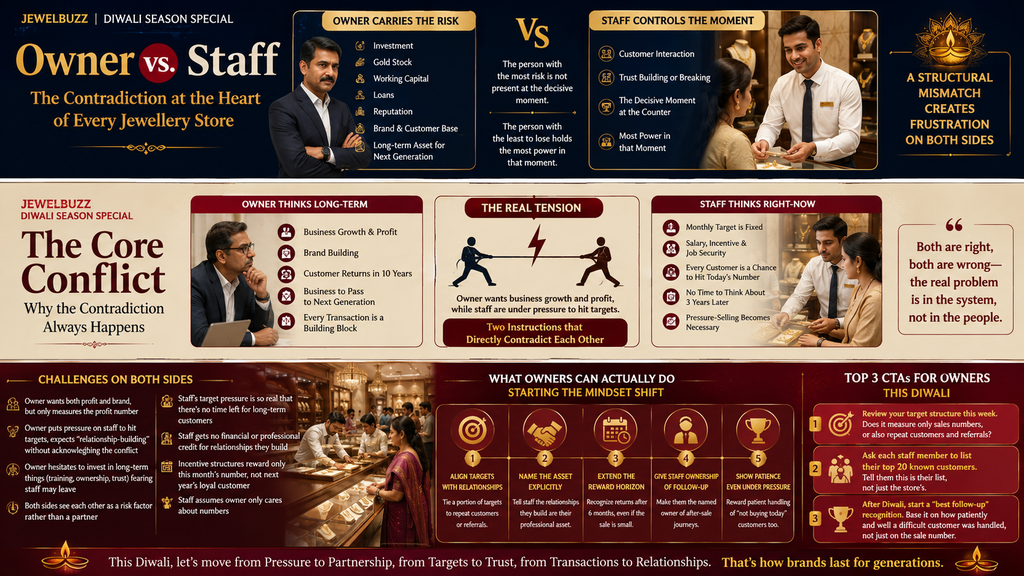
The real tension is this: the owner wants business growth and profit, while staff are under pressure to hit targets.
The owner thinks long-term — how does the brand grow, how does a customer come back after ten years, how does the business pass to the next generation. For the owner, every transaction is a building block toward something bigger.
The staff’s reality is completely different. Their monthly target is fixed. Their salary, incentive, and sometimes even job security depend on how much they sold this month, this Diwali. For staff, every customer is a chance to hit today’s number — right now, this moment. They cannot afford to think about whether this customer comes back in three years, because their performance is reviewed at month-end, not three years later.

So when the owner says “build the relationship, be patient,” and in the same breath increases the target by 20%, these two instructions directly contradict each other. Staff are not confused about what they should ideally do — they understand it perfectly. But they don’t have the choice. The target has to be met, so pressure-selling becomes necessary — even if it means pushing a customer slightly, or using lines like “buy today, rate will go up tomorrow” that create small cracks in trust.
These cracks don’t show up immediately. But after Diwali, when that customer doesn’t return a second time, the owner assumes it’s the staff’s fault. The staff believes the owner set an unrealistic target. Both are right, and both are wrong — because the real problem is in the system, not in the people.
The Challenges on Both Sides
- Owner wants both profit and brand, but only measures the profit number
- Owner puts pressure on staff to hit targets, then also expects “relationship-building” — without acknowledging the two often can’t coexist
- Owner hesitates to invest in long-term things (training, ownership, trust) due to fear that staff will leave anyway
- Staff’s target pressure is so real that there’s no time left to think about the long-term customer
- Staff gets no financial or professional credit for the relationships they build
- Incentive structures reward only this month’s number, not next year’s loyal customer
- Both sides see each other as a risk factor rather than a partner — the owner assumes staff will eventually leave, staff assumes the owner only cares about numbers
What Owners Can Actually Do — Starting the Mindset Shift
- Stop treating targets and relationships as separate — align them. Don’t set targets purely on sales numbers. Tie a small portion of the target to repeat customers or referrals, so staff know that long-term customers count too.
- Name the asset explicitly. Tell staff directly: the relationship you’re building with a customer is your professional asset, not just the store’s. This has to be shown in practice, not just said out loud.
- Extend the reward horizon. Don’t reward only Diwali-week sales — when a customer returns six months later and asks for that staff member by name, recognize that, even if the sale itself is small.
- Give staff ownership of the follow-up. Make each staff member the named owner of their customers’ after-sale journey — repairs, exchanges, the next occasion. This helps them feel the relationship is theirs, not just a transaction.
- Show patience even under pressure. If Diwali week only rewards closed sales, staff will only chase closing. If a staff member who handles a “not buying today” customer well is also appreciated, that’s when the mindset actually starts to shift — because staff notices what the owner actually rewards, not just what they say.
Top 3 CTAs for owners this Diwali
- Review your target structure this week. Does it only measure sales numbers, or does it also give weight to repeat customers and referrals? If not, try a small adjustment starting this Diwali.
- Ask each staff member to list their top 20 known customers. Tell them this is their list, not just the store’s. This builds a sense of ownership.
- After Diwali, start a “best follow-up” recognition. Base it not on the sale number, but on how patiently and well a difficult customer was handled. Staff need to see that patience is rewarded too, not just closing.
Shivaram A
Retail Gurukul



Joyalukkas Opens ‘Jewel Of Joy,’ The Biggest jewellery Destination In The Middle East’s At Dubai Gold District.

PNG Jewellers Brings Madhuri Dixit and Ranbir Kapoor Together In Its New Brand Campaign, Unstoppable Legacy

GJEPC, IndusInd Bank Host Webinar On FEMA Guidelines For GJ Exporters

US Holiday Shopping Expected To Top $1 Trillion For The First Time: NRF
Joyalukkas Opens ‘Jewel Of Joy,’ The Biggest jewellery Destination In The Middle East’s At Dubai Gold District.
GJEPC, IndusInd Bank Host Webinar On FEMA Guidelines For GJ Exporters
-
 International News8 hours ago
US Holiday Shopping Expected To Top $1 Trillion For The First Time: NRF
-
 New Premises4 hours ago
Joyalukkas Opens ‘Jewel Of Joy,’ The Biggest jewellery Destination In The Middle East’s At Dubai Gold District.
-
 National News8 hours ago
GJEPC, IndusInd Bank Host Webinar On FEMA Guidelines For GJ Exporters
-
 BrandBuzz5 hours ago
PNG Jewellers Brings Madhuri Dixit and Ranbir Kapoor Together In Its New Brand Campaign, Unstoppable Legacy
