
By Invitation
Professional Guidelines for Training Jewellery Retail Sales Staff
By Shivaram A, Founder – Retail Gurukul


Selling jewellery requires a distinct approach from other retail sectors. Customers in this environment anticipate a higher level of service and expertise than they might expect at a grocery or clothing store. To achieve success, staff must possess specialized skills tailored to jewellery sales. The following guide outlines key training principles for jewellery sales associates, complemented by practical examples for each area.
1. Appearance
• All employees should maintain impeccable grooming and attire.
• Example: Associates arrive in pressed shirts and polished shoes daily.
• Where possible, provide uniforms; otherwise, ensure personal clothing is clean, ironed, and understated.
• Example: Staff without uniforms wear plain, well-ironed garments, avoiding prominent logos.
• Hair must be neatly styled and footwear kept clean for all staff members.
• Example: Management conducts pre-shift checks to confirm proper grooming standards.
• Dress codes apply universally, including to security personnel.
• Example: Security staff participate in regular dress code reviews and grooming inspections.
2. Attitude
• Encourage staff to display consistent friendliness and positivity throughout the workday.
• Example: Every customer is welcomed with a genuine smile and warm greeting.
• Staff should maintain courteous engagement, even if customers do not reciprocate.
• Example: In cases where a customer appears upset, the associate still offers a friendly introduction and assistance.
• Staff are expected to compartmentalize personal issues during shifts, remaining constructive and solution-oriented.
• Example: Employees adopt a focused mindset before starting their shift to prioritise exemplary customer service.
3. Communication
• Employees must uphold polite, respectful dialogue at all times.
• Example: Use courteous phrases such as “May I assist you, Sir?” or “Thank you, Madam” consistently.
• Appropriate titles or respectful terms in local languages should be used when addressing clientele.
• Example: “Good afternoon, Sir. Is there something special you are searching for today?”
• Professional etiquette should permeate every interaction.
• Example: Regularly incorporating “please” and “thank you” in conversations.
• Indifference must be strictly avoided.
• Example: If an employee is occupied, they acknowledge waiting customers with assurances of prompt attention.
• Multilingual abilities are advantageous in serving a diverse customer base.
• Example: Staff transition to Hindi when necessary to make customers feel comfortable.
• Demonstrate extra patience and care with elderly patrons.
• Example: Spend time clearly outlining details for older customers who may require additional support.
• Engage children hospitably so adults can shop undistracted.
• Example: Offer small toys or converse briefly with children while adults browse.
• Ensure equal treatment for all visitors, irrespective of appearance or attire.
• Example: Give consistent attention to both casually and formally dressed customers.
4. Hospitality
• Begin interactions by welcoming guests and offering seating.
• Example: “Please have a seat while I present our newest collection.”
• Provide complimentary refreshments as a hospitality gesture.
• Example: Serve water or tea to customers as they view products.
• All team members should be prepared to assist customers, regardless of primary responsibilities.
• Example: If the primary salesperson is occupied, another employee steps in seamlessly.
• Owners should occasionally interact directly with clients to lead by example.
• Example: The owner personally thanks loyal customers for their continued patronage.
• Always offer proactive and attentive service.
• Example: Assist customers with carrying purchases or parking arrangements when needed.
5. Product Knowledge
• Deliver thorough training to ensure staff are knowledgeable about inventory.
• Example: Monthly training sessions update employees on new designs and materials.
• Define clear guidelines regarding which product details and certifications to share.
• Example: Staff are informed about certifications relevant to gold purity inquiries.
• Team members should confidently describe product features, fabrication methods, and distinctive qualities.
• Example: Discuss differences between handcrafted pieces and machine-made jewellery.
• Educating customers is integral to the sales role.
• Example: Clearly explain gemstone properties or style benefits to interested shoppers.
• Counter personnel must answer queries knowledgeably or direct customers to appropriate experts.
• Example: Junior associates promptly consult senior colleagues when complex questions arise.
• New hires should discreetly seek supervisory guidance rather than stating uncertainty.• Example: “Let me verify that information with my manager to provide you with an accurate response.”






By Shivaram A
The Core Issue
The owner carries the entire risk of the business — investment, gold stock, working capital, loans, everything is in their name. The long-term asset also belongs to the owner — reputation, brand, the customer base built over years, often meant to pass to the next generation. But the moment that matters most — when the customer is standing at the counter, when trust is being built or broken — that moment is entirely controlled by the staff.
The person with the most risk is not present at the decisive moment. And the person with the least to lose holds the most power in that moment. This structural mismatch creates frustration on both sides — and it’s rarely discussed openly.
Making the Conflict Explicit
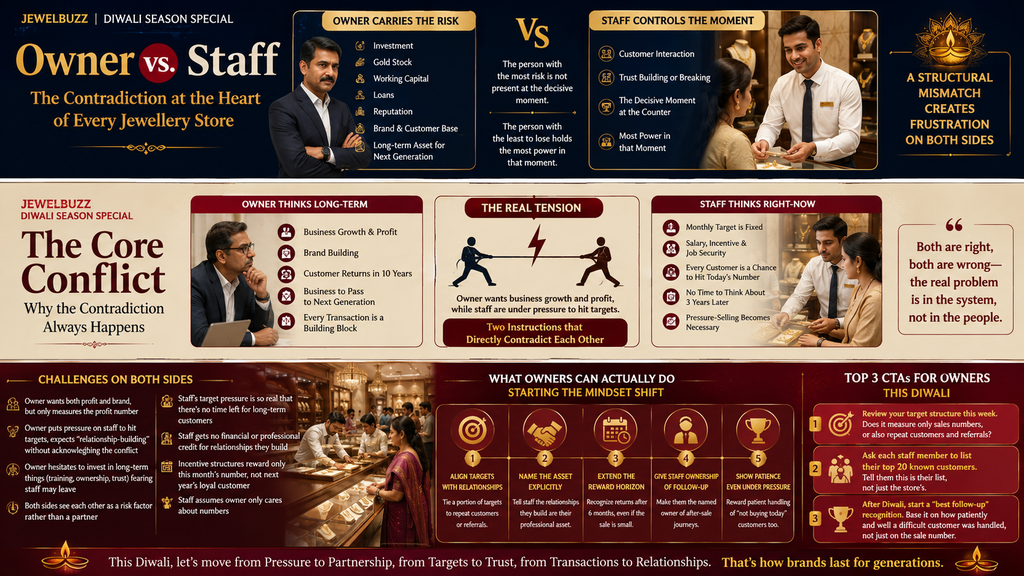
The real tension is this: the owner wants business growth and profit, while staff are under pressure to hit targets.
The owner thinks long-term — how does the brand grow, how does a customer come back after ten years, how does the business pass to the next generation. For the owner, every transaction is a building block toward something bigger.
The staff’s reality is completely different. Their monthly target is fixed. Their salary, incentive, and sometimes even job security depend on how much they sold this month, this Diwali. For staff, every customer is a chance to hit today’s number — right now, this moment. They cannot afford to think about whether this customer comes back in three years, because their performance is reviewed at month-end, not three years later.

So when the owner says “build the relationship, be patient,” and in the same breath increases the target by 20%, these two instructions directly contradict each other. Staff are not confused about what they should ideally do — they understand it perfectly. But they don’t have the choice. The target has to be met, so pressure-selling becomes necessary — even if it means pushing a customer slightly, or using lines like “buy today, rate will go up tomorrow” that create small cracks in trust.
These cracks don’t show up immediately. But after Diwali, when that customer doesn’t return a second time, the owner assumes it’s the staff’s fault. The staff believes the owner set an unrealistic target. Both are right, and both are wrong — because the real problem is in the system, not in the people.
The Challenges on Both Sides
- Owner wants both profit and brand, but only measures the profit number
- Owner puts pressure on staff to hit targets, then also expects “relationship-building” — without acknowledging the two often can’t coexist
- Owner hesitates to invest in long-term things (training, ownership, trust) due to fear that staff will leave anyway
- Staff’s target pressure is so real that there’s no time left to think about the long-term customer
- Staff gets no financial or professional credit for the relationships they build
- Incentive structures reward only this month’s number, not next year’s loyal customer
- Both sides see each other as a risk factor rather than a partner — the owner assumes staff will eventually leave, staff assumes the owner only cares about numbers
What Owners Can Actually Do — Starting the Mindset Shift
- Stop treating targets and relationships as separate — align them. Don’t set targets purely on sales numbers. Tie a small portion of the target to repeat customers or referrals, so staff know that long-term customers count too.
- Name the asset explicitly. Tell staff directly: the relationship you’re building with a customer is your professional asset, not just the store’s. This has to be shown in practice, not just said out loud.
- Extend the reward horizon. Don’t reward only Diwali-week sales — when a customer returns six months later and asks for that staff member by name, recognize that, even if the sale itself is small.
- Give staff ownership of the follow-up. Make each staff member the named owner of their customers’ after-sale journey — repairs, exchanges, the next occasion. This helps them feel the relationship is theirs, not just a transaction.
- Show patience even under pressure. If Diwali week only rewards closed sales, staff will only chase closing. If a staff member who handles a “not buying today” customer well is also appreciated, that’s when the mindset actually starts to shift — because staff notices what the owner actually rewards, not just what they say.
Top 3 CTAs for owners this Diwali
- Review your target structure this week. Does it only measure sales numbers, or does it also give weight to repeat customers and referrals? If not, try a small adjustment starting this Diwali.
- Ask each staff member to list their top 20 known customers. Tell them this is their list, not just the store’s. This builds a sense of ownership.
- After Diwali, start a “best follow-up” recognition. Base it not on the sale number, but on how patiently and well a difficult customer was handled. Staff need to see that patience is rewarded too, not just closing.
Shivaram A
Retail Gurukul



Kangana Ranaut Unveils PNG Jewellers New Showroom In Ayodhya~

GGJS 2026 Concludes With High-Volume Trade and Strategic Focus On Next-Gen Leadership

The Solitaire Festival Of India Concludes; Bumper Prize Winner At Ranka Jewellers Wins XUV 7XO
GGJS 2026 Concludes With High-Volume Trade and Strategic Focus On Next-Gen Leadership

ABARAN Commemorates The 125th Birth Anniversary Of Founder Shri Burde Sadananda Kamath With Special Gold Coin Launch

MCX Gold Silver Futures See Dip
-
 National News2 hours ago
GGJS 2026 Concludes With High-Volume Trade and Strategic Focus On Next-Gen Leadership
-
 National News6 hours ago
ABARAN Commemorates The 125th Birth Anniversary Of Founder Shri Burde Sadananda Kamath With Special Gold Coin Launch
-
 National News6 hours ago
MCX Gold Silver Futures See Dip
-

 National News3 days ago
P N Gadgil Jewellers Limited – Quarterly Update Q2FY27
