
JB Insights
Natural diamonds are more than just an investment


Russell Mehta reflects on the diamond industry’s evolution, noting a shift from romantic experiences to transactional purchases due to increased transparency and lab-grown alternatives. While the market faces fluctuations, natural diamonds retain intrinsic value, rarity, and emotional significance, distinguishing them from commodities like gold.
Consumer perspectives have shifted significantly over the 40years that I have been in the diamond business. When I started out in the early 1980s, buying a diamond was a romantic, emotional experience. Its mystique was linked to its rarity, its perceived uniqueness, and the joy of discovery during the shopping process. This traditional view of diamonds has shifted with the rise of certification, transparency, and the accessibility offered by the internet. The diamond market has become more commoditized, where consumers can compare prices, examine flaws, and get a better understanding of what they are buying, often without stepping into a store. The process of acquiring a diamond, once filled with romance, has become increasingly transactional.

Recent reports have raised doubts over diamonds as viable investments, often comparing them to gold or other financial assets. Unlike other luxury items, such as designer bags, diamonds’ value comes from a combination of art, history, and sentiment—an acquisition that can be passed down through generations. I own a diamond from my grandfather, and its value to me is immeasurable; no price tag could ever capture its significance.
Unlike gold, with which diamonds are erroneously compared to, or art, diamonds occupy a middle ground. While not as liquid as gold or as illiquid as art, natural diamonds retain intrinsic value over time.
For example, I have collected numerous works of art, but only a handful have appreciated significantly over two decades. This unpredictability does not make the art any less valuable to me, but it highlights the varied nature of investments. I cherish the stories behind my art collection—how I discovered each artist and acquired each piece alongside my wife. That does not mean diamonds do not serve as a form of security in times of crisis. History has shown that in turbulent moments, diamonds have been portable assets that can be used to re-establish stability.
The value of diamonds can fluctuate, but it doesn’t depreciate—nor does it get damaged—as quickly as other commodities. According to a Bain & Co report, on an average, prices have increased by 3% year-on-year over the last 35 years.
The rarity of natural diamonds will only grow, as their supply is limited. No significant new diamond deposits have been discovered in the past two decades and the current mines are gradually depleting. The natural pink diamonds that the Argyle mine in Australia produced over 30 years, for instance, are now coveted collectors’ items, providing extraordinary returns as the Argyle mine is now closed.

The introduction of lab-grown diamonds has added a layer of variety to the industry. These diamonds, created in a controlled environment, are more affordable and abundant compared to natural diamonds. While they share the same physical properties, they lack the rarity, preciousness, and emotional weight of natural diamonds. They follow Moore’s Law—as technology improves, their production becomes cheaper, their quality better, and their size larger—further reinforcing their status as a manufactured commodity, rather than a unique and naturally-available gem.
Their rise reflects the broader trend of commoditization in the diamond industry. Some consumers may be drawn to the lower price point of lab-grown diamonds. For example, it may work for the 25-27 year-old on his—dare I say—first marriage proposal. But for his 10th wedding anniversary, his gift would be the real thing, a natural diamond.
After an unprecedented boom in 2021 and 2022, the market has contracted, with the value of global retail-studded diamond jewellery declining from $90 billion to approximately $75 billion in 2024. This was due in part to slowing luxury demand in China and some cannibalisation from lab-grown diamonds in the U.S. While the diamond market may go through its cycles, the emotional and lasting value of real diamonds will continue to endure.
I see this as an industry that’s in the business of bringing joy to consumers, through birthdays, engagements, anniversaries and gifting. Life is an assimilation of memories, time spent with loved ones and natural diamonds are attached to landmarks in life. It’s the only commodity that’s a brand in itself.
– News Courtesy-TOI




JB Insights
From Customer Intelligence To Autonomous Growth Intelligence: Deepansh Bhargava Senior Vice President & Head Marketing at VBJ
From Customer Intelligence To AI-powered Growth Decisions, The Next-Gen CDP Is Built To Create Measurable Incremental Value.


For the last 6 years, Customer Data Platforms have transformed how brands understand their customers. They have brought fragmented data together, created unified customer profiles, enabled segmentation and made personalisation more intelligent. But the next evolution of CDPs will not be defined by how much customer data they can organise. It will be defined by how intelligently AI can convert that data into consumer value and incremental business outcomes.
The shift is from Customer Intelligence to Growth Intelligence.
Businesses today know more about their existing customers than ever before their purchase history, frequency, preferences, lifetime value and likelihood of buying again. Yet the larger opportunity lies in moving beyond what customers did to understanding what they need next, where their behaviour is changing and where the next phase of growth will come from. This also requires a sharper focus on incrementality.
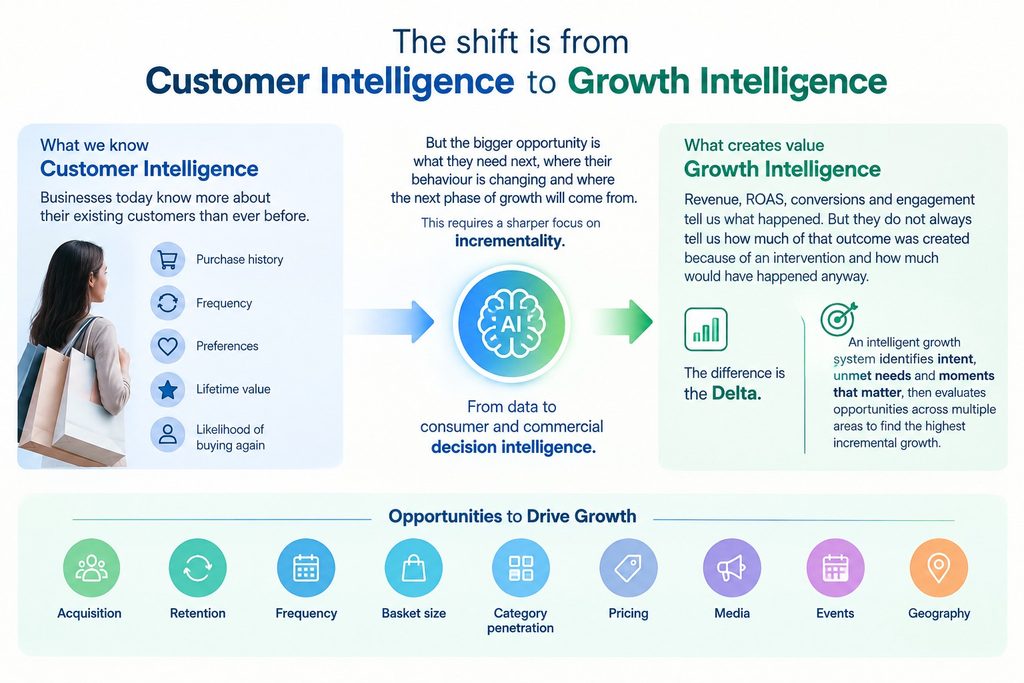
Revenue, ROAS, conversions and engagement tell us what happened. But they do not always tell us how much of that outcome was created because of an intervention and how much would have happened anyway.
That difference is the Delta. AI can help take CDPs beyond systems of customer intelligence and turn them into systems of consumer and commercial decision intelligence. Instead of simply identifying customers with a high propensity to purchase, an intelligent growth system could identify intent, unmet needs and moments that matter then evaluate opportunities across acquisition, retention, frequency, basket size, category penetration, pricing, media, events and geography to identify where the highest incremental growth opportunity lies.
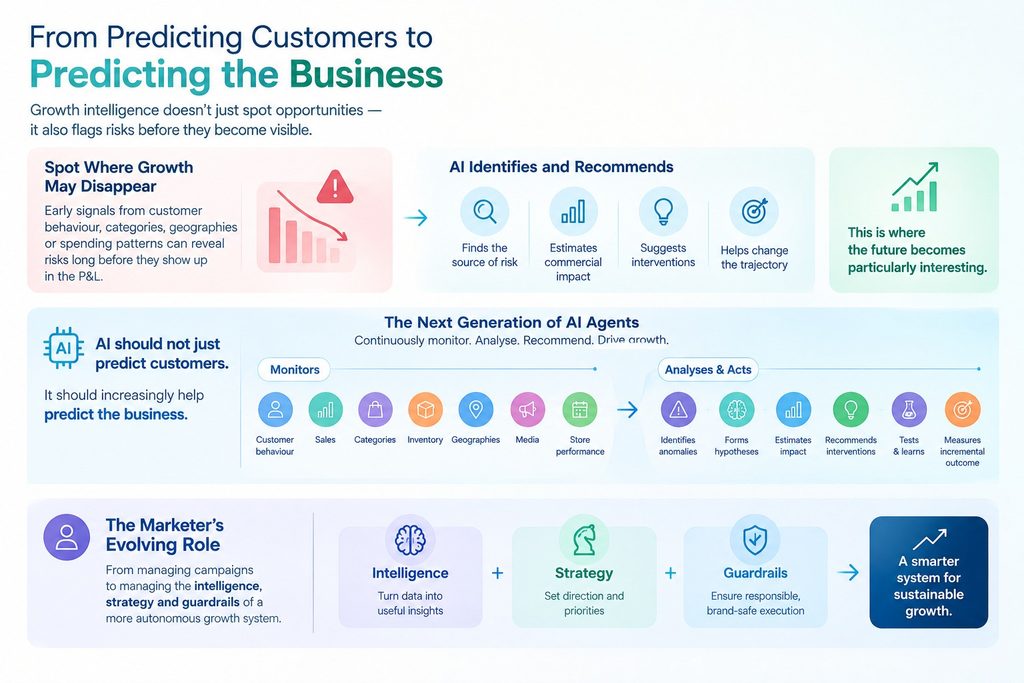
Growth intelligence should also help businesses identify where growth is likely to disappear. Early signals from customer behaviour, categories, geographies or spending patterns could reveal risks long before they become visible in the P&L. AI could identify the source of the risk, estimate its potential commercial impact and recommend interventions to change the trajectory. This is where the future becomes particularly interesting.
AI should not just predict customers. It should increasingly help predict the business.
The next generation of AI agents could continuously monitor customer behaviour, sales, categories, inventory, geographies, media and store performance. They could identify anomalies, form hypotheses, estimate commercial impact, recommend interventions, test them and measure the incremental outcome.
The role of the marketer would evolve from simply managing campaigns to managing the intelligence, strategy and guardrails around a more autonomous growth system.
This evolution can be built around three principles: Anticipate, Act and Account.
1. Anticipate where consumer needs and growth will emerge and where they may disappear.
2. Act by identifying and eventually executing the most relevant intervention for the consumer and the business.
3. Account for whether that intervention genuinely created incremental value.
The CDP of the future, therefore, should move beyond being a platform that simply manages customer data. It should become a Growth Decision Platform one that helps businesses understand consumers better, identify opportunities, detect risks, recommend actions, measure incrementality and continuously learn from every intervention. The ultimate measure of such a platform should not be the volume of data it manages.
It should be much simpler:
Show me the Delta you create.
Because ultimately, consumer centricity is not the opposite of growth. It is where sustainable growth begins.



Belgian Prime Minister Bart De Wever opens expanded HRD Antwerp laboratory in Mumbai

Verlas Introduces the ‘Alyssa’ Collection in India, Bringing Modern Luxe Floral-Inspired Design to Lab-Grown Diamond Jewelry Crafted in Fine Gold

Gold rebounds,Silver reclaims Rs 2.33 lakh mark

Limelight Lab Grown Diamonds Inaugurates Showroom In Kalyan, Its 8th Exclusive Store MMR
Verlas Introduces the ‘Alyssa’ Collection in India, Bringing Modern Luxe Floral-Inspired Design to Lab-Grown Diamond Jewelry Crafted in Fine Gold
Belgian Prime Minister Bart De Wever opens expanded HRD Antwerp laboratory in Mumbai
-
 National News3 days ago
Limelight Lab Grown Diamonds Inaugurates Showroom In Kalyan, Its 8th Exclusive Store MMR
-
 BrandBuzz2 days ago
Verlas Introduces the ‘Alyssa’ Collection in India, Bringing Modern Luxe Floral-Inspired Design to Lab-Grown Diamond Jewelry Crafted in Fine Gold
-
 DiamondBuzz2 days ago
Belgian Prime Minister Bart De Wever opens expanded HRD Antwerp laboratory in Mumbai
-

 National News2 days ago
Value Addition Drives August Jewellery Exports as Studded Gold Jewellery Rises 51.22% to US$642.85 Million
