

JB Insights
Jewellery machinery is vital investment for global competitiveness

JBExlusive
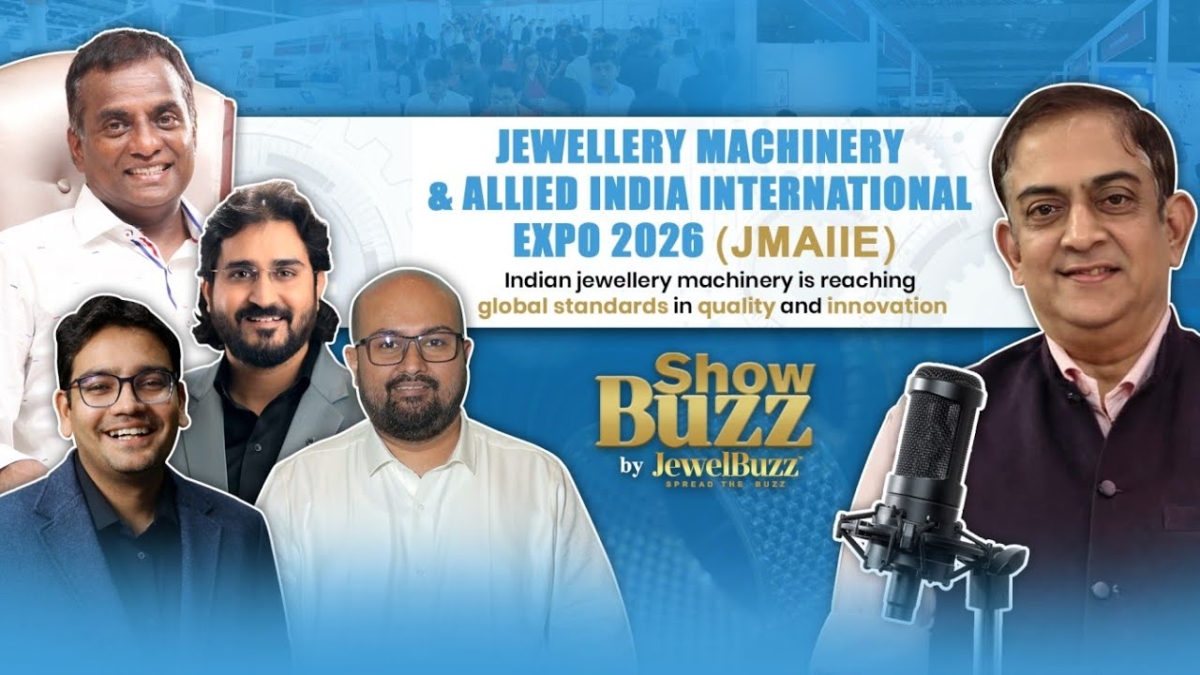
Jewel Buzz recently hosted a high-level panel featuring the titans of the jewelry manufacturing industry to discuss the significance of the JMAIIE 2026. The Panel of Stalwarts comprised :K Srinivasan: Chairman, Emerald Group,Dr. Chetan Kumar: CMD, Lakshmi Diamonds, Bengaluru Nitesh Jain, MD, Purple Jewels Private Limited,Nikhil Ranavat: Director, AR Gold Private Limited & Director, Swarnshilp Chains and Jewels Pvt Ltd
The discussion highlighted how technology is no longer an optional expense but a vital investment for global competitiveness. The importance of machinery was summed by said K Srinivasan: Investing in machinery is not an expenditure; it is an investment.
Key Objectives for JMAIIE 2026
The leaders identified several critical reasons for attending the expo, emphasizing that the “machinery-only” focus of JMAIIE allows for deep concentration without the distractions of finished jewelry.
- Technology Upgradation: K Srinivasan emphasized that with 41 years in the field, he views quality machinery as the foundation for working with all gold purities (from 9k to 22k) and silver. Continuous updating is required to stay relevant.
- Cost & Loss Reduction: Nikhil Ranawat pointed out that with rising gold prices, the priority is minimizing manufacturing losses. Even recovering an extra 1% of gold through better technology significantly impacts the bottom line.
- Weight & Aesthetics: Dr. Chetan Kumar noted the industry’s shift toward both ultra-lightweight and complex fashionable jewelry, both of which require advanced precision tools.
- Production Efficiency: Nitesh Jain highlighted the need for robust, “non-breakdown” machines to keep manufacturing costs low for the end consumer.
The State of “Make in India” Machinery
The panel offered a candid assessment of domestic vs. international machinery standards:
| Strengths of Indian Machinery | Areas for Improvement |
| Outstanding quality in Enameling, Casting Furnaces, and Buffing Machines. | Chain-making technology still lags behind global standards. |
| Excellence in CAD/CAM software and implementation. | Need for more robust, long-term durability to match Italian/Western builds. |
| High value-for-money and improving after-sales service. | Consistency in high-end finishing for luxury products. |
Future Outlook
The industry leaders called for a strategic shift to align with the Atmanirbhar Bharat (Self-Reliant India) vision.
- Technology Hubs: Dr. Chetan Kumar said government support was imperative and proposed the creation of a dedicated Technology Park for the jewelry industry where manufacturers and AI researchers can collaborate on new machinery.
- Skill Development: Nitesh Jain warned that high-tech machines are useless without a skilled workforce trained to operate them. A cultural shift from traditional handmade methods to tech-driven manufacturing is essential.
- Global Ambitions: With the conclusion of various FTAs (Free Trade Agreements), the panel believes that superior technology will allow India to truly become the “Jeweler to the World.”
Conclusion
JMAIIE 2026 stands as a pivotal platform for the industry. The consensus is clear: the future of Indian jewelry lies in the marriage of traditional hand-craftsmanship and cutting-edge technology.




By Invitation
India’s Next Decade in Jewellery Exports: Scale, Discipline & Global Positioning
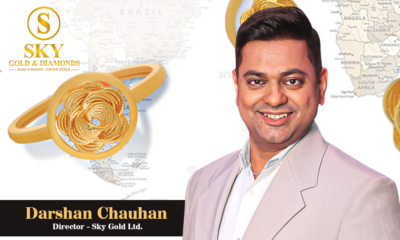
By Darshan Chauhan, Director –

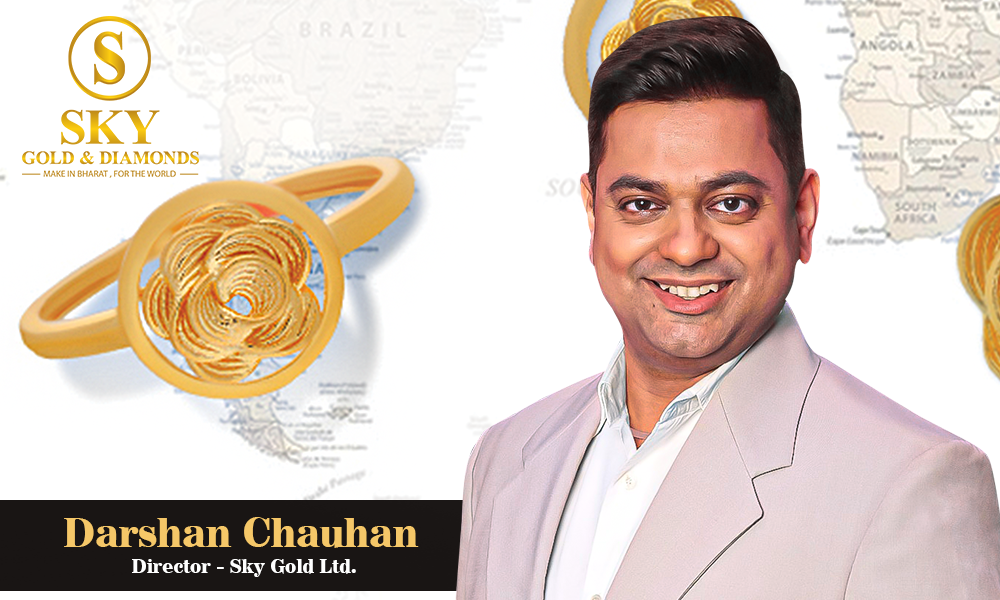
Sky Gold Ltd.
India’s jewellery export journey has been built on generations of craftsmanship, entrepreneurial resilience and an unmatched manufacturing ecosystem. From artisan-led workshops to technologically advanced facilities, the country has steadily earned global recognition as a reliable sourcing destination. Yet the coming decade represents a transition. The conversation is no longer only about producing more; it is about exporting smarter, operating with discipline and positioning India as a structured global partner rather than merely a manufacturing base.
The global jewellery trade itself is undergoing a quiet transformation. International buyers today evaluate suppliers through a wider lens. Design capability and competitive pricing remain important, but equal weight is now given to compliance, transparency, delivery consistency and financial stability. Export relationships are becoming long-term strategic partnerships rather than transactional buying arrangements.
For Indian exporters, this shift presents both an opportunity and a responsibility.
One of the most significant changes ahead will be market diversification. The United States has historically driven a substantial share of India’s jewellery exports, and it will continue to remain a vital market. However, concentration in a single geography exposes businesses to currency fluctuations, economic cycles and regulatory shifts. The Middle East has emerged as a strong growth corridor, supported by trade agreements, logistical advantages and evolving consumer demand. At the same time, regions such as Australia and parts of Europe are opening opportunities for exporters willing to meet higher compliance standards.
Diversification, therefore, is not about expanding aggressively into every market. It is about building balanced exposure that enhances stability while protecting margins.
Alongside geographic expansion, compliance is becoming a defining factor in global positioning. Responsible sourcing practices, traceability systems and governance standards are increasingly shaping procurement decisions. International brands are consolidating supplier networks and partnering with exporters who demonstrate reliability beyond production capability. In this environment, compliance should not be viewed as an external obligation. It strengthens credibility and enables access to premium markets where trust carries measurable value.
Equally important is capital discipline. Jewellery exports operate within a high-value commodity framework where gold price volatility directly impacts profitability. Elevated gold prices amplify the cost of inefficiencies, whether through excess inventory, unhedged exposure or extended payment cycles. Export growth in the coming decade will depend on closer alignment between procurement, treasury management and production planning. Structured hedging practices, bullion banking relationships and disciplined working capital management will increasingly separate stable exporters from vulnerable ones.
Manufacturing evolution will also play a central role. India already possesses scale; the next step is precision. Technology adoption, including CNC manufacturing, advanced prototyping and integrated digital production systems, enhances consistency while reducing wastage. Global buyers value predictability as much as creativity. When craftsmanship is supported by
process-driven manufacturing, India’s competitive advantage becomes far more compelling.
At the same time, India must gradually move beyond being perceived solely as a cost-competitive supplier. Countries that have successfully strengthened their global positioning have invested in design identity, innovation and long-term brand perception. Indian exporters have the opportunity to shift the narrative toward reliability, creativity and manufacturing excellence. Building deeper partnerships with international buyers, rather than focusing only on order volumes, will help achieve this transition.
Sustainability is emerging as another critical dimension of export strategy. Renewable energy adoption, responsible sourcing and environmental accountability are becoming key evaluation criteria in developed markets. These initiatives are not merely ethical considerations; they are risk-management tools that safeguard long-term market access. Exporters who align early with global sustainability expectations will find themselves better positioned as international standards continue to evolve.
Domestic retail trends are also influencing export direction more than before. The growing demand for lightweight, versatile jewellery in India mirrors changing consumer preferences globally. Faster design cycles and data-led product planning are reshaping manufacturing strategies. Exporters who remain closely connected to consumer behaviour both domestically and internationally gain stronger foresight into demand patterns.
The next decade of Indian jewellery exports will therefore be defined by alignment: scale supported by systems, creativity supported by discipline and growth supported by governance. India already has the foundation, skilled artisans, manufacturing depth and strong global relationships. The opportunity now lies in strengthening operational maturity.
If approached with clarity and intention, India can transition from being viewed primarily as the world’s jewellery workshop to being recognised as a trusted global partner in design, manufacturing and supply chain excellence. The future of exports will not depend solely on how much we produce, but on how confidently global markets rely on us.
In that shift lies the true potential of India’s next decade in jewellery exports.




Indriya unveils ‘Orizon’ at Lakmē Fashion Week X FDCI, in partnership with Amit Aggarwal

Ashth Prive’s New Udaya collection Turns the Geometry of Rani ki Vav into Radiant High Jewellery

Lukson Launches ‘Glitch Glam’ – A Bold New Collection Inspired by the Electric Energy of EDM Nights

IIJS Bharat Tritiya 2026 Wraps Up Triumphant 4th Edition, Connecting 15,000 Buyers with India’s Top Jewellery Manufacturers

Bhima Jewellery’s Theni Showroom Relaunched By Actress Aishwarya Lekshmi

India’s Next Decade in Jewellery Exports: Scale, Discipline & Global Positioning
-
 ShowBuzz1 day ago
IIJS Bharat Tritiya 2026 Wraps Up Triumphant 4th Edition, Connecting 15,000 Buyers with India’s Top Jewellery Manufacturers
-
 GlamBuzz1 day ago
Bhima Jewellery’s Theni Showroom Relaunched By Actress Aishwarya Lekshmi
-
 By Invitation1 day ago
India’s Next Decade in Jewellery Exports: Scale, Discipline & Global Positioning
-
 New Premises18 hours ago
PNG Jewellers intensifies retail strength with launch of its New Store in Varanasi by Madhuri Dixit
