By Invitation
How Divine Solitaires Restructured Strategy in FY’26 To Meet Growing Demand
By Jignesh Mehta, Founder and MD- Divine Solitaires


The 2026 fiscal year has been a defining year for Divine Solitaires, a turning point of sorts that posed several challenges but also opened new opportunities. It was a year that kept us on our toes and pushed us out of our comfort zone to rethink our business strategies and align with shifts in the market as well as in consumer expectations.
High gold prices, market fluctuations, demand and supply gaps, as well as a growing category of young, informed millennials with large disposable incomes and new design orders, have all collectively contributed to the demand for natural diamond solitaire jewellery in India.
Here’s a glimpse of what we achieved at Divine Solitaires in 2025-26:
Shifts in consumer sentiment
A new generation of affluent, well-informed buyers is reshaping the diamond market. Younger consumers increasingly research certification, compare value, and prioritise long-term worth over short-lived trends. Their demand for authenticity, transparency, and trust has strengthened confidence in certified natural solitaires, encouraging retailers to deliver clearer value propositions and more credible, seamless purchase experiences.

Growth in numbers
For Divine Solitaires, FY 25–26 was a year of disciplined growth and sharper execution. We hope to close the financial year with nearly 30–35% growth over the previous year, driven by strong partner trust and sustained consumer confidence. We continue to add over 1,500 customers every month, with more than 35% being first-time diamond buyers, a clear indicator that the category is expanding beyond its traditional audience.
Focus on innovation
A significant contributor to this growth momentum has been our continued focus on innovation within the natural diamonds space. We introduced the Intense and Vivid Yellow Diamonds and also saw growing interest for fancy diamond shapes like an oval or a pear. We delved deeper into smaller diamond sizes in 0.04 to 0.09 carats, which helped us improve overall profitability by over 30% compared to previous years. Rather than extracting short-term gains, we chose to reinvest these earnings into brand building and expansion, strengthening the foundation for long-term growth.
Omni-channel expansion
Today, Divine Solitaires is present across 215 stores in 108 cities, operating through a Shop-in-Shop model with some of the most reputed jewellers in each market. This approach has not only allowed us to remain accessible to our consumers living in Tier II/III and beyond cities but also helped us focus and gain expertise in a consumer-facing category that is still evolving in India. While nearly 95% of our sales continue to come from offline channels, we strongly believe that every purchase today is influenced by omni-channel touch points, with a strong digital presence playing an equally decisive role in building trust before the final in-store decision.
From big to smaller milestone celebrations
The year 2025 saw a notable expansion in the role of natural diamond solitaires as celebratory purchases. While weddings and engagements remained important drivers, consumers increasingly began marking everyday life milestones such as anniversaries, the birth of a child, new home purchases, career achievements, and self-gifting with solitaire diamonds. This trend gained visibility during festive periods like Dhanteras and through platforms such as the Solitaire Festival of India, where solitaires were positioned as symbols of life moments rather than mere jewellery.
Looking ahead, the Rs.25,000 crore solitaire diamond jewellery market in India is the fastest-growing segment within the gems and jewellery industry. As a focused brand in this category, our ambition is to build scale responsibly and increase our market share through strategic planning and execution of strategies. The value of natural diamonds has endured because of what they represent — trust, permanence, and emotional value. Divine Solitaires remains committed to building a resilient, value-driven business that evolves with consumers and partners.



By Shivaram A
The Core Issue
The owner carries the entire risk of the business — investment, gold stock, working capital, loans, everything is in their name. The long-term asset also belongs to the owner — reputation, brand, the customer base built over years, often meant to pass to the next generation. But the moment that matters most — when the customer is standing at the counter, when trust is being built or broken — that moment is entirely controlled by the staff.
The person with the most risk is not present at the decisive moment. And the person with the least to lose holds the most power in that moment. This structural mismatch creates frustration on both sides — and it’s rarely discussed openly.
Making the Conflict Explicit
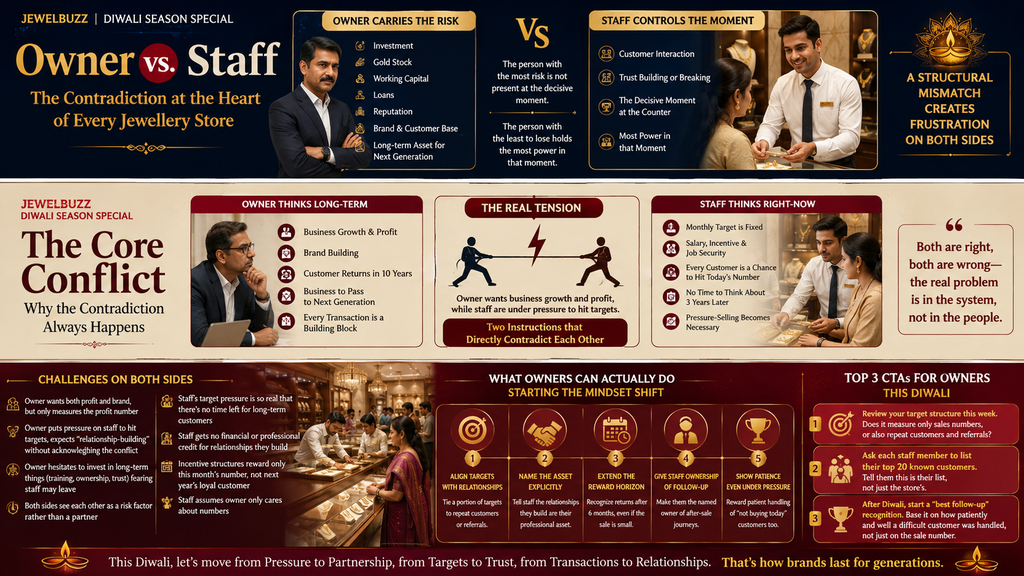
The real tension is this: the owner wants business growth and profit, while staff are under pressure to hit targets.
The owner thinks long-term — how does the brand grow, how does a customer come back after ten years, how does the business pass to the next generation. For the owner, every transaction is a building block toward something bigger.
The staff’s reality is completely different. Their monthly target is fixed. Their salary, incentive, and sometimes even job security depend on how much they sold this month, this Diwali. For staff, every customer is a chance to hit today’s number — right now, this moment. They cannot afford to think about whether this customer comes back in three years, because their performance is reviewed at month-end, not three years later.

So when the owner says “build the relationship, be patient,” and in the same breath increases the target by 20%, these two instructions directly contradict each other. Staff are not confused about what they should ideally do — they understand it perfectly. But they don’t have the choice. The target has to be met, so pressure-selling becomes necessary — even if it means pushing a customer slightly, or using lines like “buy today, rate will go up tomorrow” that create small cracks in trust.
These cracks don’t show up immediately. But after Diwali, when that customer doesn’t return a second time, the owner assumes it’s the staff’s fault. The staff believes the owner set an unrealistic target. Both are right, and both are wrong — because the real problem is in the system, not in the people.
The Challenges on Both Sides
- Owner wants both profit and brand, but only measures the profit number
- Owner puts pressure on staff to hit targets, then also expects “relationship-building” — without acknowledging the two often can’t coexist
- Owner hesitates to invest in long-term things (training, ownership, trust) due to fear that staff will leave anyway
- Staff’s target pressure is so real that there’s no time left to think about the long-term customer
- Staff gets no financial or professional credit for the relationships they build
- Incentive structures reward only this month’s number, not next year’s loyal customer
- Both sides see each other as a risk factor rather than a partner — the owner assumes staff will eventually leave, staff assumes the owner only cares about numbers
What Owners Can Actually Do — Starting the Mindset Shift
- Stop treating targets and relationships as separate — align them. Don’t set targets purely on sales numbers. Tie a small portion of the target to repeat customers or referrals, so staff know that long-term customers count too.
- Name the asset explicitly. Tell staff directly: the relationship you’re building with a customer is your professional asset, not just the store’s. This has to be shown in practice, not just said out loud.
- Extend the reward horizon. Don’t reward only Diwali-week sales — when a customer returns six months later and asks for that staff member by name, recognize that, even if the sale itself is small.
- Give staff ownership of the follow-up. Make each staff member the named owner of their customers’ after-sale journey — repairs, exchanges, the next occasion. This helps them feel the relationship is theirs, not just a transaction.
- Show patience even under pressure. If Diwali week only rewards closed sales, staff will only chase closing. If a staff member who handles a “not buying today” customer well is also appreciated, that’s when the mindset actually starts to shift — because staff notices what the owner actually rewards, not just what they say.
Top 3 CTAs for owners this Diwali
- Review your target structure this week. Does it only measure sales numbers, or does it also give weight to repeat customers and referrals? If not, try a small adjustment starting this Diwali.
- Ask each staff member to list their top 20 known customers. Tell them this is their list, not just the store’s. This builds a sense of ownership.
- After Diwali, start a “best follow-up” recognition. Base it not on the sale number, but on how patiently and well a difficult customer was handled. Staff need to see that patience is rewarded too, not just closing.
Shivaram A
Retail Gurukul



Gauri Khan in ZOYA High Jewellery Collection Her Again

DP Jewellers Emerges As The First Choice Of Millions Of Customers On The Auspicious Occasion Of Dhanteras

Augmont-NSE Partnership Drives Strong Start for India’s Gold EGR Market, with Over 1,60,357 Units Traded in First Few Hours

Dhanteras Gold Business Across India Estimated at Approximately ₹60,000 Crore – A Promising Start for the Jewellery Industry: GJC
Augmont-NSE Partnership Drives Strong Start for India’s Gold EGR Market, with Over 1,60,357 Units Traded in First Few Hours
Gauri Khan in ZOYA High Jewellery Collection Her Again
-
 JB Insights2 days ago
Dhanteras Gold Business Across India Estimated at Approximately ₹60,000 Crore – A Promising Start for the Jewellery Industry: GJC
-
 National News1 day ago
Augmont-NSE Partnership Drives Strong Start for India’s Gold EGR Market, with Over 1,60,357 Units Traded in First Few Hours
-
 BrandBuzz1 day ago
Gauri Khan in ZOYA High Jewellery Collection Her Again
-
 BrandBuzz1 day ago
DP Jewellers Emerges As The First Choice Of Millions Of Customers On The Auspicious Occasion Of Dhanteras