
International News
Geopolitical Flashpoints and Macro Crosswinds Keep Bullion Markets In Check AUGMONT BULLION REPORT
Gold Increasingly Rivaling US Treasuries As A Preferred Reserve Asset For Central Banks Globally, For The First Time In Decades


Gold prices slipped below $4,700 and silver below $80, retracing a portion of last week’s gains after President Trump publicly rejected Iran’s diplomatic response as “TOTALLY UNACCEPTABLE,” keeping inflationary concerns elevated. Tehran had proposed relocating part of its highly enriched uranium stockpile to a third country while refusing to dismantle its nuclear infrastructure — a position Washington found insufficient.
Geopolitical conditions deteriorated further over the weekend, with renewed cross-border attacks threatening to unravel the fragile ceasefire established in early April. US Central Command confirmed that American forces intercepted Iranian strikes and conducted defensive operations, while guided missile destroyers transited the Strait of Hormuz. The US subsequently reported sinking several Iranian vessels in the strait on Monday, as Iran escalated with fresh missile and drone strikes against the UAE. The Strait of Hormuz remains effectively closed, sustaining elevated energy prices and amplifying inflation risk globally.
Persistent inflationary pressure has reinforced expectations that central banks may tighten policy further — a headwind that typically weighs on precious metals. The April NFP report, released May 8, delivered a significant upside surprise: 177,000 jobs added against a consensus of 65,000, though below March’s 185,000, signaling a gradual cooling trajectory. The unemployment rate held at 4.3%. Rate cut expectations have shifted to late 2027 or early 2028, limiting dollar weakness and capping gold’s near-term upside.
On the USDINR front, currency markets were highly volatile, driven by crude oil dynamics. The rupee depreciated to record lows near 95.2 per dollar on May 7 following a 6% crude oil surge after Iran’s military escalation and a strike on a UAE oil facility. The move constrained capital inflows and triggered a surge in importer hedging activity. India’s physical gold demand has weakened sharply. Imports declined from approximately 100 tonnes in January to 65–66 tonnes in February, fell further to 20–22 tonnes in March, and are estimated at just 15 tonnes in April — among the lowest monthly readings in decades outside the Covid period.
Sentiment last week reflected a tug-of-war between safe-haven demand and the hawkish overlay from elevated energy prices. Analytically, the most notable shift in the pre-NFP environment is a structural repricing of gold: the metal has transitioned from a data-reactive asset to one driven by fiscal sustainability, monetary policy credibility, and sovereign reserve allocation. While Fed hawkishness remains a short-term constraint, 2026 has been defined by what analysts are calling “The Great Bullion Pivot” — gold increasingly rivaling US Treasuries as a preferred reserve asset for central banks globally, for the first time in decades.
Gold has been trading within a $4,500–$4,750 range (approximately ₹148K–₹154K). Having tested the upper boundary last week, profit-booking pressure may push prices back toward the lower end this week. Silver has been ranging between $71–$82 (approximately ₹235K–₹265K), and similarly, having touched the top of its range, a reversion toward support levels is likely in the near term.




International News
Gold Prices On Track To Reach $4,900/oz By End 2026 :Goldman Sachs
Goldman’s $4,900/oz Forecast Assumes Central Bank Demand Averages 50 Tonnes Per Month In 2026 and 40 Tonnes Per Month In 2027
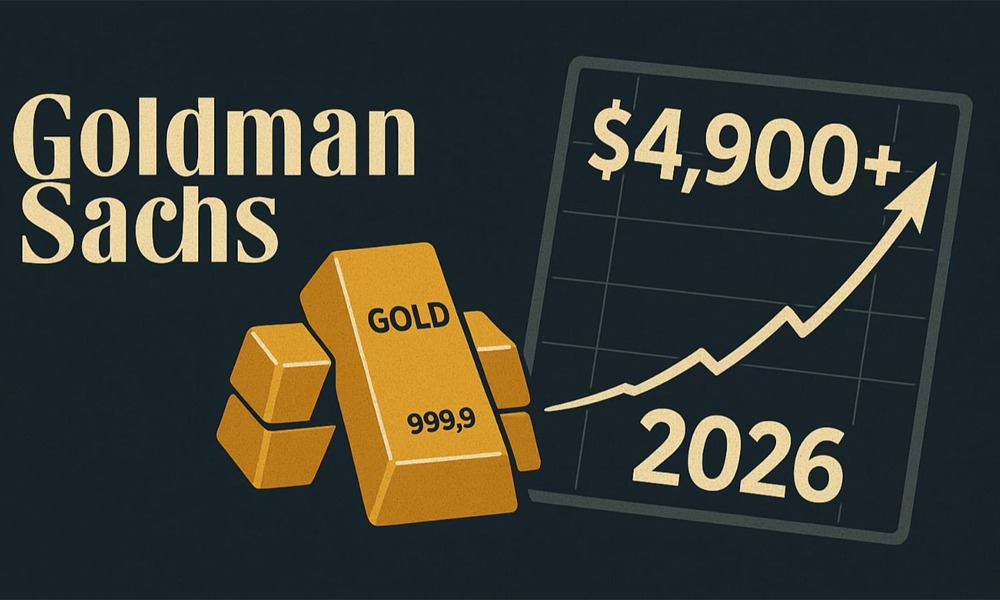
Gold prices are on track to reach $4,900 per ounce by the end of 2026, driven by aggressive central bank purchases—led by undisclosed buying from China—and recovering exchange-traded fund (ETF) demand, Goldman Sachs said in a research note.
The bank maintained its bullish base-case target for bullion while warning that positioning in options markets could amplify price volatility in both directions. Central banks accumulated an estimated 44 tonnes of gold in July, well above the pre-2022 monthly average of 17 tonnes, according to Goldman Sachs’ nowcast model. On a three-month seasonally adjusted basis, central bank buying stood at 91 tonnes per month.
China was the primary driver, with Goldman estimating the People’s Bank of China bought 35 tonnes in July—roughly 75% more than official public disclosures indicated.
To account for unreported sovereign purchases, Goldman’s model tracks physical bullion flows through London’s over-the-counter (OTC) market into custodian vaults. The Bank of England’s central bank holdings alone rose by 63 tonnes in July, exceeding outflows from the Federal Reserve Bank of New York.
Price Risks and Volatility
Goldman’s $4,900/oz forecast assumes central bank demand averages 50 tonnes per month in 2026 and 40 tonnes per month in 2027, alongside steady Federal Reserve policy and a rebound in private ETF inflows.
However, analysts noted that elevated demand for gold call options—used by investors to hedge against macroeconomic and geopolitical risks—creates mechanical upside and downside risks:
Bullish Case: Continued strong ETF inflows combined with existing call option positioning could force options dealers to buy underlying metal to hedge short exposure, pushing prices “well above” $4,900.
Bearish Case: If the Federal Reserve resumes interest rate hikes, unwinding hedge positions and triggering ETF outflows, gold could drop to $4,440/oz by end-2026. Goldman noted that ongoing central bank buying would limit further downside.
Goldman expects the Federal Reserve to remain on hold through 2026 as inflation cools, removing a key interest rate headwind for the non-yielding asset.


-

 Special Reports1 day ago
Growth of the 925 Sterling Silver Gifting Segment
-

 ShowBuzz1 day ago
TRENDS @ SSI DELHI 3RD EDITION
-

 JB Insights2 days ago
Devotion, Heritage & Diversification: The defining trends of SSI Delhi’s 3rd Edition
-

 JB Insights2 days ago
Gold-plated silver jewellery is seeing explosive growth
