
JB Insights
Gold Prices May Touch ₹1 Lakh in H2 2025 Amid Strong Investment Demand: ICICI Report

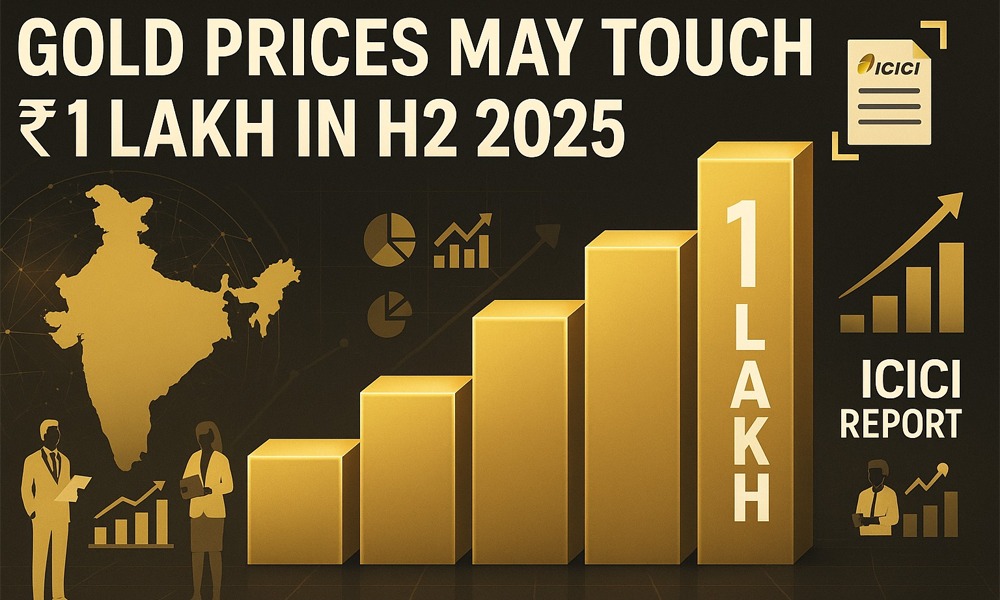
Gold prices in India are expected to trend higher in the second half of 2025, potentially reaching the ₹1,00,000 per 10 grams mark, according to a report by ICICI Bank Global Markets. Prices are currently trading in the range of ₹96,500 to ₹98,500 per 10 grams, but are forecasted to edge upward due to sustained investment demand and a mild depreciation in the Indian Rupee.
“Local gold prices are expected to continue trading with an upside bias, moving from a near-term range of ₹96,500–₹98,500 to the ₹98,500–₹100,000 range in H2 2025,” the report stated.
In June, domestic gold prices rose by 0.6% despite a global slowdown in momentum, supported by a 0.2% decline in the rupee. However, jewellery demand showed signs of weakening, with gold imports declining from USD 3.1 billion in April to USD 2.5 billion in May.
Investment demand, in contrast, remains strong. AMFI data showed net inflows of ₹2.92 billion into gold ETFs in May, following two months of outflows. Globally, SPDR Gold ETF holdings increased from 930 tonnes on June 1 to 948 tonnes by July 1, and speculative net long positions rose by 13,000 lots.
Despite gold’s YTD gains of 28%, prices have remained flat in recent weeks due to improving global risk sentiment. Key geopolitical developments, including a ceasefire between Israel and Iran and progress on U.S. trade agreements with the UK, Vietnam, Japan, India, and the EU, have eased safe-haven demand.
“The upshot is that easing geopolitical tensions and expectations that trade-war 2.0 could ease in magnitude have worked to limit further sharp upside emerging in gold prices,” the report noted.
While jewellery demand remains soft, strong investment-related buying continues to underpin the yellow metal’s upward momentum.







JB Insights
India’s Major Retail Jewelers See Double Digit Revenue Growth
Growth Points To Robust Momentum Ahead Of The Crucial Third-Quarter Holiday Season.


India’s major listed jewelers are shrugging off a shift in the traditional holiday shopping calendar, reporting revenue growth between 22% and 28% for the quarter ended September on the back of resilient consumer appetite and higher average customer spending.
Industry giants including Titan Co., Kalyan Jewellers India Ltd., P N Gadgil Jewellers Ltd., and PC Jeweller Ltd. posted broad-based sales gains in business updates to stock exchanges, pointing to robust momentum ahead of the crucial third-quarter holiday season.
The strong second-quarter numbers come despite a calendar quirk: Navratri, the nine-night festival that typically kicks off peak seasonal gold buying, fell in October this year rather than September. That shift is expected to push a significant volume of traditional holiday sales into the quarter ending in December.
Kalyan Jewellers posted a consolidated revenue increase of more than 26% year-over-year, buoyed by a 27% surge in its domestic operations and a 20% rise in same-store sales. Its international operations expanded 18%, while its digital lifestyle arm, Candere, saw sales jump 64%. The company noted that domestic operations maintained strong momentum even against a tough comparison from the year-ago period, when the entire Navratri festival landed in the second quarter.
The revenue growth reflects both steady store expansion and higher ticket sizes. At Tata Group-owned Titan Co., which operates the Tanishq and Zoya brands, total jewelry sales rose approximately 21%.
While buyer volume growth tracked in the mid-single digits, average spend per transaction rose by double digits. Sales of studded, higher-margin jewelry led the way with growth in the low 30s percentage range, outstripping a 20% gain in plain gold items. Titan’s digital-first brand, CaratLane, posted a 32% rise in sales.
Strategically, several retailers are intentionally pivoting away from low-margin bullion toward high-margin studded items and branded pieces. P N Gadgil Jewellers, which logged 22.4% overall revenue growth and a 31.1% gain in its core retail segment, saw e-commerce sales fall sharply by 83.6% after deliberately trimming back online sales of low-margin gold coins.
Consequently, gold coins and bars made up 15.8% of P N Gadgil’s retail revenue during the quarter, down from 23.3% a year earlier—a mix shift executives say will sustain higher profitability.
Meanwhile, Delhi-based PC Jeweller posted a consolidated revenue gain of roughly 28%, citing sustained underlying demand across key urban markets.
With fundamental demand holding firm despite elevated gold prices, market analysts expect the delayed start to the Hindu festive season to set up Indian jewelers for a particularly lucrative December quarter.


-

 National News1 hour ago
Precious Metal Futures Continued Their Downward Momentum
-

 JB Insights1 hour ago
India’s Major Retail Jewelers See Double Digit Revenue Growth
-

 DiamondBuzz1 hour ago
De Beers Cuts Diamond Production But Sees Sales Rise
-

 National News22 hours ago
BHIMA Jewellery Receives Prestigious IAGES Accreditation
