
JB Insights
Shaping Gem Enthusiasts for a Global Retail Reality: Inside GSI’s Colored Stone Program
By Ramit Kapur, Managing Director GSI India

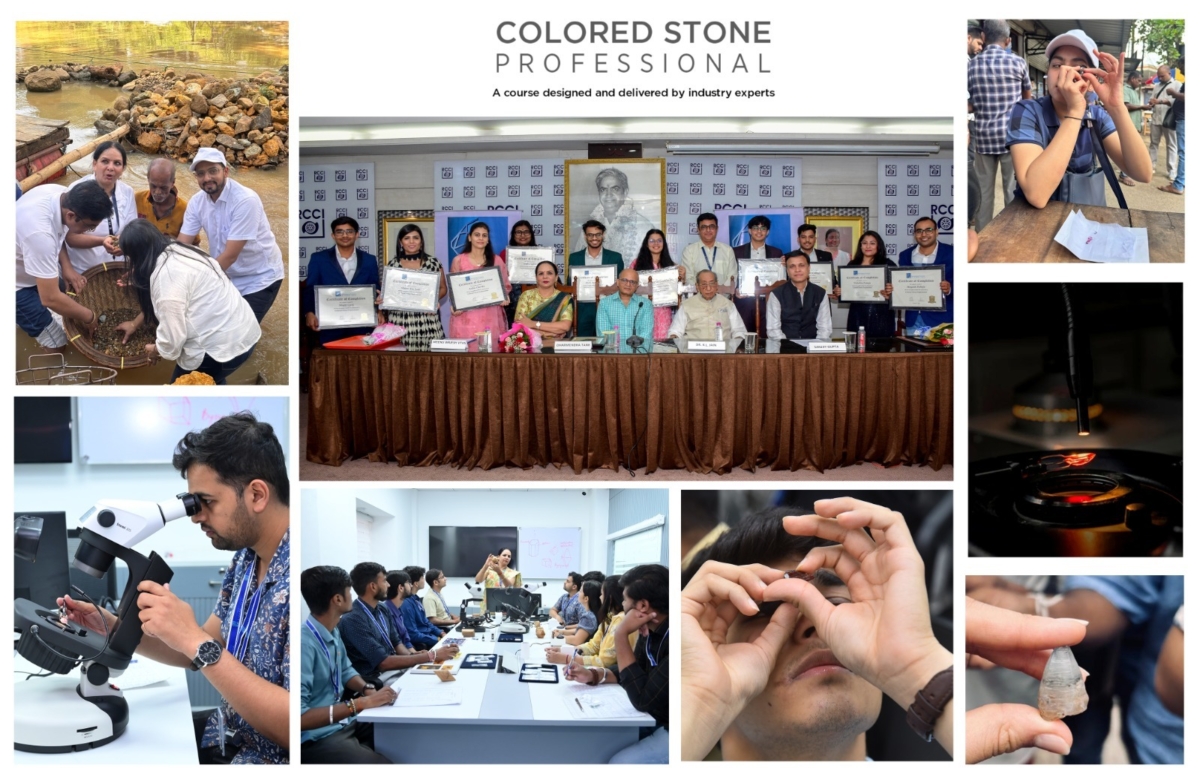
One of the recurring questions I hear from retailers, whether in the heart of Mumbai or in the luxury corridors of New York is this: Where do we find individuals who truly understand colored stones? Not just those who can name them or describe their appearance, but professionals who understand their essence. People who grasp quality, origin, treatments, pricing influences and most importantly, how all of it directly impacts customer trust and retail flow.
Too often, gemology education ends at surface-level theory. Students know the textbook answers but lack the confidence to apply that knowledge when faced with a real-world stone. That’s because being a gemological professional is never about just one thing; it’s a sum of many factors. Theory is essential, but without hands-on exposure, it stays abstract. Practical lab experience should be backed by a mindset that encourages critical thinking and pattern recognition. Add to that real-world exposure, problem-solving under pressure, and the ability to communicate insights clearly and you begin to shape someone truly capable.
A Lab-Driven Approach to Learning
That’s the exact gap GSI set out to address when we created the Colored Stone Professional (CSP) Diploma Program.
With our global expertise, advanced instrumentation, and access to live inventory, we are in a special position to build a course that doesn’t just skim the surface, but goes deeper, one that stands out in a sea of generic gemology programs. Our vision is to go beyond just another degree course and create professionals of the very standard we’d want to hire for our own labs: accurate, efficient, thoughtful. And once trained, whether they choose to become designers, sourcing leads, retail trainers, or full-time gemologists, the world becomes their oyster.
Our approach to this course is not purely academic. We built it from the inside out; as industry participants who live this work every day. GSI, as a global laboratory, examines gemstones daily from all major trading centers. Our experts are constantly updated; researching detection techniques, documenting treatment trends, and working with inventories that reflect the full range of market realities. With that vantage point, we are set to solve a real industry problem: the widening gap between gemological knowledge and real-world application.
The CSP Difference
I could write an entire book on why this course is different. And honestly, I can’t stress enough the value of learning from a global laboratory like GSI that is connected to daily realities across continents. That makes GSI a platform reflecting something much deeper than theory, it reflects practice, insight, and precision. So while I could list countless strengths of the Colored Stone Professional (CSP) Diploma, here are a few that I believe define its true character.
First, the practical exposure is unmatched. Students don’t just “learn” stones, they work with 800 gemstones across the span of the course. It’s a curriculum-integrated journey that helps them observe and identify inclusions, verify treatments, and understand what those treatments mean in real market conditions.
Then comes instrumentation. Students get the opportunity to attend advanced lab sessions, where they experience GSI’s state-of-the-art instrumentation firsthand, and understand its applicability. When they see how and why FTIR, UV-Vis, and advanced spectroscopy are used, they begin to appreciate the rigor behind every report.
We also take them to the source. Our mine visits aren’t just field trips. They’re reality checks. Students see rough material in its natural environment, understand how value begins at origin, and how supply chain complexities play out from mine to market. They grasp pricing at the root, not just from the price tag on a finished piece.
And finally, perspective. We bring in industry veterans for open sessions. These are not scripted lectures, they’re candid conversations. Students are encouraged to ask, challenge, and absorb insights from people who’ve spent decades in design, manufacturing, trading, and retail. The result is perspective rooted in reality.
International curriculum with a domestic blend.
The CSP diploma program has been carefully curated by some of the finest minds in the gem and jewelry world;not just in India, but globally. Our team includes global experts who ensure the curriculum remains current, rigorous, and industry-relevant across borders. It’s updated frequently to reflect the latest market realities, treatment discoveries, and sourcing challenges. The diploma itself is issued from our headquarters in New York, giving our graduates global credibility and recognition.
Through the CSP diploma program, we are building professionals who can sit across from a buyer and explain why two seemingly similar stones have a vast price difference, or why a particular origin commands a premium. That’s the kind of clarity that transforms retail experiences and builds trust. By the end of the program, every graduate stands at par with a fresher gemologist, equipped not only for technical positions but also to bring value in retail, sourcing, manufacturing, or design. In fact, designers who complete our program often find themselves pitching better, sourcing smarter, and delivering with far greater conviction.






JB Insights
India’s Major Retail Jewelers See Double Digit Revenue Growth
Growth Points To Robust Momentum Ahead Of The Crucial Third-Quarter Holiday Season.


India’s major listed jewelers are shrugging off a shift in the traditional holiday shopping calendar, reporting revenue growth between 22% and 28% for the quarter ended September on the back of resilient consumer appetite and higher average customer spending.
Industry giants including Titan Co., Kalyan Jewellers India Ltd., P N Gadgil Jewellers Ltd., and PC Jeweller Ltd. posted broad-based sales gains in business updates to stock exchanges, pointing to robust momentum ahead of the crucial third-quarter holiday season.
The strong second-quarter numbers come despite a calendar quirk: Navratri, the nine-night festival that typically kicks off peak seasonal gold buying, fell in October this year rather than September. That shift is expected to push a significant volume of traditional holiday sales into the quarter ending in December.
Kalyan Jewellers posted a consolidated revenue increase of more than 26% year-over-year, buoyed by a 27% surge in its domestic operations and a 20% rise in same-store sales. Its international operations expanded 18%, while its digital lifestyle arm, Candere, saw sales jump 64%. The company noted that domestic operations maintained strong momentum even against a tough comparison from the year-ago period, when the entire Navratri festival landed in the second quarter.
The revenue growth reflects both steady store expansion and higher ticket sizes. At Tata Group-owned Titan Co., which operates the Tanishq and Zoya brands, total jewelry sales rose approximately 21%.
While buyer volume growth tracked in the mid-single digits, average spend per transaction rose by double digits. Sales of studded, higher-margin jewelry led the way with growth in the low 30s percentage range, outstripping a 20% gain in plain gold items. Titan’s digital-first brand, CaratLane, posted a 32% rise in sales.
Strategically, several retailers are intentionally pivoting away from low-margin bullion toward high-margin studded items and branded pieces. P N Gadgil Jewellers, which logged 22.4% overall revenue growth and a 31.1% gain in its core retail segment, saw e-commerce sales fall sharply by 83.6% after deliberately trimming back online sales of low-margin gold coins.
Consequently, gold coins and bars made up 15.8% of P N Gadgil’s retail revenue during the quarter, down from 23.3% a year earlier—a mix shift executives say will sustain higher profitability.
Meanwhile, Delhi-based PC Jeweller posted a consolidated revenue gain of roughly 28%, citing sustained underlying demand across key urban markets.
With fundamental demand holding firm despite elevated gold prices, market analysts expect the delayed start to the Hindu festive season to set up Indian jewelers for a particularly lucrative December quarter.


-

 National News3 hours ago
Precious Metal Futures Continued Their Downward Momentum
-

 JB Insights2 hours ago
India’s Major Retail Jewelers See Double Digit Revenue Growth
-

 DiamondBuzz2 hours ago
De Beers Cuts Diamond Production But Sees Sales Rise
-
 National News23 hours ago
BHIMA Jewellery Receives Prestigious IAGES Accreditation
