By Invitation
Gems Embodying Republic Day Spirit: Symbolism and Significance
By – Sumit Dassani, Partner at Dassani Brothers


As we enter a time of celebrations with weddings, festivities, and Republic Day, there’s a buzz of excitement. This season brings not just joy but also some great deals. If you’re considering adding exquisite jewellery to your collection, now is the opportune moment. Dassani Brothers, recognising the significance of Republic Day, are ensuring to uphold the spirit of the occasion by meticulously curating an exclusive collection of necklaces, ensuring each piece is crafted with precision.
Whether going to parties or special events, wearing jewellery is a great way to show your style. Let’s explore the meaning behind gems, adding a classy and patriotic touch to your collection.

1. Timeless Elegance Embodied in Rice Pearl and Round Diamond Polki Choker: If you have minimal taste, this stunning choker adorned with syndicate quality polki, round brilliant cut diamonds, emerald cut, tanzanite cut, orange coral beads, and rice pearls is for you. This exquisite piece is meticulously crafted in 18kt gold, and the inclusion of vibrant green emeralds makes it an ideal choice for a Republic Day celebration.

2. Radiant Glamour in Emerald and Tanzanite Polki Fusion Choker and Exquisite Earrings: Captivating at first glance, this neckpiece is crafted with syndicate quality polki, round brilliant cut diamonds, emerald cut, tanzanite cut, emerald beads, and rice pearls. Fashioned in 18kt gold, the exquisite set features delicately designed lotus motifs gracefully suspended on pearl strings. Complementing this set are matching earrings that epitomise elegance, adding a touch of sophistication to the wearer’s ensemble. This set is a true statement of refined craftsmanship and timeless beauty.

3. Royal Essence: Emerald Cabochon and Rice Pearl Polki Elegance Choker Adorned with Intricate Details: Elevate your ensemble with this exquisite piece, perfect for pairing with formals or semi-formals. Adorned with syndicate quality polki, round brilliant cut diamonds, emerald cabochon, emerald beads, and rice pearls, this crafted-in-18kt-gold masterpiece exudes sophistication. The intricately designed floral pattern pays homage to the spokes of the Ashoka Chakra, making it a flawless choice for your Republic Day shopping. Enhance your look with this refined blend of elegance and patriotic spirit.

4. Timeless Beauty Ensemble: Polki Ruby and Diamond Pendant Gracefully Paired with a Cultured Pearl Chain: For those seeking a lighter option, this cultured pearl chain with a stunning pendant is an excellent choice. The pendant is adorned with a delightful mix of syndicate quality polki, round brilliant cut diamonds, emerald cabochon, tanzanite cut, ruby cut, tanzanite beads, tourmaline mani, emerald beads, and cultured pearls – all elegantly crafted in 18kt gold. This piece is a beautiful mix of precious gems and intricate design, making it an exceptional addition to your collection. Its light and graceful presence adds a touch of sophistication to any ensemble.
As you shop for your favourite jewellery and designs this Republic Day, Dassani Brothers transform each gem into a storyteller. This collection celebrates diverse beauty, from the decadent allure of rubies and emeralds to the timeless elegance of pearls and diamonds and the unique charm of tanzanite and tourmalines. With a commitment to artistic finesse and skilled precision, they ensure that every piece of jewellery becomes a masterpiece—priceless and unique.










By Shivaram A
The Core Issue
The owner carries the entire risk of the business — investment, gold stock, working capital, loans, everything is in their name. The long-term asset also belongs to the owner — reputation, brand, the customer base built over years, often meant to pass to the next generation. But the moment that matters most — when the customer is standing at the counter, when trust is being built or broken — that moment is entirely controlled by the staff.
The person with the most risk is not present at the decisive moment. And the person with the least to lose holds the most power in that moment. This structural mismatch creates frustration on both sides — and it’s rarely discussed openly.
Making the Conflict Explicit
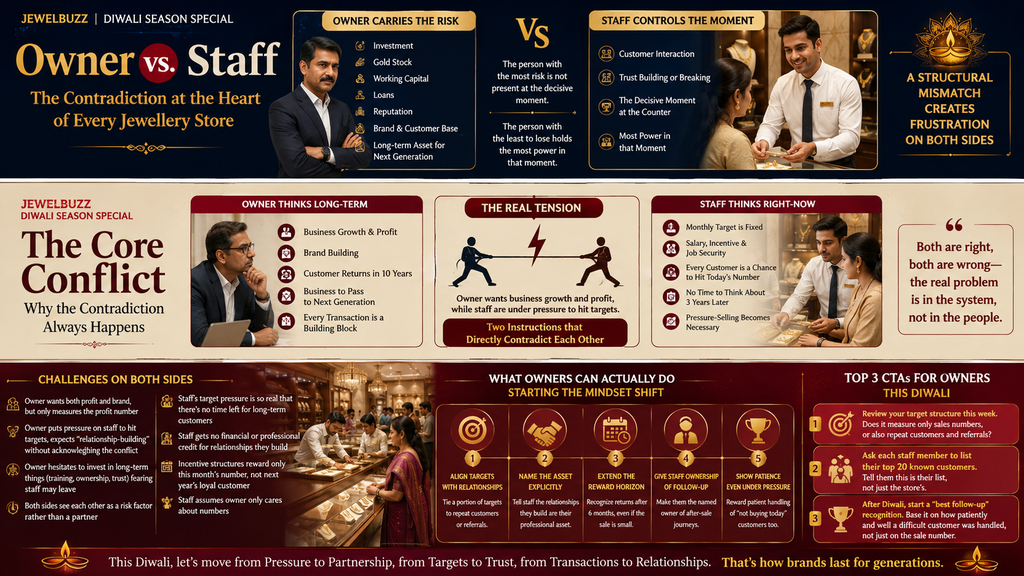
The real tension is this: the owner wants business growth and profit, while staff are under pressure to hit targets.
The owner thinks long-term — how does the brand grow, how does a customer come back after ten years, how does the business pass to the next generation. For the owner, every transaction is a building block toward something bigger.
The staff’s reality is completely different. Their monthly target is fixed. Their salary, incentive, and sometimes even job security depend on how much they sold this month, this Diwali. For staff, every customer is a chance to hit today’s number — right now, this moment. They cannot afford to think about whether this customer comes back in three years, because their performance is reviewed at month-end, not three years later.

So when the owner says “build the relationship, be patient,” and in the same breath increases the target by 20%, these two instructions directly contradict each other. Staff are not confused about what they should ideally do — they understand it perfectly. But they don’t have the choice. The target has to be met, so pressure-selling becomes necessary — even if it means pushing a customer slightly, or using lines like “buy today, rate will go up tomorrow” that create small cracks in trust.
These cracks don’t show up immediately. But after Diwali, when that customer doesn’t return a second time, the owner assumes it’s the staff’s fault. The staff believes the owner set an unrealistic target. Both are right, and both are wrong — because the real problem is in the system, not in the people.
The Challenges on Both Sides
- Owner wants both profit and brand, but only measures the profit number
- Owner puts pressure on staff to hit targets, then also expects “relationship-building” — without acknowledging the two often can’t coexist
- Owner hesitates to invest in long-term things (training, ownership, trust) due to fear that staff will leave anyway
- Staff’s target pressure is so real that there’s no time left to think about the long-term customer
- Staff gets no financial or professional credit for the relationships they build
- Incentive structures reward only this month’s number, not next year’s loyal customer
- Both sides see each other as a risk factor rather than a partner — the owner assumes staff will eventually leave, staff assumes the owner only cares about numbers
What Owners Can Actually Do — Starting the Mindset Shift
- Stop treating targets and relationships as separate — align them. Don’t set targets purely on sales numbers. Tie a small portion of the target to repeat customers or referrals, so staff know that long-term customers count too.
- Name the asset explicitly. Tell staff directly: the relationship you’re building with a customer is your professional asset, not just the store’s. This has to be shown in practice, not just said out loud.
- Extend the reward horizon. Don’t reward only Diwali-week sales — when a customer returns six months later and asks for that staff member by name, recognize that, even if the sale itself is small.
- Give staff ownership of the follow-up. Make each staff member the named owner of their customers’ after-sale journey — repairs, exchanges, the next occasion. This helps them feel the relationship is theirs, not just a transaction.
- Show patience even under pressure. If Diwali week only rewards closed sales, staff will only chase closing. If a staff member who handles a “not buying today” customer well is also appreciated, that’s when the mindset actually starts to shift — because staff notices what the owner actually rewards, not just what they say.
Top 3 CTAs for owners this Diwali
- Review your target structure this week. Does it only measure sales numbers, or does it also give weight to repeat customers and referrals? If not, try a small adjustment starting this Diwali.
- Ask each staff member to list their top 20 known customers. Tell them this is their list, not just the store’s. This builds a sense of ownership.
- After Diwali, start a “best follow-up” recognition. Base it not on the sale number, but on how patiently and well a difficult customer was handled. Staff need to see that patience is rewarded too, not just closing.
Shivaram A
Retail Gurukul



Malabar Gold & Diamonds Unveils ‘SWAYE’, A Natural Diamond Collection Inspired By Spiral Forms and Modern Elegance

Nike Enters Jewellery Market With First-Ever Collection Priced Up To $5,750

Kylie Jenner Debuts At Victoria’s Secret Show In $50 Million Fantasy Bra By Jacob & Co.

Limelight Lab Grown Diamonds Crosses 100 Stores Milestone This Dussehra: Targets 200 In 2027
Kylie Jenner Debuts At Victoria’s Secret Show In $50 Million Fantasy Bra By Jacob & Co.
Nike Enters Jewellery Market With First-Ever Collection Priced Up To $5,750
-
 National News2 days ago
Limelight Lab Grown Diamonds Crosses 100 Stores Milestone This Dussehra: Targets 200 In 2027
-
 DiamondBuzz1 hour ago
Kylie Jenner Debuts At Victoria’s Secret Show In $50 Million Fantasy Bra By Jacob & Co.
-
 International News50 minutes ago
Nike Enters Jewellery Market With First-Ever Collection Priced Up To $5,750
-
 BrandBuzz32 minutes ago
Malabar Gold & Diamonds Unveils ‘SWAYE’, A Natural Diamond Collection Inspired By Spiral Forms and Modern Elegance