
By Invitation
Five social media-inspired trends that are pushing diamond sales
By Jignesh Mehta-Founder & Managing Director, Divine Solitaires


There was a time when traditionally, buying diamond jewellery was reserved for those special occasions when the entire family walked into a trusted jeweller’s store once in a year for weddings, anniversaries, and those once-a-year moments.
Today, the name of the game has changed and how! Thanks to the power of social media, diamonds are no longer just tucked away in lockers waiting for that one occasion to sparkle. You see the flash of a diamond every day, be it during daily conversations, when you’re travelling to and from work, and even when you’re chilling at home with friends.
The younger generation—new brides, working professionals, millennials, and Gen Z—are rewriting the rulebook. What was once considered a milestone buy has now become a symbol of personal style, celebration, and aspirational luxury.
At Divine Solitaires, we’ve watched this shift closely and can clearly see how these five social media-driven trends are inspiring today’s generation to own their diamonds, literally too!
1. Proposals and Love Stories that Melt Hearts
We’ve all seen those dreamy proposal reels and wedding moments—filled with raw emotion, happy tears, and the kind of love that feels straight out of a fairytale. But beyond the grand gestures and picture-perfect settings, there’s one detail that stands as a lasting symbol of that forever moment: the diamond! A solitaire isn’t just a ring—it represents the start of journey when two lives changed forever. Every time you watch a social media reel that captures all these emotions, you want your own diamond story too!
2. The Rise of ‘Everyday Diamonds’
In a country with such a large young population, you can be assured that the market dynamics are driven by the youth! Youngsters today don’t believe in saving diamonds only for a handful of days a year. We’re seeing a growing trend where people wear their solitaires daily—to work, brunches, and even on coffee runs, because why not? If everyone else is doing it and making it look so goon on their social media handles, you can too! FOMO is a real thing!
3. Sharing Personal Milestones
Whether it’s a job promotion, a first home, or even just celebrating oneself—people now buy diamonds to mark every small or big personal victory. The celebratory allure of diamonds has that effect. This mindset has shifted buying behaviour tremendously. Diamonds are no longer a ‘gift from someone else’ but a powerful symbol of self-love.
4. Conscious Choices and Meaningful Purchases
Transparency matters more than ever for the young, very aware generation who makes informed purchases, no matter what they buy. It’s encouraging to see the conversations around ethically sourced, conflict-free diamonds, trending. Social media has ensured people ask the right questions— ‘Where did this diamond come from?’ and ‘What does this stone represent?’ As a brand that’s always believed in ethical sourcing, we welcome this change. People now buy diamonds with pride, knowing they stand for both beauty and responsibility.
5. Peer Influence and Social Proof
Let’s admit it—we all read reviews before we go in for the kill and are constantly tracking what our idols friends or peers are buying. Honest testimonials, real customer stories, and shared experiences have become the new word of mouth marketing. When someone sees a friend or a peer buying a beautiful solitaire and sharing their journey, it sparks desire and trust. That’s the power of social proof, and it’s making diamonds more approachable than ever.
At Divine Solitaires, we’re inspired by how today’s generation connects with diamonds at such a personal level every single day!










By Shivaram A
The Core Issue
The owner carries the entire risk of the business — investment, gold stock, working capital, loans, everything is in their name. The long-term asset also belongs to the owner — reputation, brand, the customer base built over years, often meant to pass to the next generation. But the moment that matters most — when the customer is standing at the counter, when trust is being built or broken — that moment is entirely controlled by the staff.
The person with the most risk is not present at the decisive moment. And the person with the least to lose holds the most power in that moment. This structural mismatch creates frustration on both sides — and it’s rarely discussed openly.
Making the Conflict Explicit
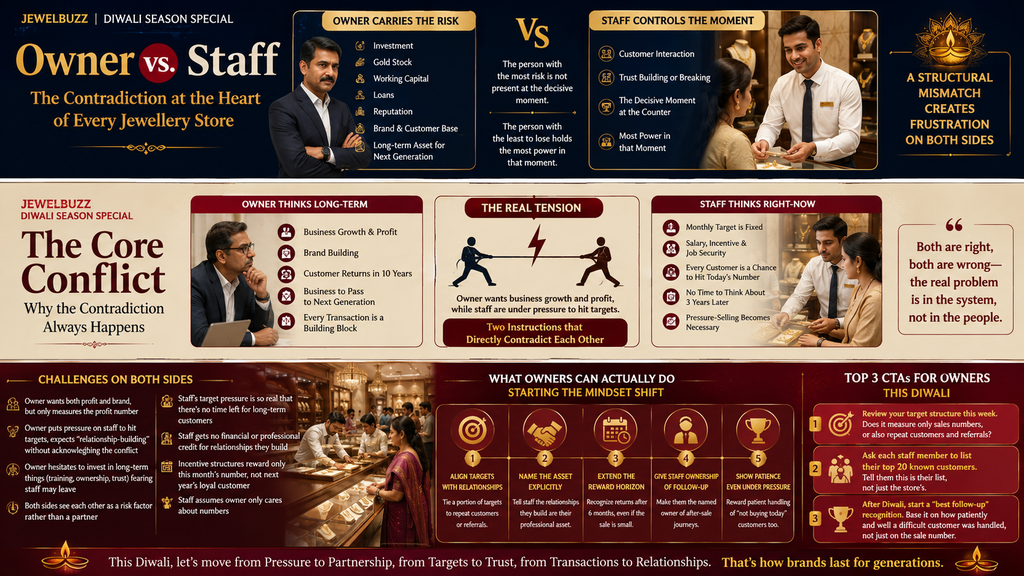
The real tension is this: the owner wants business growth and profit, while staff are under pressure to hit targets.
The owner thinks long-term — how does the brand grow, how does a customer come back after ten years, how does the business pass to the next generation. For the owner, every transaction is a building block toward something bigger.
The staff’s reality is completely different. Their monthly target is fixed. Their salary, incentive, and sometimes even job security depend on how much they sold this month, this Diwali. For staff, every customer is a chance to hit today’s number — right now, this moment. They cannot afford to think about whether this customer comes back in three years, because their performance is reviewed at month-end, not three years later.

So when the owner says “build the relationship, be patient,” and in the same breath increases the target by 20%, these two instructions directly contradict each other. Staff are not confused about what they should ideally do — they understand it perfectly. But they don’t have the choice. The target has to be met, so pressure-selling becomes necessary — even if it means pushing a customer slightly, or using lines like “buy today, rate will go up tomorrow” that create small cracks in trust.
These cracks don’t show up immediately. But after Diwali, when that customer doesn’t return a second time, the owner assumes it’s the staff’s fault. The staff believes the owner set an unrealistic target. Both are right, and both are wrong — because the real problem is in the system, not in the people.
The Challenges on Both Sides
- Owner wants both profit and brand, but only measures the profit number
- Owner puts pressure on staff to hit targets, then also expects “relationship-building” — without acknowledging the two often can’t coexist
- Owner hesitates to invest in long-term things (training, ownership, trust) due to fear that staff will leave anyway
- Staff’s target pressure is so real that there’s no time left to think about the long-term customer
- Staff gets no financial or professional credit for the relationships they build
- Incentive structures reward only this month’s number, not next year’s loyal customer
- Both sides see each other as a risk factor rather than a partner — the owner assumes staff will eventually leave, staff assumes the owner only cares about numbers
What Owners Can Actually Do — Starting the Mindset Shift
- Stop treating targets and relationships as separate — align them. Don’t set targets purely on sales numbers. Tie a small portion of the target to repeat customers or referrals, so staff know that long-term customers count too.
- Name the asset explicitly. Tell staff directly: the relationship you’re building with a customer is your professional asset, not just the store’s. This has to be shown in practice, not just said out loud.
- Extend the reward horizon. Don’t reward only Diwali-week sales — when a customer returns six months later and asks for that staff member by name, recognize that, even if the sale itself is small.
- Give staff ownership of the follow-up. Make each staff member the named owner of their customers’ after-sale journey — repairs, exchanges, the next occasion. This helps them feel the relationship is theirs, not just a transaction.
- Show patience even under pressure. If Diwali week only rewards closed sales, staff will only chase closing. If a staff member who handles a “not buying today” customer well is also appreciated, that’s when the mindset actually starts to shift — because staff notices what the owner actually rewards, not just what they say.
Top 3 CTAs for owners this Diwali
- Review your target structure this week. Does it only measure sales numbers, or does it also give weight to repeat customers and referrals? If not, try a small adjustment starting this Diwali.
- Ask each staff member to list their top 20 known customers. Tell them this is their list, not just the store’s. This builds a sense of ownership.
- After Diwali, start a “best follow-up” recognition. Base it not on the sale number, but on how patiently and well a difficult customer was handled. Staff need to see that patience is rewarded too, not just closing.
Shivaram A
Retail Gurukul



Joyalukkas Opens ‘Jewel Of Joy,’ The Biggest jewellery Destination In The Middle East’s At Dubai Gold District.

PNG Jewellers Brings Madhuri Dixit and Ranbir Kapoor Together In Its New Brand Campaign, Unstoppable Legacy

GJEPC, IndusInd Bank Host Webinar On FEMA Guidelines For GJ Exporters

US Holiday Shopping Expected To Top $1 Trillion For The First Time: NRF
Joyalukkas Opens ‘Jewel Of Joy,’ The Biggest jewellery Destination In The Middle East’s At Dubai Gold District.
GJEPC, IndusInd Bank Host Webinar On FEMA Guidelines For GJ Exporters
-
 International News9 hours ago
US Holiday Shopping Expected To Top $1 Trillion For The First Time: NRF
-
 New Premises5 hours ago
Joyalukkas Opens ‘Jewel Of Joy,’ The Biggest jewellery Destination In The Middle East’s At Dubai Gold District.
-
 National News8 hours ago
GJEPC, IndusInd Bank Host Webinar On FEMA Guidelines For GJ Exporters
-
 BrandBuzz6 hours ago
PNG Jewellers Brings Madhuri Dixit and Ranbir Kapoor Together In Its New Brand Campaign, Unstoppable Legacy
