JB Insights
Dr Chetan Kumar Mehta awarded Youth Icon – Jewellery Industry by JDIFT

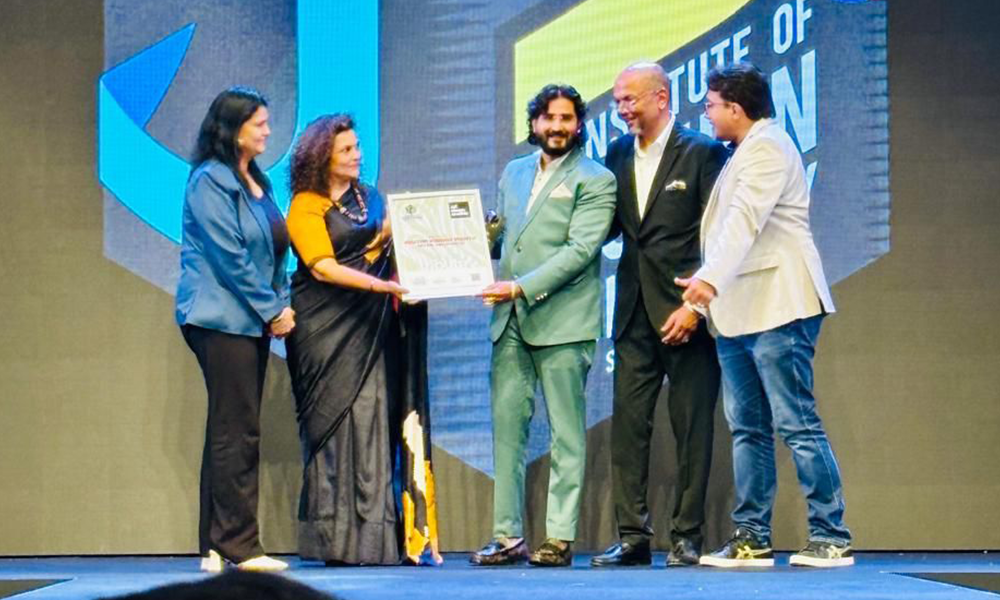
Dr Chetan Kumar Mehta, CMD- Laxmi Diamonds, Bengaluru, was awarded Youth Icon – Jewellery Industry by JD Institute of Fashion Technology, Mumbai.
The award was presented by Yogesh Dalal and Payal Dalal – Partners JD Institute of Fashion Technology, Mumbai, Rahul Desai, CEO-IIG and Gunjan Sapra, COO- IIG.







JB Insights
Jewellery retailers’ Backward Integration Into Jewellery Manufacturing Strategy To Secure Design, Quality, Cost and Delivery Control.

By Steve Fernandes
Indian jewellery retailers are moving into manufacturing to secure design, quality, cost and delivery control. PNG Jewellers’ proposed diamond-and-gold manufacturing subsidiary is the latest example.
1. Why Retailers Integrate Backward
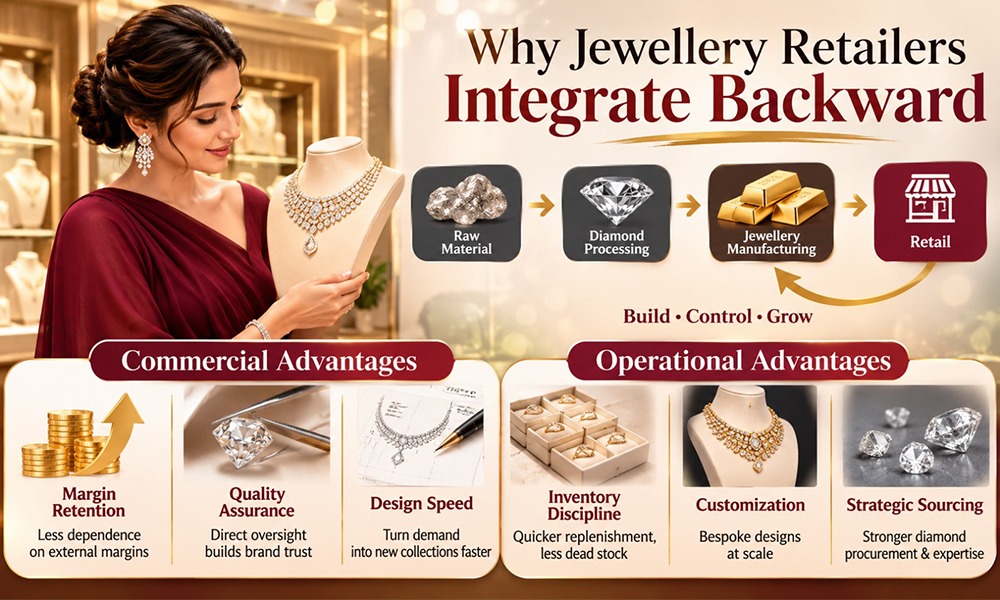
Backward integration means a retailer builds or acquires capability earlier in its value chain, here jewellery manufacturing, rather than relying solely on third-party suppliers. The commercial logic rests on margin capture, differentiation and supply-chain resilience.
1.1 Commercial Advantages
- Margin retention: Less dependence on external conversion margins; better control of product cost.
- Quality assurance: Direct oversight of diamond setting, gold purity, finishing and hallmarking protects brand trust.
- Design speed: Store-level demand signals convert into new collections faster than vendor production calendars allow.
1.2 Operational Advantages
- Inventory discipline: Quicker replenishment of fast sellers; less dead stock in slow-moving SKUs.
- Customization: A captive base supports bespoke, bridal, regional and occasion-led jewellery at scale.
- Strategic sourcing: Stronger diamond procurement, grading and polishing expertise, covering both natural and lab-grown stones.
2. PNG Jewellers: The Move
2.1 Deal Structure
- Structure: Proposed 76%-owned subsidiary for diamond and gold jewellery manufacturing; initial investment of up to Rs 10 crore.
- Partners: Operational partners bring 27 years of technical experience, including cutting and polishing.
- Control with incentive: PNG keeps majority ownership and strategic direction, while the minority stake aligns partners with quality and execution.
2.2 Strategic Fit
- Not a standing start: PNG already has retail reach, a design portfolio and diamond-procurement capability.
- Northern push: Studded jewellery holds a higher market share in several northern states, so assured design range supports expansion there.
- Phased rollout: Validates asset acquisition, production quality, design acceptance and working capital before scaling.
3. How the Majors Compare
PNG’s announcement fits a broader pattern: vertically integrated players combine retail distribution with manufacturing, design and sourcing to create a more controllable value chain.
3.1 Integration Models at a Glance
| Retailer | Model | Highlights |
| Titan / Tanishq | Mature, integrated | Factories at Hosur and Pantnagar; stone-sourcing in Surat and Jaipur; product-development centre in Mumbai; mix of in-house plants, karigar centres and vendors. |
| Malabar Gold & Diamonds | Fully vertical | 15 manufacturing units across five countries and 14 wholesale units in eight. Hyderabad facility integrates design, refining, manufacturing, QA, hallmarking and warehousing; capacity above 4.7 tonnes of gold jewellery and 1.8 lakh carats of diamond jewellery. |
| Kalyan Jewellers | Hybrid | Consolidated manufacturing plus long-term contract manufacturers, supporting a franchise-led retail network. |
| Senco Gold | Regional | Senco Gold Artisanship Pvt. Ltd. preserves Eastern India design identity and supply reliability. |
| PNG Jewellers | Capital-light entry | Majority control with experienced partners; sits between Titan’s integration and Kalyan’s hybrid approach. |
3.2 Key Lesson
Integration need not mean owning everything. Retailers can balance control and flexibility:
- Captive capacity for high-value, design-sensitive, fast-turning products.
- Third-party vendors for overflow, seasonality and lower-complexity lines.
4. Success Factors for PNG
4.1 Execution Priorities
- Start with studded jewellery, where design and quality control matter most.
- Use capacity selectively, retaining external vendors for overflow and regional specialities.
- Build strong governance around diamond procurement, transfer pricing, capacity allocation and quality standards.
4.2 Scaling Discipline
- Prove unit economics before scaling: yield, rejection rates, labour productivity, inventory turns, delivery reliability.
- Link production to retail data, so store-level and regional demand drives designs, not factory capacity.
5. Bottom Line
KEY TAKEAWAY Controlling more of the value chain improves responsiveness and margin capture, but only when manufacturing is tightly tied to merchandising, quality systems and working-capital discipline.


-

 New Premises22 hours ago
From White Gold to Sterling Silver: Gargi by PNGS Opens Its 51st Store in Akola
-

 National News4 hours ago
World Gold Council – India Gold Market Update
-
 National News5 hours ago
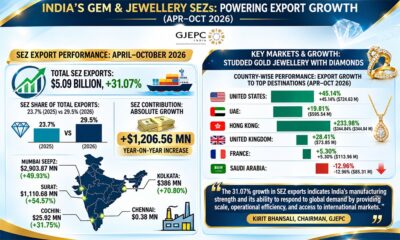
GJ Exports Through SEZs Registered An Impressive 31.07% Year-On-Year Growth
-

 JB Insights1 day ago
Redefining Fine Jewellery: How Technological Innovation, Haute Couture Synergy, and Avant-Garde Palettes Are Shaping The Festive & Wedding Season