By Invitation
Harness the power of AI in your retail jewellery business
Sridevi Reddy is an IT/Marketing professional turned services entrepreneur. Sridevi is founder of a retail service business and strongly committed to fixing merchant pain points she experienced herself.


Have you ever wished you could effortlessly blend the timeless charm of in-store jewellery shopping with the cutting-edge convenience of online technology? With AI, that wish is not just a dream—it’s the future of retail jewellery. Let’s explore how artificial intelligence can transform your business and give your customers an unforgettable shopping experience, both online and offline.
How AI Enhances Customer Engagement
Your customers deserve an experience that makes them feel special, and AI helps you achieve this by delivering highly personalized interactions, both online and in-store. Here’s how:
Automating the Customer Journey
AI handles everything from the moment a customer shows interest to after they’ve made a purchase. This not only ensures a seamless experience but also gives you more time to focus on what matters—delivering quality service and beautiful products.
Turn Leads into Loyals
With AI, you can turn casual browsers into loyal customers. By analyzing data from multiple touchpoints—whether it’s a walk-in, an Instagram inquiry, or a lead from an exhibition—AI centralizes lead management for seamless follow-up and conversion. It helps you track customer journeys and engage with them through personalized offers, driving long-term loyalty.
Personalized Recommendations
Imagine having a system that understands your customers’ preferences, past purchases, and even current trends to suggest the perfect piece of jewellery. With AI-powered recommendation engines, that’s exactly what you get. Whether it’s helping a customer find an engagement ring based on their browsing history or suggesting the ideal bracelet to match their style, AI enables you to tailor each experience to their tastes.
Customer Service Chatbots
Providing 24/7 customer service can be a challenge, but AI-powered chatbots make it easy. These intelligent systems can answer questions, help with product recommendations, track orders, and offer personalized assistance at any time. Not only does this improve customer satisfaction, but it also frees up your team to focus on complex queries that require a human touch.
Virtual Try-Ons
With augmented reality (AR) and virtual reality (VR) powered by AI, customers can virtually try on your jewellery from the comfort of their homes. This makes it easier for them to visualize how a product looks on them in real time, helping them make more confident purchase decisions while reducing return rates. This is a huge win for both your online and in-store shopping experiences.
Optimize Inventory Management
AI-driven systems predict demand, optimize stock levels, and reduce excess inventory by analyzing sales data and market trends. This ensures popular items stay in stock, minimizing stockouts and overstock, leading to better inventory control and financial management.
Zithara.AI empowers retail jewelers
Zithara.AI empowers retail jewelers by seamlessly integrating both online and offline customer data to provide personalized, data-driven experiences that drive conversions.
It also automates lead qualification through seamless CRM integration. For existing customers, leads are qualified based on past purchase history, while new leads are assessed through social media interactions to determine their potential. This comprehensive approach ensures that high-potential prospects are prioritized, allowing you to focus on converting the best leads and fostering stronger customer relationships.
Zithara.AI provides:
- Centralized Lead Management & Automated Qualification
- Targeted Marketing & Personalization
- Predictive Analytics for Smarter Decisions
AI in retail has become a game-changer, especially when it comes to understanding and serving your customers better. Our goal at Zithara.AI is to help jewelers create personalized experiences that blend the physical and digital shopping worlds. It’s not just about offering products; it’s about offering the right product and right communication at the right time.










By Shivaram A
The Core Issue
The owner carries the entire risk of the business — investment, gold stock, working capital, loans, everything is in their name. The long-term asset also belongs to the owner — reputation, brand, the customer base built over years, often meant to pass to the next generation. But the moment that matters most — when the customer is standing at the counter, when trust is being built or broken — that moment is entirely controlled by the staff.
The person with the most risk is not present at the decisive moment. And the person with the least to lose holds the most power in that moment. This structural mismatch creates frustration on both sides — and it’s rarely discussed openly.
Making the Conflict Explicit
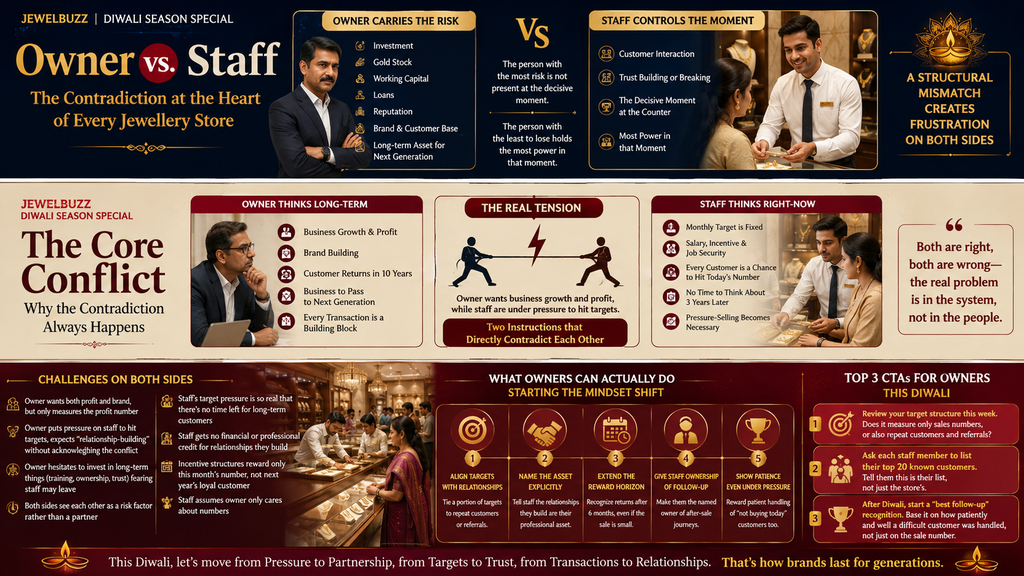
The real tension is this: the owner wants business growth and profit, while staff are under pressure to hit targets.
The owner thinks long-term — how does the brand grow, how does a customer come back after ten years, how does the business pass to the next generation. For the owner, every transaction is a building block toward something bigger.
The staff’s reality is completely different. Their monthly target is fixed. Their salary, incentive, and sometimes even job security depend on how much they sold this month, this Diwali. For staff, every customer is a chance to hit today’s number — right now, this moment. They cannot afford to think about whether this customer comes back in three years, because their performance is reviewed at month-end, not three years later.

So when the owner says “build the relationship, be patient,” and in the same breath increases the target by 20%, these two instructions directly contradict each other. Staff are not confused about what they should ideally do — they understand it perfectly. But they don’t have the choice. The target has to be met, so pressure-selling becomes necessary — even if it means pushing a customer slightly, or using lines like “buy today, rate will go up tomorrow” that create small cracks in trust.
These cracks don’t show up immediately. But after Diwali, when that customer doesn’t return a second time, the owner assumes it’s the staff’s fault. The staff believes the owner set an unrealistic target. Both are right, and both are wrong — because the real problem is in the system, not in the people.
The Challenges on Both Sides
- Owner wants both profit and brand, but only measures the profit number
- Owner puts pressure on staff to hit targets, then also expects “relationship-building” — without acknowledging the two often can’t coexist
- Owner hesitates to invest in long-term things (training, ownership, trust) due to fear that staff will leave anyway
- Staff’s target pressure is so real that there’s no time left to think about the long-term customer
- Staff gets no financial or professional credit for the relationships they build
- Incentive structures reward only this month’s number, not next year’s loyal customer
- Both sides see each other as a risk factor rather than a partner — the owner assumes staff will eventually leave, staff assumes the owner only cares about numbers
What Owners Can Actually Do — Starting the Mindset Shift
- Stop treating targets and relationships as separate — align them. Don’t set targets purely on sales numbers. Tie a small portion of the target to repeat customers or referrals, so staff know that long-term customers count too.
- Name the asset explicitly. Tell staff directly: the relationship you’re building with a customer is your professional asset, not just the store’s. This has to be shown in practice, not just said out loud.
- Extend the reward horizon. Don’t reward only Diwali-week sales — when a customer returns six months later and asks for that staff member by name, recognize that, even if the sale itself is small.
- Give staff ownership of the follow-up. Make each staff member the named owner of their customers’ after-sale journey — repairs, exchanges, the next occasion. This helps them feel the relationship is theirs, not just a transaction.
- Show patience even under pressure. If Diwali week only rewards closed sales, staff will only chase closing. If a staff member who handles a “not buying today” customer well is also appreciated, that’s when the mindset actually starts to shift — because staff notices what the owner actually rewards, not just what they say.
Top 3 CTAs for owners this Diwali
- Review your target structure this week. Does it only measure sales numbers, or does it also give weight to repeat customers and referrals? If not, try a small adjustment starting this Diwali.
- Ask each staff member to list their top 20 known customers. Tell them this is their list, not just the store’s. This builds a sense of ownership.
- After Diwali, start a “best follow-up” recognition. Base it not on the sale number, but on how patiently and well a difficult customer was handled. Staff need to see that patience is rewarded too, not just closing.
Shivaram A
Retail Gurukul



Padmini Kolhapure Launches Fine Jewellery Wholesale and Manufacturing Brand

Palmonas Introduces ‘Tiny Treasures’, A 9KT Gold Jewellery Collection Designed For Little Ones

Gold and Silver Prices Rebound In Early Domestic Trading

Bullion Prices Extend Losing Streak n AI Equity Selloff and Hawkish Fed Outlook

Paid B2B Jewellery Exhibitions Attract Entertainment Duty: Supreme Court

De Beers Group In Collaboration With Grandview Klein Diamond Unveils Namibia’S 176 Carat Owishi Natural Diamond In Washington, Dc
-
 International News2 days ago
Bullion Prices Extend Losing Streak n AI Equity Selloff and Hawkish Fed Outlook
-
 National News2 days ago
Paid B2B Jewellery Exhibitions Attract Entertainment Duty: Supreme Court
-
 DiamondBuzz3 days ago
De Beers Group In Collaboration With Grandview Klein Diamond Unveils Namibia’S 176 Carat Owishi Natural Diamond In Washington, Dc
-

 National News2 days ago
ANTISTATUS Jewellery Debuts Rider Collection At India Bike Week 2026