
International News
China’s jewellery market recovering faster than other luxury goods : Bain Report


Jewellery demand in China slowed its rate of decline in 2025, emerging as one of the most resilient segments in a personal luxury market that is still contracting but beginning to find its footing, according to Bain & Company.
China’s mainland personal luxury goods market contracted 3-5% in 2025, yet jewellery posted a far milder decline of just 0-5%, sharply improving from the 15-20% drop recorded a year earlier. The narrowing fall positions jewellery among the most resilient categories in the sector.
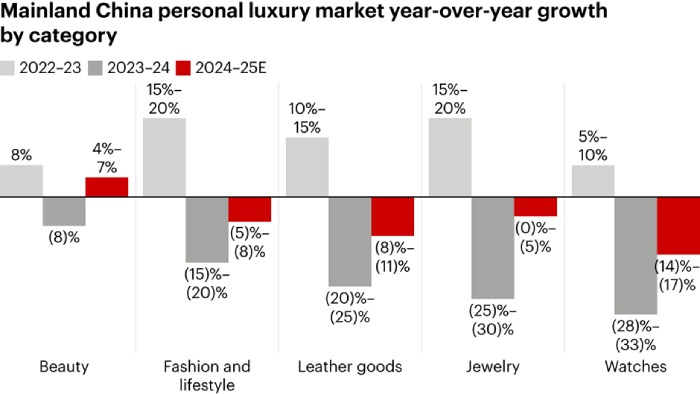
The recovery reflects steady consumer interest even amid cautious spending. Buyers increasingly prioritized enduring value and quality, traits closely associated with jewellery purchases, helping the segment hold ground while discretionary categories weakened.
Domestic buying trends further supported sales. About 65% of luxury purchases took place on the mainland, as overseas shopping softened due to smaller price gaps and reduced travel. This shift channeled spending back to local retailers and brands, benefiting jewellery counters in particular.
Other categories recorded mixed results. Beauty edged up, watches struggled, and second-hand luxury expanded 15-20%, though jewellery’s resale share remained modest. Bain described the year as a recalibration phase, with jewellery leading the early signs of recovery and setting a steadier tone for the market heading into 2026.




International News
Gold Prices On Track To Reach $4,900/oz By End 2026 :Goldman Sachs
Goldman’s $4,900/oz Forecast Assumes Central Bank Demand Averages 50 Tonnes Per Month In 2026 and 40 Tonnes Per Month In 2027

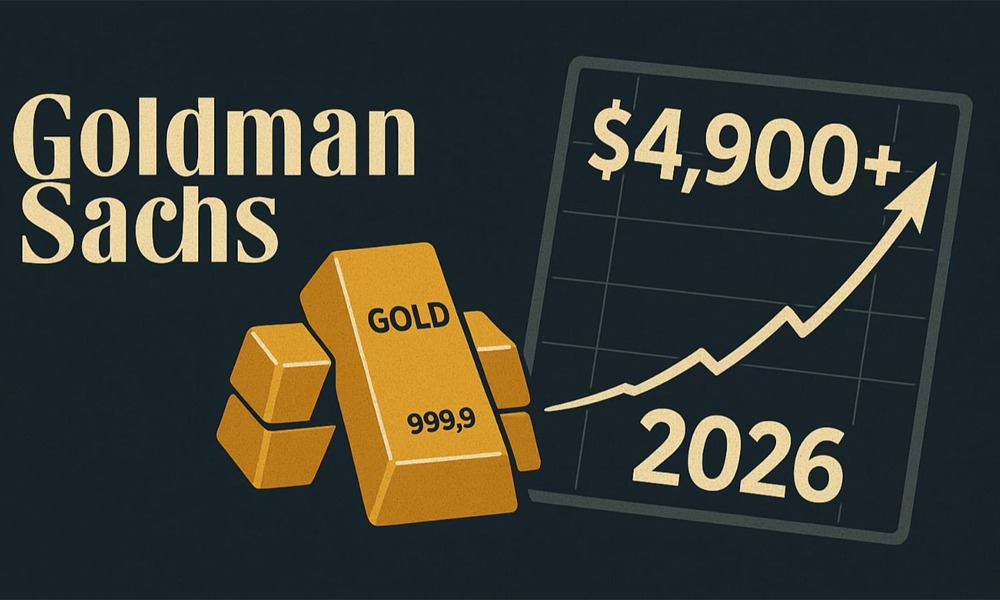
Gold prices are on track to reach $4,900 per ounce by the end of 2026, driven by aggressive central bank purchases—led by undisclosed buying from China—and recovering exchange-traded fund (ETF) demand, Goldman Sachs said in a research note.
The bank maintained its bullish base-case target for bullion while warning that positioning in options markets could amplify price volatility in both directions. Central banks accumulated an estimated 44 tonnes of gold in July, well above the pre-2022 monthly average of 17 tonnes, according to Goldman Sachs’ nowcast model. On a three-month seasonally adjusted basis, central bank buying stood at 91 tonnes per month.
China was the primary driver, with Goldman estimating the People’s Bank of China bought 35 tonnes in July—roughly 75% more than official public disclosures indicated.
To account for unreported sovereign purchases, Goldman’s model tracks physical bullion flows through London’s over-the-counter (OTC) market into custodian vaults. The Bank of England’s central bank holdings alone rose by 63 tonnes in July, exceeding outflows from the Federal Reserve Bank of New York.
Price Risks and Volatility
Goldman’s $4,900/oz forecast assumes central bank demand averages 50 tonnes per month in 2026 and 40 tonnes per month in 2027, alongside steady Federal Reserve policy and a rebound in private ETF inflows.
However, analysts noted that elevated demand for gold call options—used by investors to hedge against macroeconomic and geopolitical risks—creates mechanical upside and downside risks:
Bullish Case: Continued strong ETF inflows combined with existing call option positioning could force options dealers to buy underlying metal to hedge short exposure, pushing prices “well above” $4,900.
Bearish Case: If the Federal Reserve resumes interest rate hikes, unwinding hedge positions and triggering ETF outflows, gold could drop to $4,440/oz by end-2026. Goldman noted that ongoing central bank buying would limit further downside.
Goldman expects the Federal Reserve to remain on hold through 2026 as inflation cools, removing a key interest rate headwind for the non-yielding asset.


-
 Special Reports8 hours ago
Growth of the 925 Sterling Silver Gifting Segment
-

 ShowBuzz8 hours ago
TRENDS @ SSI DELHI 3RD EDITION
-

 JB Insights20 hours ago
Devotion, Heritage & Diversification: The defining trends of SSI Delhi’s 3rd Edition
-
 JB Insights21 hours ago
Gold-plated silver jewellery is seeing explosive growth
