
National News
As gold prices hit historic highs, gold loans surge


For generations, the “locker of the house”—the family’s ancestral gold— was a sacred reserve of last resort. To pledge a wife’s mangalsutra or a grandmother’s bangles was a mark of deep financial shame, the ultimate signal of a family in distress.
But a fundamental shift in the Indian psyche is turning that social taboo into a sophisticated financial strategy. As gold prices hit historic highs, what was once “idle” jewelry is being recast as a high-octane asset class, driving triple-digit growth across the sector and attracting a new breed of affluent borrower.
The shift is most visible in the scale of borrowing. Historically, the gold loan market was dominated by the small borrower, with loans under Rs.2.5 lakh ($3,000) making up 60% of the market.
New data from CRIF High Mark reveals a sharp reversal:
- FY2025: Small-ticket loans dipped to 51% of the market.
- Current Fiscal (8 Months): Small-ticket loans have cratered to just 40%.
The vacuum is being filled by entrepreneurs and high-net-worth individuals (HNIs) who are using gold as collateral to secure single-digit interest rates for business expansion, often bypassing more expensive unsecured loans.
According to a Morgan Stanley note in Oct 2025, India holds about 34,600 tonnes of gold, valued at approximately ₹550 lakh crore. In comparison, the value of gold loans in India stands at around ₹15 lakh crore, against which nearly ₹25 lakh crore worth of gold is pledged.
Why Monetization Failed Where Loans Succeeded
The trend represents a private sector victory where government policy stumbled. In 2015, the Reserve Bank of India (RBI) launched the Gold Monetization Scheme to bring an estimated 25,000 tonnes of privately held gold into the formal economy.
The policy failed largely due to sentimental barriers. To earn interest, owners had to melt their jewelry into bullion, effectively destroying the artistic value and ancestral craftsmanship of heirlooms.
A Structural Change
Banking analysts suggest this is not a temporary spike, but a structural realignment in how India perceives wealth. The modern borrower is increasingly pragmatic, prioritizing the cost of capital over the stigma of the pawnshop.
As banks and NBFCs digitize the process—offering doorstep pick-up and instant credit—the traditional local moneylender is being replaced by fintech-driven platforms and institutional vaults.
The family gold is finally stepping out of the shadows—returning not as ornamentation, but as a powerful line of credit.


National News
PNG Jewellers Wins IACC Excellence In Service Award At IACE 2026
Prestigious Recognition Honours PNG Jewellers’ Commitment To Customer Service, Retail Excellence and Evolving Consumer Expectations

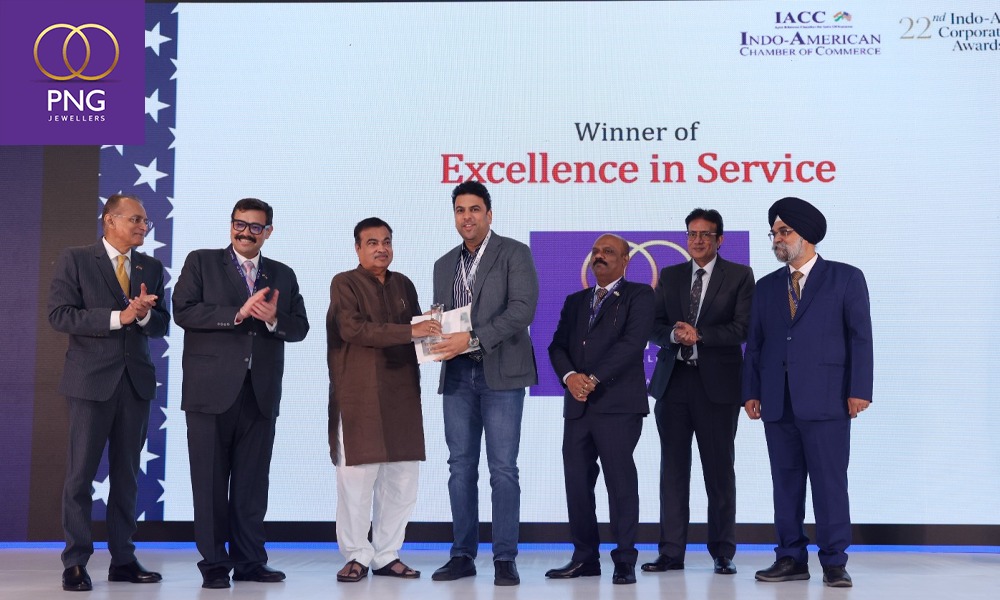
PNG Jewellers has been honoured with the Excellence in Service award at the 22nd Indo-American Corporate Excellence Awards (IACE) 2026, organised by the Indo-American Chamber of Commerce (IACC). The recognition celebrates PNG Jewellers’ retail excellence in Sunnyvale, California, and its commitment to delivering service excellence and trusted jewellery retail experiences to customers in the U.S. market.
The award was presented at a prestigious ceremony held on September 11, 2026, at Hotel Sahara Star, Mumbai, in the presence of business leaders, members of the Indo-U.S. business community, IACC members and representatives of the diplomatic community. Dr. Saurabh Gadgil, Chairman and Managing Director, PNG Jewellers, received the award on behalf of the company from Union Minister Shri Nitin Gadkari.
The winners were selected by an eminent jury chaired by Shailesh Haribhakti, alongside Kaku Nakhate, S. S. Mundra, Rajyalakshmi Rao and Nilesh Vikamsey. P. N. Gadgil Jewellers Ltd. was unanimously selected as the winner in the Excellence in Service category.
Commenting on the recognition, Dr. Saurabh Gadgil, Chairman and Managing Director, PNG Jewellers, said:

“This recognition is a testament to the trust our customers have placed in PNG Jewellers and to the commitment of our teams who work relentlessly to deliver an exceptional jewellery-buying experience. For us, service excellence goes beyond the transaction. It is about understanding evolving customer expectations, offering greater transparency and ensuring that every interaction strengthens a relationship built over generations. We are deeply honoured to receive this recognition from the Indo-American Chamber of Commerce.”
The recognition specifically acknowledges PNG Jewellers’ store in Sunnyvale, California, and the brand’s commitment to extending its legacy of trust, craftsmanship and service excellence to customers in the United States. The Sunnyvale store represents an important milestone in PNG
Jewellers’ international journey, bringing its heritage-led approach together with contemporary retail experiences tailored to evolving consumer expectations in the U.S. market.
The Indo-American Corporate Excellence Awards recognise organisations and individuals making significant contributions to the Indo-U.S. trade and business corridor.



PNG Jewellers Wins IACC Excellence In Service Award At IACE 2026

Dagina Maharashtra-Cha — Since 1832: PNGS Welcomes Ganeshotsav With Silver Rooted In Maharashtra’s Festive Heritage

India Has Emerged As The Most Important Startup Market In LGD Segment, Home To 70 Lab-Grown Diamond Companies

GJC CALLS 67% HIKE IN GOLD HALLMARKING CHARGES UNWARRANTED; SEEKS IMMEDIATE REVIEW
PNG Jewellers Wins IACC Excellence In Service Award At IACE 2026
Dagina Maharashtra-Cha — Since 1832: PNGS Welcomes Ganeshotsav With Silver Rooted In Maharashtra’s Festive Heritage
-
 National News7 hours ago
GJC CALLS 67% HIKE IN GOLD HALLMARKING CHARGES UNWARRANTED; SEEKS IMMEDIATE REVIEW
-
 National News5 hours ago
PNG Jewellers Wins IACC Excellence In Service Award At IACE 2026
-
 BrandBuzz6 hours ago
Dagina Maharashtra-Cha — Since 1832: PNGS Welcomes Ganeshotsav With Silver Rooted In Maharashtra’s Festive Heritage
-

 JB Insights7 hours ago
What Happens When The World’s 0.03% Of Diamonds Meet 131 Pairs Of Masterful Hands At QWEEN?
