
DiamondBuzz
India Has Emerged As The Most Important Startup Market In LGD Segment, Home To 70 Lab-Grown Diamond Companies
Surat Has Developed An Extensive Ecosystem Over Several Decades. LGD Give This Ecosystem An Opportunity To Move Into A New Segment Of The Global Diamond Economy.

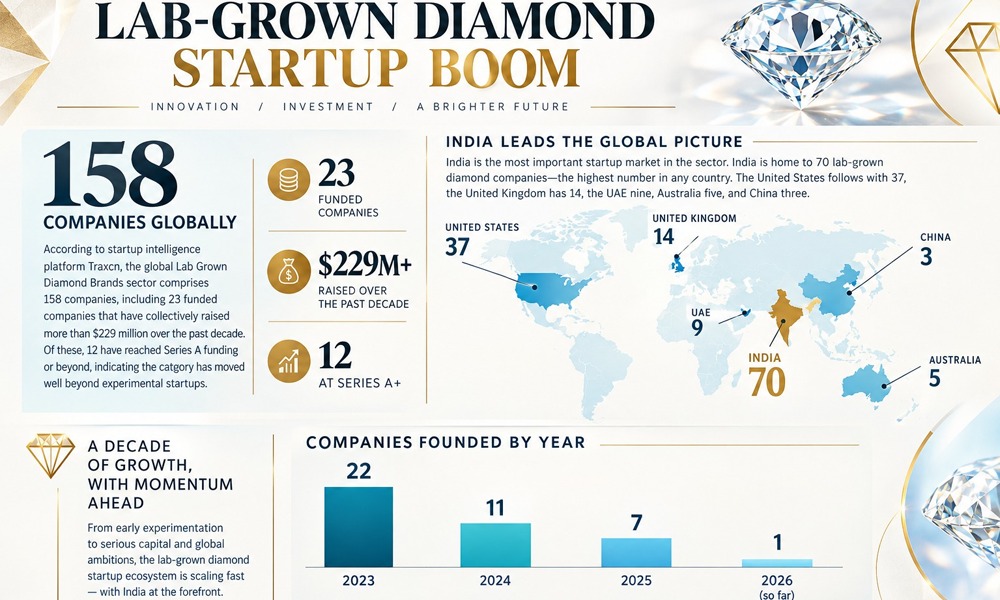
According to startup intelligence platform Traxcn, the global Lab Grown Diamond brands sector comprises 158 companies, including 23 funded companies that have collectively raised more than $229 million over the past decade. Of these, 12 have reached Series A funding or beyond, indicating the category has moved well beyond experimental startups.
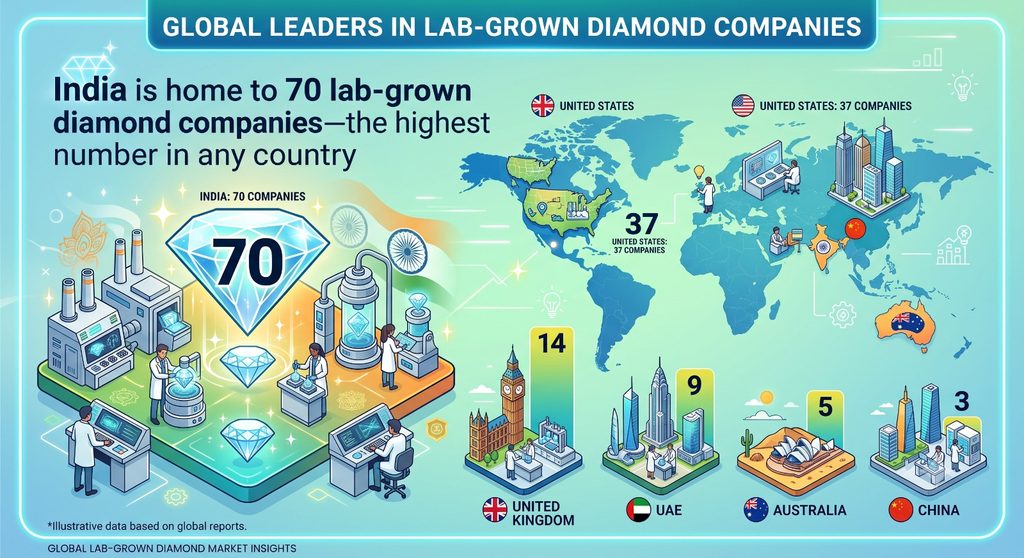
India is home to 70 lab-grown diamond companies—the highest number in any country. The United States follows with 37, the United Kingdom has 14, the UAE nine, Australia five, and China three.
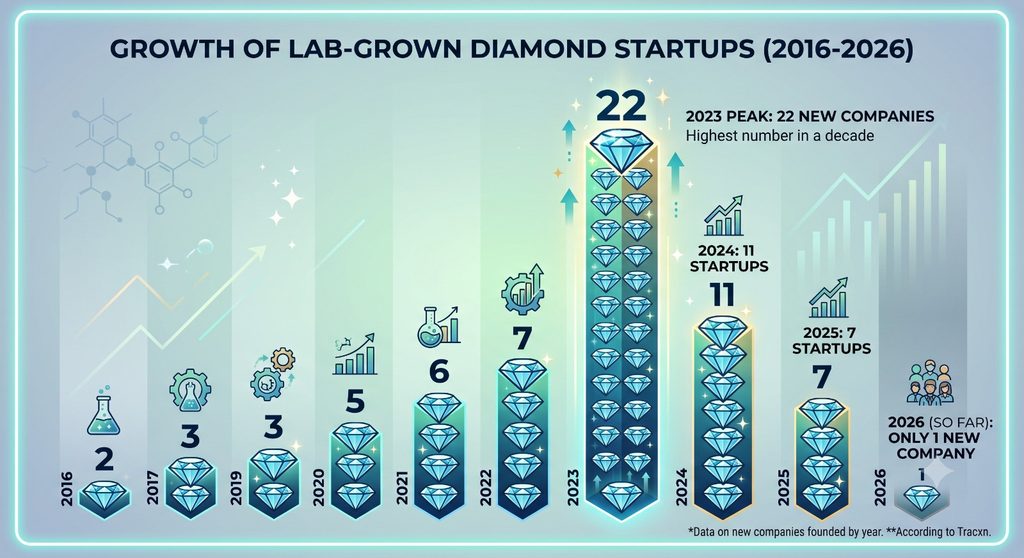
Data shows 22 lab-grown diamond companies were founded in 2023—the highest number in any year over the past decade. That was followed by 11 in 2024 and seven in 2025. In 2026, only one new startup had been founded so far, according to Traxcn.
The numbers underline India’s considerable advantage. The country has long been one of the world’s most important centres for the diamond business, particularly in cutting and polishing. Surat has developed an extensive ecosystem of manufacturers, skilled workers, exporters and jewellery businesses over several decades. Lab-grown diamonds give this ecosystem an opportunity to move into a new segment of the global diamond economy.
The sector received approximately $43.6 million in 2019, before funding fell sharply to $4.76 million in 2020. It recovered to $16.4 million in 2021 before peaking in 2022. Funding then dropped substantially—just $1.1 million in 2023 and $7.1 million in 2024—before rebounding sharply in 2025.This volatility suggests investors are still trying to understand the long-term economics of the industry.
Lab-grown diamonds are evolving beyond a single business category. The sector includes manufacturers, technology companies, exporters, retailers and consumer-facing jewellery brands. Their economics and risks are very different. Manufacturers invest heavily in technology, machinery and production capacity, while jewellery brands spend on design, marketing, stores and customer acquisition.
Traxcn data highlights another divide: India has more companies, while the US has attracted more capital. India has 70 lab-grown diamond companies compared with 37 in the US and 14 in the UK. The US has received about $126 million in funding over the past decade, compared with $97.2 million for India. Globally, the sector comprises 158 companies that have collectively raised more than $229 million.
Yet the industry’s biggest advantage—affordability—could also become its biggest challenge. As manufacturing technology improves and capacity expands, production costs and diamond prices can decline. Lower prices may stimulate demand, but they can also compress margins and reduce the value of existing inventory.
This changes the competitive equation. As stones become increasingly standardised, the battle may shift from who makes the diamond to who creates the strongest consumer proposition. Design, certification, trust, retail experience, after-sales service and branding could become increasingly important.
The experience of platinum offers a useful lesson. Marketing helped create a distinct consumer proposition around platinum, but changing preferences and price movements later challenged its position.
For lab-grown diamonds, the central question is therefore not simply how much demand can be created, but whether companies can build lasting brand value and healthy margins around a product whose supply can continually expand. The technology may make diamonds cheaper; the brand will determine where the value ultimately resides.


DiamondBuzz
De Beers Group Science & Technology Showcases SynthDetect 2: The World’s Most Versatile Automated Diamond Screening Instrument
SynthDetect™ 2 Delivers Faster Screening, Greater Automation and Enhanced Reporting For Diamond Trade Participants.
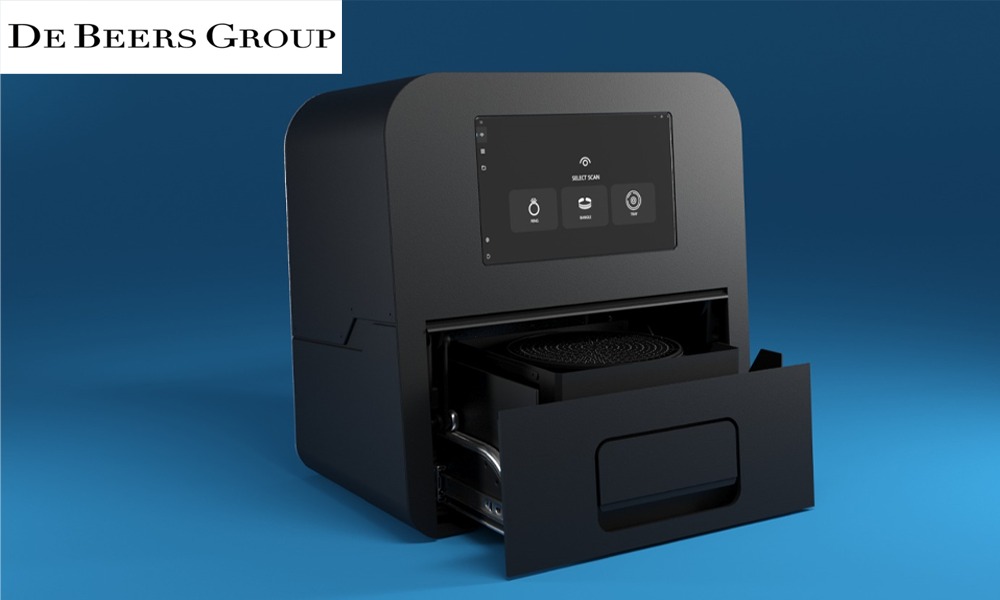
SynthDetect™ 2 builds on the leading-edge technical capabilities of its forerunners, adding greater automation, more effective reporting and faster throughput.
Collaborative approach to development means the instrument integrates effectively with diamond companies’ operations.
De Beers Group’s Science & Technology division today revealed SynthDetect 2, the next generation desktop diamond screening instrument. The first SynthDetect instrument and its successor SynthDetect XL– released in 2017 and 2018 respectively – have been among the most successful instruments in De Beers Group’s suite of diamond verification instruments due to their outstanding technical screening functionality and ability to test multiple stones in set jewellery at once without the need for a probe.
With SynthDetect 2, De Beers Group Science & Technology has worked closely with a range of trade participants to innovate on how best to integrate the technology with customer operations. This process has resulted in the development of an instrument that makes the diamond screening process significantly easier, faster and more cost-effective for diamond manufacturers, laboratories, and retailers’ back-office operations.
SynthDetect 2’s increased screening speed, throughput and productivity mean that the time taken for a full tray scan has been reduced from around 30 minutes to under five minutes. The instrument can screen more types of diamonds and jewellery than previous versions, while increased automation reduces the need for operator input, helping to reduce costs in the screening process.
With the instrument also offering automatically generated reporting and software updates, SynthDetect 2 provides a comprehensive screening tool for trade participants.
Sarandos Gouvelis, Senior Vice President for Science & Technology at De Beers Group, said:

“We have worked closely with industry partners to ensure that SynthDetect 2 is not only tailored to meet diamond companies’ screening requirements, but also to meet their operational needs. Through this process of collaboration we are proud to introduce SynthDetect 2, providing the trade with an instrument that will integrate seamlessly into their operations, marrying outstanding technical performance with enhanced speed, cost and efficiency.”



Dagina Maharashtra-Cha — Since 1832: PNGS Welcomes Ganeshotsav With Silver Rooted In Maharashtra’s Festive Heritage

India Has Emerged As The Most Important Startup Market In LGD Segment, Home To 70 Lab-Grown Diamond Companies

GJC CALLS 67% HIKE IN GOLD HALLMARKING CHARGES UNWARRANTED; SEEKS IMMEDIATE REVIEW
GJC CALLS 67% HIKE IN GOLD HALLMARKING CHARGES UNWARRANTED; SEEKS IMMEDIATE REVIEW
Dagina Maharashtra-Cha — Since 1832: PNGS Welcomes Ganeshotsav With Silver Rooted In Maharashtra’s Festive Heritage
India Has Emerged As The Most Important Startup Market In LGD Segment, Home To 70 Lab-Grown Diamond Companies
-
 National News1 hour ago
GJC CALLS 67% HIKE IN GOLD HALLMARKING CHARGES UNWARRANTED; SEEKS IMMEDIATE REVIEW
-
 BrandBuzz21 minutes ago
Dagina Maharashtra-Cha — Since 1832: PNGS Welcomes Ganeshotsav With Silver Rooted In Maharashtra’s Festive Heritage
-

 National News2 hours ago
MCX Gold and Silver Futures Rebounded In Early Domestic Trading
-

 JB Insights2 hours ago
What Happens When The World’s 0.03% Of Diamonds Meet 131 Pairs Of Masterful Hands At QWEEN?
