JB Insights
ANSAA JEWELLERS: Showcasing innovative artistry and timeless elegance
Ansaa Jewellers has become a renowned name in the gems and jewellery industry, celebrated for giving new dimensions to Indian traditional jewellery. Kantilal Shah, founder of Ansaa Jewellers spoke to JewelBuzz on Ansaa’s dazzling journey across three decades.


Please provide a brief history of Ansaa Jewellers.When and where was it established, name of the founders, growth and expansion of the company.
Ansaa Jewellers Private Limited, founded in 1997 by Kantilal Shah, has become a renowned name in the gems and jewellery industry, celebrated for giving new dimensions to Indian traditional jewellery. Kantilal Shah’s profound knowledge and artistic expertise shine through in the intricately handcrafted designs that exude passion and elegance. With numerous national and international accolades, Ansaa is a trendsetter in luxurious jewellery, redefining the beauty of Indian craftsmanship through timeless and innovative creations.


Growth and Expansion:
Since its inception, Ansaa Jewellers has grown into a globally recognized name in the gems and jewellery industry. Today, Ansaa Jewellers is synonymous with elegance and quality, offering a wide range of exquisite jewellery pieces that cater to a diverse clientele. The brand continues to expand its reach, solidifying its reputation as a pioneer in the industry.


• Please give details on the various product lines. Give details of special designs, techniques employed. What is your USP in Jewellery design?
Ansaa Jewellers offers a diverse range of jewellery, from traditional Indian designs to contemporary collections, opulent bridal sets, and bespoke creations. Renowned for blending heritage techniques like Kundan, Meenakari, and filigree with modern technologies such as 3D designing, the brand delivers intricate, versatile, and high-quality pieces. Their unique selling proposition lies in seamlessly fusing tradition with modernity, creating timeless masterpieces that reflect meticulous craftsmanship and innovation. Ansaa’s personalized approach and award-winning designs make it a trendsetter in redefining Indian jewellery.
The USP of Ansaa Jewellers lies in its ability to seamlessly blend traditional Indian craftsmanship with contemporary design sensibilities, creating jewellery that is both timeless and modern. Their designs stand out for their intricate detailing, innovative patterns, and versatility, including multi-use and reversible pieces.


• Are you planning to integrate AI in jewellery designing for your forthcoming collections?
Ansaa Jewellers is revolutionizing its design process by integrating Artificial Intelligence (AI) into upcoming collections. This innovation enhances precision, efficiency, and personalization by analyzing design data, market trends, and customer preferences. AI-driven tools will inspire unique patterns, streamline prototyping with 3D modelling, and reduce production timelines while ensuring accuracy. This strategic move reinforces Ansaa’s commitment to innovation and excellence, further solidifying its reputation as a pioneer in crafting exquisite and timeless jewellery.
• Details on manufacturing technology used to create high quality products that high level of detailing in design.
Ansaa Jewellers Private Limited employs advanced manufacturing technology to produce high-quality jewellery that stands out for its intricate detailing and exceptional craftsmanship. By integrating traditional techniques with state-of-the-art tools, the brand ensures precision and efficiency at every stage of production. Modern technologies such as 3D CAD (Computer-Aided Design) allow for the creation of detailed digital prototypes, enabling the visualization and refinement of complex designs before manufacturing. This ensures that each piece is crafted to perfection, meeting the brand’s exacting standards. The use of advanced casting techniques guarantees consistency in the intricate elements of each design, while precision laser cutting and engraving add fine details that elevate the aesthetic appeal of the jewellery. Additionally, Ansaa incorporates micro-setting techniques to achieve flawless gemstone placement, enhancing both durability and visual brilliance.
The fusion of these modern manufacturing methods with traditional Indian craftsmanship allows Ansaa Jewellers to produce exquisite pieces that reflect both heritage and innovation. This technological integration not only enhances the quality and detail of the jewellery but also optimizes production timelines, ensuring timely delivery of customized and exclusive pieces. Ansaa Jewellers’ commitment to leveraging cutting-edge manufacturing technology underscores its dedication to delivering exceptional designs that captivate and inspire.


• How do you stay ahead of design trends, and how do you balance timeless styles with contemporary trends?
Ansaa Jewellers consistently stays ahead of design trends, balancing timeless elegance with contemporary innovation Ansaa achieves this by continuously researching emerging trends, analysing customer preferences, and employing cutting-edge design technology. This approach allows the brand to anticipate shifts in the market and integrate them seamlessly into their collections, ensuring that each piece remains both on-trend and timeless.
• What are your plans with regards to your brand presence in the market, sales strategies if any? Kindly decode.
Ansaa Jewellers Private Limited is committed to enhancing its brand presence and expanding its reach in the global jewellery market through strategic initiatives. The company plans to strengthen its position by leveraging a multi-channel approach that includes both physical and digital platforms. This includes the expansion of flagship stores in key metropolitan areas and enhancing its online presence with an enriched e-commerce platform that provides a seamless shopping experience. The brand will employ targeted marketing strategies, such as digital advertising, social media campaigns, and influencer partnerships, to engage with a wider audience and build brand loyalty.
In addition, Ansaa plans to implement customer-centric sales strategies that emphasize personalized service and bespoke offerings. By using advanced data analytics and AI-driven insights, the brand aims to better understand consumer preferences and tailor product recommendations accordingly. To boost sales, Ansaa will introduce exclusive collections and limited-edition pieces that attract collectors and connoisseurs. Partnerships with international retailers and participation in global jewellery exhibitions will further bolster its reputation as an industry leader. With a commitment to innovation, quality, and customer satisfaction, Ansaa Jewellers seeks to establish itself as a premier choice for discerning jewellery enthusiasts around the world.


• What are the target cities/ regions you are looking forward to grow in terms of Distribution & Retail Network.
Ansaa Jewellers Private Limited has a strong presence in North India and South India, where the brand has established a reputation for high-quality, intricately designed jewellery. To build on this success, Ansaa is focused on expanding its distribution and retail network to include key cities in the western region of India. This strategic expansion aims to capture new markets and increase accessibility for customers who appreciate the brand’s unique blend of traditional and contemporary jewellery. Cities such as Mumbai, Pune, Ahmedabad, and Surat are being prioritized, as these locations have a robust consumer base with a strong affinity for premium jewellery.
To facilitate this growth, Ansaa plans to open new flagship stores and collaborate with high-end retailers to reach a broader audience. The company is also enhancing its digital presence, providing a seamless online shopping experience that complements its physical retail expansion. By leveraging targeted marketing campaigns and partnerships with regional influencers, Ansaa aims to deepen brand awareness and foster customer loyalty in these new markets. Furthermore, the expansion into the western region aligns with Ansaa’s long-term vision of becoming a prominent name in India’s jewellery industry. Through this strategic distribution and retail network growth, Ansaa Jewellers seeks to deliver its exquisite craftsmanship and unparalleled designs to more customers, solidifying its position as a leading jewellery brand in the country.
• As a leader in the industry, what advice would you give to someone starting a jewelry business today?
Ansaa Jewellers advises aspiring jewellery entrepreneurs to focus on quality, uniqueness, and market insights. Success begins with skilled artisans, high-quality materials, and a balance of traditional techniques with modern innovation. Leveraging technology like CAD and 3D printing enhances precision and enables intricate, custom designs. A strong brand identity, built through a clear vision and consistent storytelling, along with a robust online and offline presence, is essential for market reach and trust. Engaging customers via social media, influencer collaborations, and personalized experiences fosters loyalty. Remaining adaptable to trends and learning from industry leaders ensures long-term competitiveness and success.

• Future plans for the next 3 years—expansion of jewellery manufacturing facilities, new product lines etc.
Ansaa Jewellers has ambitious plans for the next three years aimed at bolstering its market position and enhancing its manufacturing capabilities. The company intends to expand its jewellery manufacturing facilities to increase production capacity and integrate more advanced technologies. This expansion will include the adoption of cutting-edge equipment and automation to streamline processes and ensure the highest standards of craftsmanship, further elevating the quality of its jewellery.
In addition to facility growth, Ansaa Jewellers plans to introduce new product lines that reflect the evolving tastes and preferences of its clientele. This includes expanding into more contemporary and innovative designs that appeal to younger audiences while still maintaining the brand’s strong connection to traditional Indian artistry. The new product lines may incorporate elements like sustainable and ethically sourced materials, catering to the growing consumer demand for eco-friendly and responsibly made jewellery.
Ansaa also aims to enhance its bespoke and custom jewellery offerings, providing customers with more personalized options that align with individual tastes and special occasions. The brand will continue to focus on enhancing its digital presence, with the launch of an improved e-commerce platform and targeted online marketing campaigns to reach a wider audience. Through these strategic initiatives, Ansaa Jewellers is poised to strengthen its leadership position, expand its reach, and offer an exceptional jewellery experience to an even broader customer base.
• Comment on Ansaa Jewellers diversification in other sectors.
Ansaa Jewellers, known for its exceptional craftsmanship and innovative designs, could enhance its brand and revenue by diversifying into related sectors. Expanding into luxury lifestyle products, fashion accessories, and home décor would allow Ansaa to leverage its design expertise and appeal to a broader audience. Potential ventures include high-end watches, handbags, and eco-friendly, sustainable offerings that align with modern consumer values. Partnerships in fine art, interior design, or wellness could further reinforce its commitment to craftsmanship and luxury. Maintaining quality, innovation, and brand integrity would ensure Ansaa’s success in new markets while preserving its core identity.

/








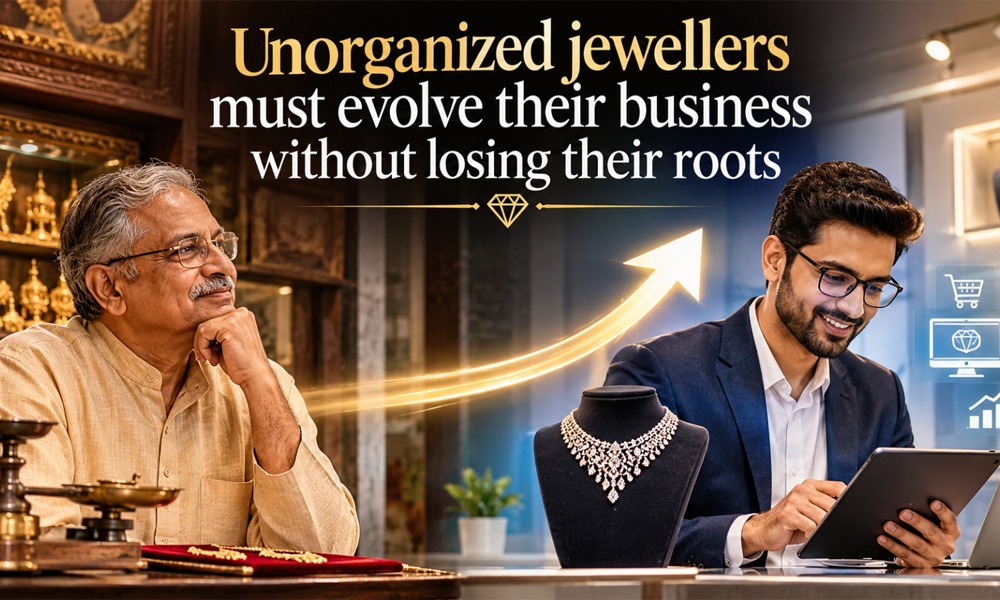
Nearly 65% of India’s jewellery market is still unorganised. This vast segment, run by local family jewellers, runs on inherited trust, community relationships and generations of craftsmanship. For decades it has been the backbone of the trade: resilient, adaptive and deeply customer-centric.
That backbone is now under strain. Higher gold prices are sapping demand, consumer preferences are drifting towards larger chain stores, and regulatory and cost pressures are rising together. Local jewellers and goldsmiths across the country report a 45% decline in volume, and many family-run businesses are facing a liquidity squeeze.
The central finding of this report is simple: the future does not demand that unorganised jewellers lose their identity. It demands that they evolve their business without losing their roots.
Context
The unorganised sector’s strength has never been scale. It has been proximity. The neighbourhood jeweller knows the family, the occasion, the budget and the history of every purchase. That relationship has sustained the trade through earlier cycles of price volatility, regulation and competition.
What has changed is the speed and the combination of pressures. Gold prices have risen sharply and remain volatile. Organised chains are scaling fast, with marketing budgets, standardised pricing and professional teams that individual family stores cannot match. Customers are better informed and compare prices before they walk in.
The human cost is visible on the shop floor. As one private jeweller from Mumbai put it, “Middle-class buyers cannot afford gold anymore. Their incomes are far too stretched to budget for such a purchase.” His shop in Worli, he says, rarely sees the footfall it once did.
Risks and Pressures
Five challenges define the sector today.
1. Increasing compliance and regulatory pressure. Hallmarking, tax documentation, reporting and record-keeping demand systems and skills that many traditional businesses were never built around. Compliance is no longer optional, and its cost falls hardest on the smallest players.
2. Price transparency and making-charge competition. When customers can compare gold rates and making charges across stores and apps in minutes, margins that once rested on relationships come under direct pressure.
3. Rising marketing and branding costs. Visibility now costs money. Organised players outspend local jewellers on advertising, digital presence and in-store experience, widening the awareness gap.
4. Talent retention and professional team-building. Skilled artisans, sales staff and managers are increasingly drawn to organised employers offering structure, training and career paths. Family businesses struggle to compete on all three.
5. Competition from fast-scaling organised players. Chains bring standardised pricing, schemes, assured quality and wide design choice, precisely the reassurances that unorganised jewellers have traditionally supplied through personal trust.
Taken together, these risks compound each other. A volume decline of 45% makes it harder to fund compliance, branding and talent, which in turn makes it harder to win back volume.
Insights
Trust is still the scarcest asset. Organised retail can copy design, pricing and schemes. It cannot easily copy a relationship built over generations. This remains the unorganised jeweller’s most defensible advantage, but only if it is made visible and backed by modern assurance such as transparent billing, hallmarked products and clear buyback terms.
The problem is rarely the product. It is the system around it. Most distressed family jewellers have strong customer relationships and sound craftsmanship. What they lack is process: inventory discipline, costing clarity, digital records, a defined brand and a trained team.
Transition is a spectrum, not a switch. Between a fully traditional shop and a corporate chain lies a wide middle ground. Semi-organised models allow a jeweller to adopt structure selectively while keeping family ownership, identity and customer relationships intact.
The next generation is the pivot. Heirs who combine inherited trust with modern management training are often the catalyst for change, which is why leadership development is as important as capital.
Strategy
With the right systems, strategy, branding and team, unorganised jewellers can improve profitability, build scalable operations, strengthen customer loyalty and move smoothly towards semi-organised or organised models. A practical roadmap:
Systems. Digitise billing, stock and customer records. Build compliance into daily operations rather than treating it as an annual scramble. Track margins by category so that making-charge decisions rest on data, not instinct.
Pricing. Move to transparent, explainable pricing. Compete on value, service and assurance rather than quietly matching the lowest making charge.
Branding. Turn heritage into a brand: the family story, the years of service, the craftsmanship. Low-cost digital presence, local community engagement and consistent in-store identity can close much of the visibility gap without chain-scale budgets.
People. Invest in training, clear roles and career growth for staff and artisans. Bring in professional managers where needed, and prepare the next generation for leadership early.
Pathway. Choose a deliberate direction: strengthen the traditional model, adopt a semi-organised structure, or build towards an organised format. Each path is legitimate. Drifting without a decision is the only wrong choice.
Conclusion
The unorganised jewellery sector is not a relic. It is a trust network that has carried Indian jewellery for generations, now facing a market that rewards structure, transparency and scale. The real winners will be those who combine traditional trust with modern business practices: keeping the relationship, upgrading the system.
-

 JB Insights1 week ago
Dhanteras Shopping Guide 2026:Gold, Silver, Diamonds & Festive Jewellery Trends To Watch
-

 BrandBuzz1 week ago
The Solenne Collection: A Celebration Of Diwali By Bharti Bangur Fine Jewels
-
 BrandBuzz1 week ago
From Diya Puja To Diwali Soirées: Jewellery Designed To Go Beyond The Festive Season
-

 National News1 week ago
Indriya, Aditya Birla Jewellery Unveiled India’s Largest Sustainable Jewellery Rangavalli