

International News
WGC: Gold Investment Rockets in 2025, Setting a New High as Uncertainty Bites


The World Gold Council’s Full-Year 2025 Gold Demand Trends report reveals that total gold demand hit a new all-time high of 5,002t last year. A record fourth quarter set the seal on a stellar year as continued geopolitical and economic uncertainty propelled hefty investment in gold with an annual value of US $555bn.
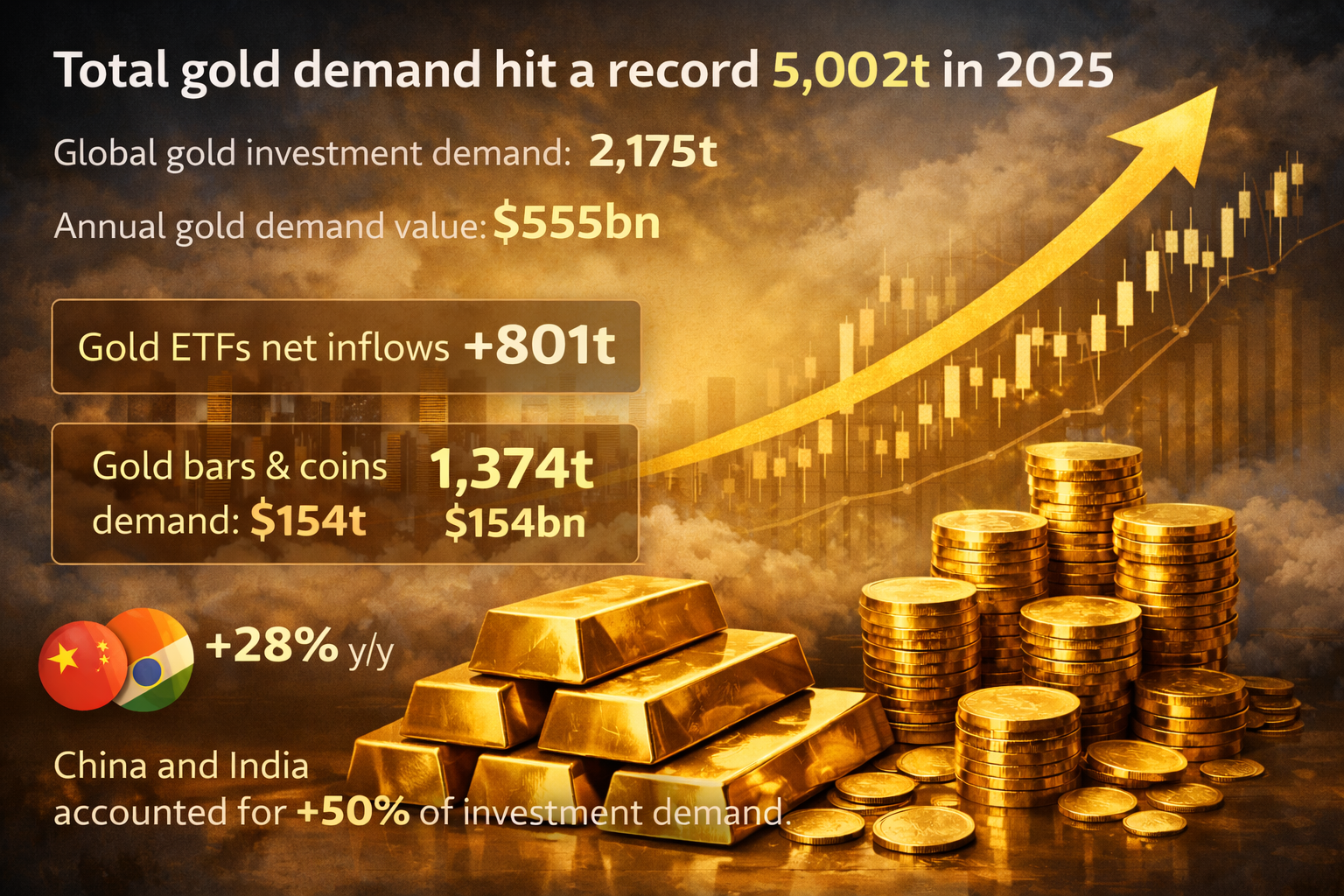
Global investment demand reached a landmark level of 2,175t and was the main driver behind gold’s remarkable and record-breaking year. Across the world, investors seeking safe haven and diversification, piled into gold ETFs, adding 801t throughout the year. Investors also bought bullion with global bar and coin demand reaching 1,374t or US $154bn in value terms. The two major markets China (+28% y/y) and India (+17% y/y) recorded significant gains, making up more than 50% of demand in the category.
Central bank demand remained elevated in 2025, with the official sector adding 863t of gold. While annual demand was below the 1,000t mark surpassed in the previous three years, central bank buying remained a prominent and additive factor in the global gold demand picture.
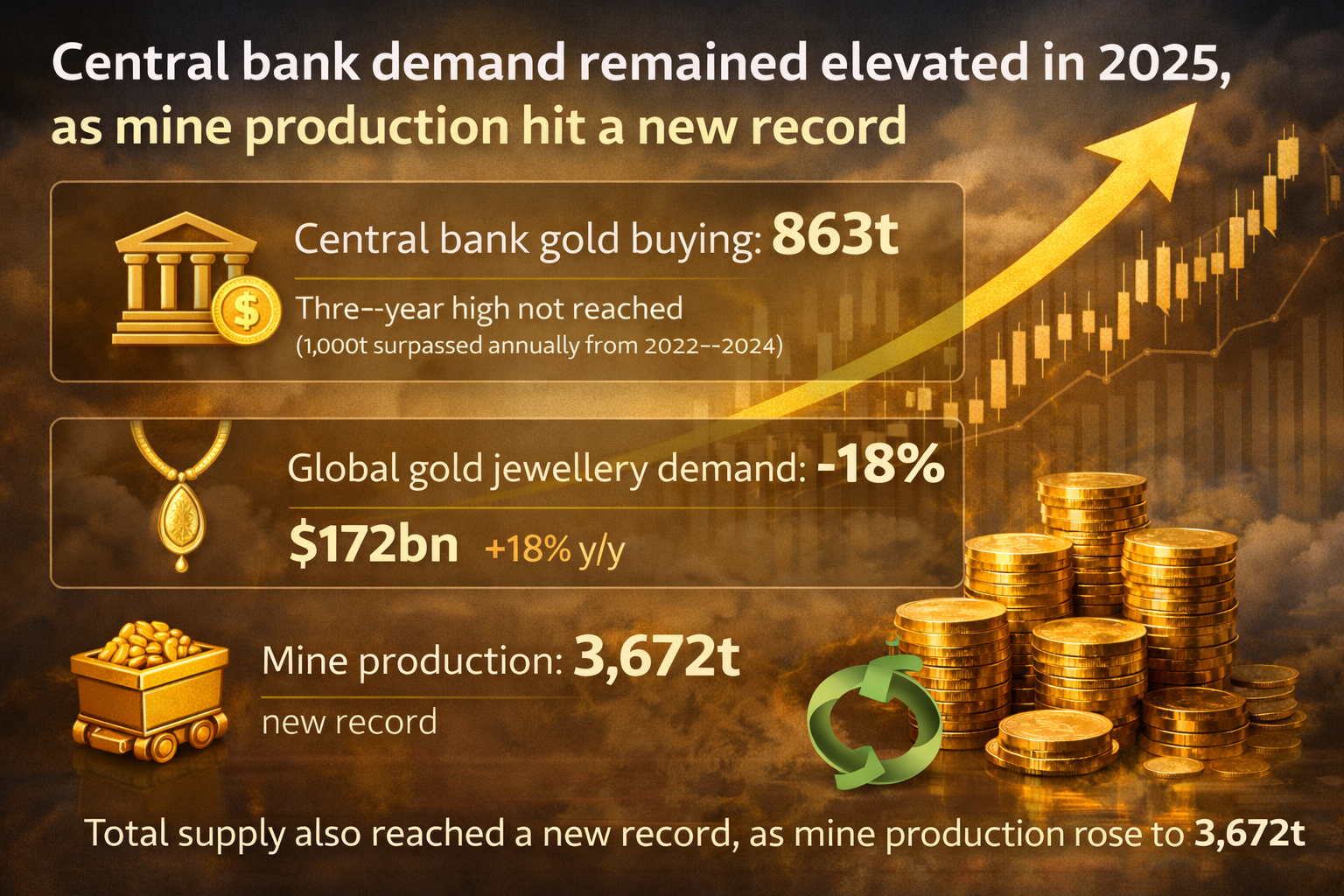
Amidst a spate of price highs, global jewellery demand softened as expected throughout the year, declining 18% compared to 2024. However, the total value of gold jewellery demand increased 18% year-on-year to US $172bn, highlighting the relevance of gold for consumers in the long term.
Total supply also reached a new record, as mine production rose to 3,672t and recycling increased by a modest 3%, remaining subdued despite high prices.

Louise Street, Senior Markets Analyst from the World Gold Council, commented:
“2025 saw surging demand for gold and rocketing prices. Consumers and investors alike bought and held gold in an environment where economic and geopolitical risks have become the new normal. Investment demand stole the show as investors raced to access gold through all available routes, but other segments played a supporting role.
Jewellery demand dipped by only 18% year-on-year against a 67% price increase – highlighting continued consumer willingness to buy at elevated prices, and central banks remained firmly committed to bolstering reserves.
“With economic and geopolitical instability showing little sign of retreat in 2026, momentum from last year’s strong gold demand is likely to persist. In the first month of this year, gold has already pushed past US $5,000/oz for the first time, underscoring gold’s role as a safe haven in uncertain times.”
Source: World Gold Council





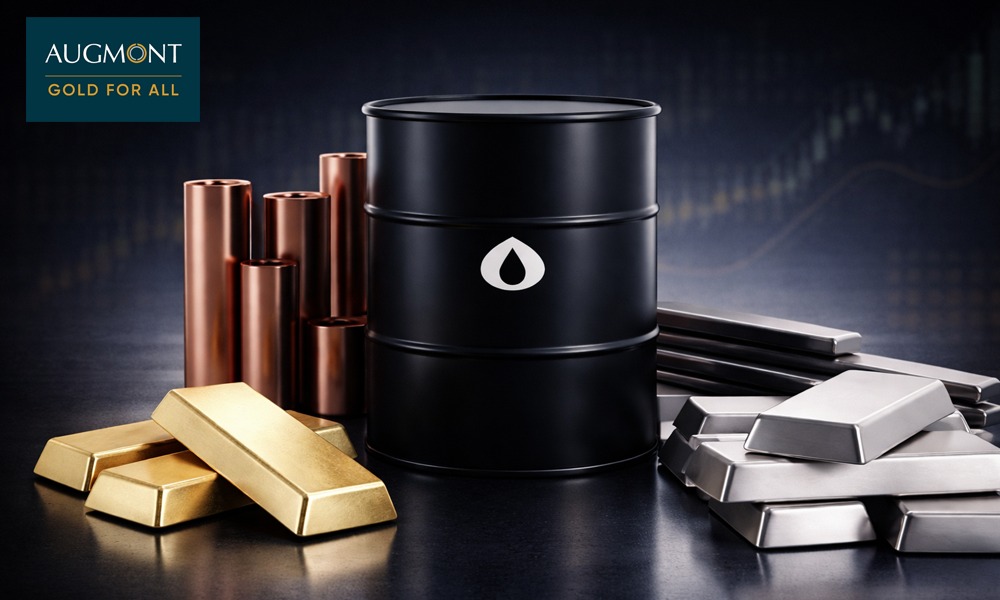
Safe Haven Dynamics – Gold and silver remain under pressure, hovering below key psychological levels of $5000 and $80 respectively, as investors stay cautious ahead of the Federal Reserve decision. Volatility in oil prices is complicating the inflation outlook, keeping real yields elevated and limiting upside in precious metals despite ongoing geopolitical risks.
Geopolitical Developments – Escalation in the US–Israel–Iran conflict, including strikes on energy infrastructure and disruptions in the Strait of Hormuz, has intensified supply concerns in oil markets. While such tensions typically support safe-haven demand, the inflationary impact of rising energy prices is delaying expectations of monetary easing, creating mixed signals for gold and silver.
Monetary Policy Stance – The Fed is expected to maintain a pause, reinforcing a “wait-and-watch” approach amid sticky inflation and a softening labor market. Similar policy stances by ECB, BoE, and BoJ indicate a synchronized global pause. The key trigger for metals will be forward guidance—any dovish tilt could revive bullish momentum.
Technical Triggers
Gold briefly broke the key $5000 (~Rs.157,000) support and short-term bias remains bearish, with strong support seen around $4850 (~Rs.150,000).
Silver has also slipped below $80 (~Rs.255,000), and a renewed break below $77 (~Rs.247,000) could trigger further profit-booking, dragging prices towards $70 (~₹230,000) in the near term.
Support and Resistance
| Metal | Market | Support Level | Resistance Level |
|---|---|---|---|
| Gold | International | $4850/oz | $5250/oz |
| Gold | Domestic | ₹158,500/10 gm | ₹165,000/10 gm |
| Silver | International | $77/oz | $85/oz |
| Silver | Domestic | ₹247,000/kg | ₹268,000/kg |
Source : AUGMONT BULLION REPORT



MMTC-PAMP Marks Navratras with Launch of 50g 999.9+ Pure Silver Vaishno Devi Coin

As gold prices hit historic highs, gold loans surge

HSBC Mutual Fund launches gold ETF

Malabar Gold & Diamonds Announces Major Expansion with ₹1,580 Crore Investment, set to open 20 new showrooms in March 2026

Precious Metals Face Macro Headwinds Amid Persistent Inflation and Geopolitical Uncertainty: AUGMONT BULLION REPORT

GJC announces 9th Edition of GJS April 2026
-
 National News4 hours ago
Malabar Gold & Diamonds Announces Major Expansion with ₹1,580 Crore Investment, set to open 20 new showrooms in March 2026
-
 International News6 days ago
Precious Metals Face Macro Headwinds Amid Persistent Inflation and Geopolitical Uncertainty: AUGMONT BULLION REPORT
-
 National News1 day ago
GJC announces 9th Edition of GJS April 2026
-

 International News5 hours ago
Gold, silver struggle amid Fed, oil uncertainty AUGMONT BULLION REPORT
