
International News
Gold, silver struggle amid Fed, oil uncertainty AUGMONT BULLION REPORT

Safe Haven Dynamics – Gold and silver remain under pressure, hovering below key psychological levels of $5000 and $80 respectively, as investors stay cautious ahead of the Federal Reserve decision. Volatility in oil prices is complicating the inflation outlook, keeping real yields elevated and limiting upside in precious metals despite ongoing geopolitical risks.
Geopolitical Developments – Escalation in the US–Israel–Iran conflict, including strikes on energy infrastructure and disruptions in the Strait of Hormuz, has intensified supply concerns in oil markets. While such tensions typically support safe-haven demand, the inflationary impact of rising energy prices is delaying expectations of monetary easing, creating mixed signals for gold and silver.
Monetary Policy Stance – The Fed is expected to maintain a pause, reinforcing a “wait-and-watch” approach amid sticky inflation and a softening labor market. Similar policy stances by ECB, BoE, and BoJ indicate a synchronized global pause. The key trigger for metals will be forward guidance—any dovish tilt could revive bullish momentum.
Technical Triggers
Gold briefly broke the key $5000 (~Rs.157,000) support and short-term bias remains bearish, with strong support seen around $4850 (~Rs.150,000).
Silver has also slipped below $80 (~Rs.255,000), and a renewed break below $77 (~Rs.247,000) could trigger further profit-booking, dragging prices towards $70 (~₹230,000) in the near term.
Support and Resistance
| Metal | Market | Support Level | Resistance Level |
|---|---|---|---|
| Gold | International | $4850/oz | $5250/oz |
| Gold | Domestic | ₹158,500/10 gm | ₹165,000/10 gm |
| Silver | International | $77/oz | $85/oz |
| Silver | Domestic | ₹247,000/kg | ₹268,000/kg |
Source : AUGMONT BULLION REPORT


International News
Gold Prices On Track To Reach $4,900/oz By End 2026 :Goldman Sachs
Goldman’s $4,900/oz Forecast Assumes Central Bank Demand Averages 50 Tonnes Per Month In 2026 and 40 Tonnes Per Month In 2027

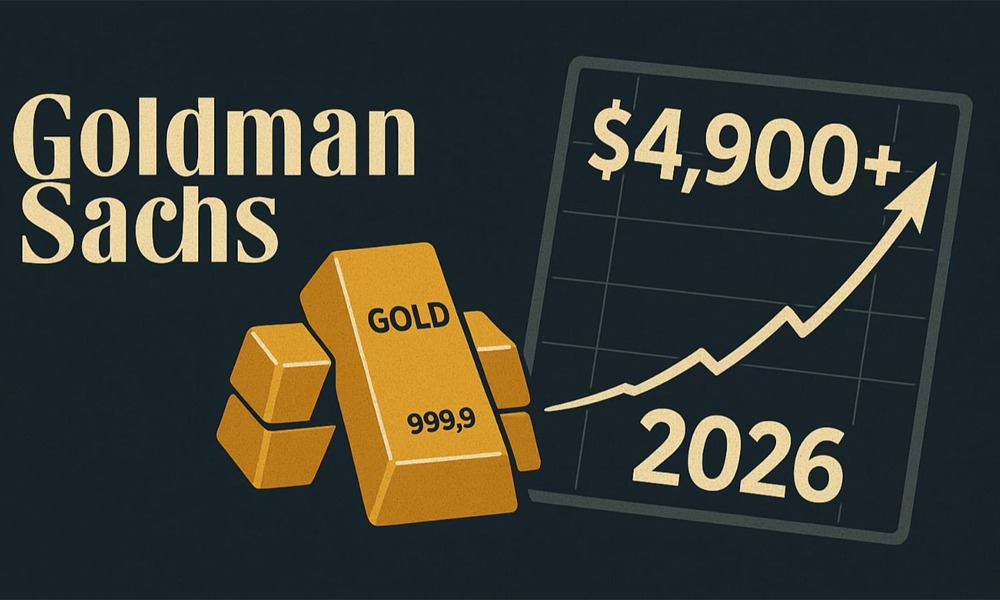
Gold prices are on track to reach $4,900 per ounce by the end of 2026, driven by aggressive central bank purchases—led by undisclosed buying from China—and recovering exchange-traded fund (ETF) demand, Goldman Sachs said in a research note.
The bank maintained its bullish base-case target for bullion while warning that positioning in options markets could amplify price volatility in both directions. Central banks accumulated an estimated 44 tonnes of gold in July, well above the pre-2022 monthly average of 17 tonnes, according to Goldman Sachs’ nowcast model. On a three-month seasonally adjusted basis, central bank buying stood at 91 tonnes per month.
China was the primary driver, with Goldman estimating the People’s Bank of China bought 35 tonnes in July—roughly 75% more than official public disclosures indicated.
To account for unreported sovereign purchases, Goldman’s model tracks physical bullion flows through London’s over-the-counter (OTC) market into custodian vaults. The Bank of England’s central bank holdings alone rose by 63 tonnes in July, exceeding outflows from the Federal Reserve Bank of New York.
Price Risks and Volatility
Goldman’s $4,900/oz forecast assumes central bank demand averages 50 tonnes per month in 2026 and 40 tonnes per month in 2027, alongside steady Federal Reserve policy and a rebound in private ETF inflows.
However, analysts noted that elevated demand for gold call options—used by investors to hedge against macroeconomic and geopolitical risks—creates mechanical upside and downside risks:
Bullish Case: Continued strong ETF inflows combined with existing call option positioning could force options dealers to buy underlying metal to hedge short exposure, pushing prices “well above” $4,900.
Bearish Case: If the Federal Reserve resumes interest rate hikes, unwinding hedge positions and triggering ETF outflows, gold could drop to $4,440/oz by end-2026. Goldman noted that ongoing central bank buying would limit further downside.
Goldman expects the Federal Reserve to remain on hold through 2026 as inflation cools, removing a key interest rate headwind for the non-yielding asset.


-

 ShowBuzz4 hours ago
SSI 2026 SETS A BIGGER STAGE FOR SILVER
-

 ShowBuzz8 hours ago
Silver Trends To Watch At SSI Delhi 2026
-

 ShowBuzz8 hours ago
Silver Show Of India- Delhi 3rd Edition Unveiled At Yashobhoomi, Delhi
-

 ShowBuzz12 hours ago
GJIIF 2026 Sets New Benchmarks As India’s Biggest-Ever Jewellery Trade Show Opens In Chennai
