

By Invitation
The new 4 C’s of Jewellery Retailing
By Shivaram A

Jewellery is a precious commodity to purchase, and every customer wishes to take a cautious decision. Most of the purchase decisions of the jewellery customer is dependent on her “perception” of the brand or the jeweller. Keeping this in mind, certain parameters can be defined to help the customer make a quick and correct decision. For example, while buying diamond jewellery, 4 factors were considered as the “C”s- cut, carat, colour and clarity of the diamonds.
Likewise, the present customer’s buying behaviour rests on the 4 new “C”s of Jewellery Retail. What are these 4 new “C”s? Let us take a look.
The 4 new “C”s
Today’s customer’s mindset has undergone a huge transformation due to the accessibility to international trends and markets (maybe due to travel or just social media) and a wide range of designs and services are now available at jewellery stores. The buying behaviour of the current customers is governed by certain factors which are depicted below.
Observing the rankings (see Figure “Factors considered while selecting a Brand”), we can conclude that a jewellery customer’s purchase decision is based on the 4 new “C” s – Cost, Confidence, Convenience and Customer Service.
1. Cost- the first “C”
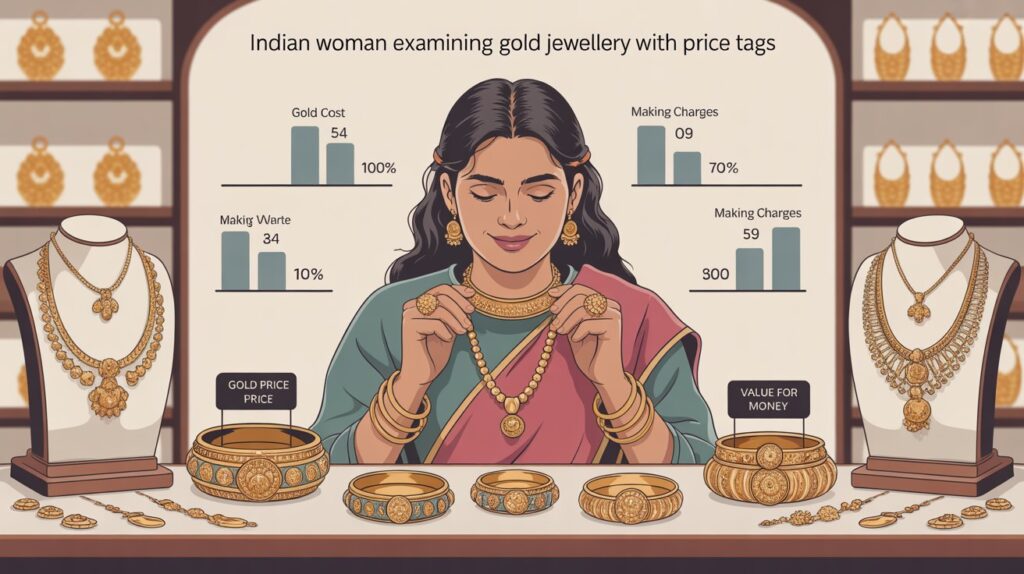
Let us face it. You, me and almost every Indian is very price conscious. Thus every customer wants to have the full value for her money- “Full paisa vasool / Good Deal” This is more so in the case of jewellery retail due to the high costs involved in the purchase. Cost is thus the dominating factor in the purchase decision of a jewellery customer. This cost of jewellery includes the making charges and the cost of the gold paid out as wastage. If this final cost looks affordable and justified to the customer, you, the retailer can make a sale.
So, the first “C” in the purchase decision is COST and as a jewellery retailer, you must position your brand rightly with respect to “cost”.
There are brands where the Making Charges / Value Addition is advertised in Bold while there are other brands like Malabar Gold or Tanishq, which may not be the cheapest in pricing but will want to still offer “Value for Money” for their set of customers. These customers might be very different from the customers for say a price warrior brand, but their customers also believe that the cost is worth it.
2. Confidence- the second “C”
A customer’s confidence in the jewellery brand starts with how the brand meets her expectations right from her first interaction during say marketing communication, her first purchase and goes on to maintain that confidence that is reflected in her repeat purchases and referrals. Word-of-mouth referrals and relatives’ recommendations still form some of the influencing factors of jewellery purchases.
Trustworthiness of a brand is a mark of the confidence the customer has in the jewellery retailer and this is an aggregate of several factors which include purity, pricing, discounts, shopping experience, after-sales service etc. A customer, who feels that the jeweller can give her
the best in all the above factors, has typically won her confidence.
This clearly shows that the “confidence” of the customer in the brand is emerging as the second “C” and it is the most important factor in brand perception and purchase decision.
3. Convenience- the third “C”
Jewellery is still a “touch and feel” market where purchases are made in person. But of late, convenience in jewellery shopping is emerging as one of the decisive factors in jewellery purchase.
Today’s customers are well-informed about the price fluctuations, making charges, wastage, and design options etc. even prior to the actual physical purchase at the shop. The presence of a website or social media like Instagram/ Facebook etc. with a design gallery and price estimates are often appreciated by customers as it helps them in planning their purchase. Such a convenience-driven model of business with knowledge-empowerment is the call of today for jewellery retailers.
This is why Convenience is emerging as the third C in brand positioning or purchase decisions.
Customers look at “customization” as part of the convenience offered by a jeweller. The convenience of customization is an added benefit offered by jewellers. Convenience also means service benefits that the jewellery outlet offers like “home delivery” or”gifting options”.
4. Customer service – the 4th C
A jewellery purchase is an emotional decision for most buyers as they attach great sentimental and personal value to the jewellery they purchase. This is why customers look for a “positive shopping experience” when they come to buy jewellery. This positive shopping experience is founded on the 4th C -customer service.
Customer service involves not only hospitality and friendly greetings but also expertise from the staff. Customers expect well informed staff to guide and advise them on their jewellery choices.
Ganesh Jewellers of Mumbai wish to position themselves with respect to their customer service. Look at what they say –
Right from the marketing communication, the entry to the store/ website, the warm welcome, the store atmosphere, the hospitality gestures, the offers on the merchandise including the range, the price, the design etc. to the customer-handling, everything in your jewellery outlet should enrich the 4th C – the customer service.
The Jewellery industry may see its ups and down regularly, but if you keep these 4 Cs in mind and position your brand or jewellery outlet, you are sure to be the champion of jewellery retail in your market and beyond.





By Invitation
A fun, practical New Year note for jewellery business owners
Wishing You a Healthier, Happier & Wiser 2026 – By Shivaram A
A new year arrives with a new set of—what else—New Year resolutions. And 2026 is no different.
Resolution makers, beware. Research says nearly 80% of New Year resolutions collapse by mid-February. There’s even a name for it: the second Friday of January is officially called Quitters’ Day.
So, here’s the uncomfortable question: Do you want 2026 to be any different, or should we just block your calendar till Quitters’ Day?
If your answer is a serious yes, then it boils down to two things:
- What exactly do you want?
- How badly do you want it?
Because let’s be honest intentions are cheap. Discipline is expensive.
If you’re still reading, congratulations. You haven’t quit yet.
Most business resolutions sound familiar: higher sales, higher profits (or much higher profits), more stores, more customers. And yes—higher gold and silver prices too. On that one, we have very little control… though prayers are always welcome!
But for 2026, let’s look beyond only business numbers and focus on three areas that quietly decide your long-term success.
1. A Healthier You in 2026
A typical day before 2025 (you may recognise this): Late wake-up. Late breakfast. Reaching the store by 11 am—or noon on a “busy” day. Vendor meetings. Lunch at 3 pm. Evening snacks at 6 pm. Endless cups of chai. Store closes at 9 pm. Dinner at 10:30 pm. Netflix or phone scrolling. Sleep well past midnight.
Not everything applies—but enough of it does to make you uncomfortable.
The result? Low energy, rising health reports, and a body that protests quietly… until it doesn’t.
Resolution for a Healthier 2026
Start with a complete health check-up. Think of it as your personal P&L statement—it shows your condition on one specific day.
Identify what I like to call “golden furniture” in the body—parts that have stopped moving but still occupy space.
Then act:
- Better food (not fancy diets)
- Regular movement (not heroic gym resolutions)
- Better sleep (yes, even for business owners)
Warning: Change will be uncomfortable. But so is ignoring the problem.
Set SMART health goals—Specific, Measurable, Achievable, Realistic, Time-bound.
2. A Happier You in 2026
Let’s admit it—becoming happier has rarely featured on a jeweller’s resolution list.

Resolution for a Happier 2026
Make happiness intentional, not accidental.
Start with something simple: one family dinner or friends’ meal every week.
According to the World Happiness Report (based on over 1,50,000 people), those who regularly eat with others report:
- Higher life satisfaction
- More positive emotions
- Fewer negative emotions
One strict rule: phones stay away. If the phone joins the table, happiness leaves early.
3. A Wiser You in 2026
You’ve built a successful business. The numbers prove it. Experience, instinct, and industry knowledge have served you well.
But the world is shifting—fast.
AI. Agentic AI. AI Agents. (And yes, everyone is still figuring out the difference.)

People deep in this space believe AI may have a bigger impact than the internet itself.
The real question is not whether AI will affect jewellery retail—but whether you’ll learn early or catch up late.
For traditional business owners, the willingness to learn and apply new tools is the new unfair advantage.
A Simple 2026 Resolution Action Plan
| Action Area | Example | Final Status – 31.12.2026 |
| Healthier | 30 minutes movement daily | Achieved / Not Achieved |
| Happier | Weekly family dinner | Achieved / Not Achieved |
| Wiser | One AI implementation | Achieved / Not Achieved |
No overthinking. No complex dashboards. Just honest tracking.
Ready to make 2026 different?
If you want help converting good intentions into clear action plans—for health, happiness, or business wisdom—I’m happy to help you think it through.
Let’s ensure you’re still on track after Quitters’ Day.
Here’s wishing you a Healthier, Happier & Wiser 2026.
Call or WhatsApp on 90360 36524
Email: RetailGurukul.com
Jb Exclusive : Digital View


Women’s Day 2026: Jewellery Brands Celebrate Independence, Identity and Self-Expression

Gold Rebounds in India After Five-Day Slide; Dollar Strength Keeps Pressure Intact

Kumari Fine Jewellery Celebrates the “Modern Indian Original” with Exclusive Women’s Day Showcase
Women’s Day 2026: Jewellery Brands Celebrate Independence, Identity and Self-Expression
Gold Rebounds in India After Five-Day Slide; Dollar Strength Keeps Pressure Intact
Kumari Fine Jewellery Celebrates the “Modern Indian Original” with Exclusive Women’s Day Showcase
-
 JB Insights4 hours ago
Women’s Day 2026: Jewellery Brands Celebrate Independence, Identity and Self-Expression
-
 National News8 hours ago
Gold Rebounds in India After Five-Day Slide; Dollar Strength Keeps Pressure Intact
-
 National News9 hours ago
Kumari Fine Jewellery Celebrates the “Modern Indian Original” with Exclusive Women’s Day Showcase
-
 National News13 hours ago
This Women’s Day, Dhirsons Jewellers Celebrates the Milestones in a Woman’s Journey