International News
Is the worst of tariff war behind us? : AUGMONT BULLION REPORT
By: Dr. Renisha Chainani , Head-Research, Augmont – Gold


The bulls dominated the first few weeks of April, while the bears, who tested the $3200 mark in gold, dominated the final two weeks. Gold prices have corrected almost 8% from their high as the worst of the tariff war is behind us.
But despite the peak in tariff rates, uncertainty has not. Even though markets are breathing easier, investors should not assume that the situation is over. If headline tariff rates remain unchanged, the true danger is long-term policy uncertainty. Making significant agreements during the current difficulties will not be easy. A protracted era of trade fragmentation and policy uncertainty poses a greater risk, even if we have already witnessed peak tariffs.
According to US President Donald Trump, there is a high likelihood that a deal will be reached with China. He also mentioned that they have “potential” trade agreements with South Korea, Japan, and India. As China announced it is evaluating a U.S. proposal to hold trade negotiations, the study was released. The nation is eager to engage in negotiations, but only if the Trump Administration lowers the 145% tax it placed on Chinese goods last month.
The Federal Reserve’s monetary policy choices on May 7 may be the next significant catalyst for gold prices. Following the May 6-7 policy meeting, it is generally expected that the Fed would maintain the interest rate at a level between 4.25 and 4.5%. Market players will closely examine the policy statement’s modifications and listen to Fed Chairman Jerome Powell’s remarks during the press conference held after the meeting.
The USD may gain strength and cause a leg lower in gold if the Fed suggests that the increased uncertainty around the inflation forecast brought on by trade policy would probably compel them to be patient about rate adjustments. Conversely, gold would rise if the Fed emphasised the deteriorating labour market and economic outlook more, which would support forecasts of a 25 basis point policy rate cut in June.
Technically, if Gold prices sustain below $3210 (~Rs 92000) this week, they may fall towards $3140 (~Rs 90500). On the higher side, $3300(~Rs 94000) is the resistance level, which prices need to sustain, to climb higher towards $3360 (~Rs 95500).









International News
Nike Enters Jewellery Market With First-Ever Collection Priced Up To $5,750
The Sportswear Giant Expands Into Jewellery, Bringing Its Brand Identity To A New Category With Premium-Priced Pieces.

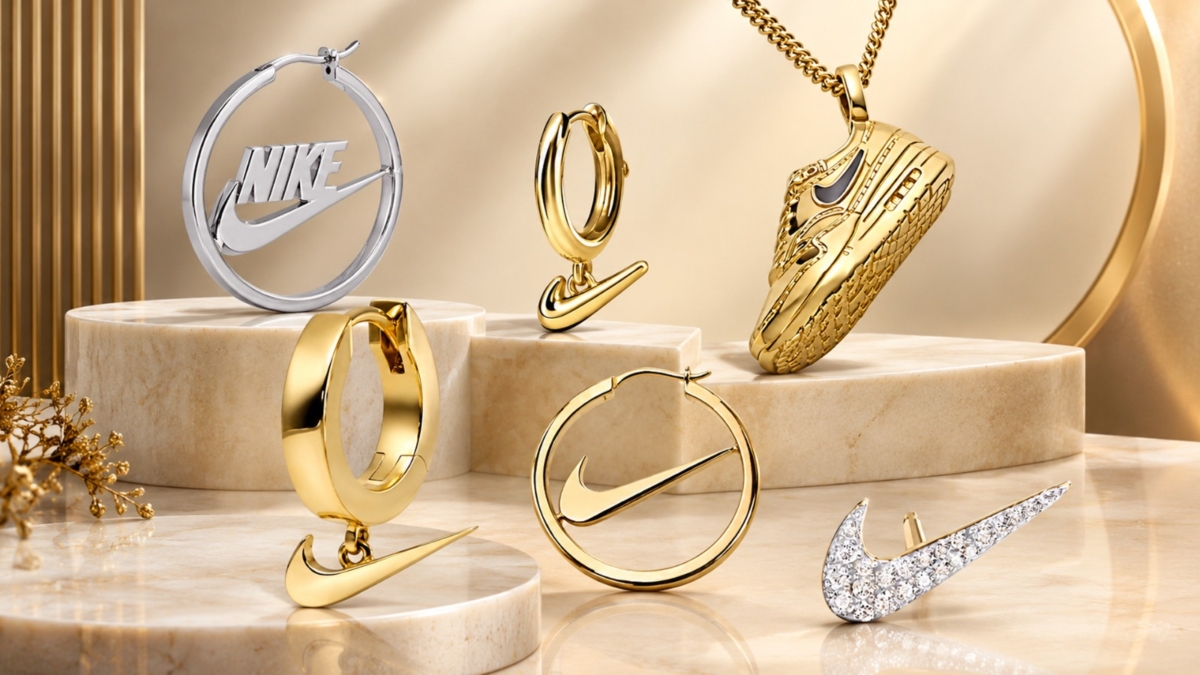
Nike is extending its brand into the jewellery market with its first dedicated jewellery collection, featuring necklaces, earrings and pendants inspired by its signature designs. The range includes a miniature Air Force 1 pendant necklace priced at $5,750, making it the collection’s standout piece.
The lineup also features a crystal-covered Swoosh necklace at $1,750, Swoosh earrings priced at $995 and an Air Max 1 pendant at $395. More accessible designs include Swoosh necklaces and hoop earrings in silver and gold finishes.
The collection combines sportswear culture with premium accessories, transforming Nike’s recognisable logos and footwear silhouettes into wearable jewellery. The range is scheduled to begin releasing through Nike’s SNKRS platform on 29 October 2026, with availability varying by design.



Malabar Gold & Diamonds Unveils ‘SWAYE’, A Natural Diamond Collection Inspired By Spiral Forms and Modern Elegance

Nike Enters Jewellery Market With First-Ever Collection Priced Up To $5,750

Kylie Jenner Debuts At Victoria’s Secret Show In $50 Million Fantasy Bra By Jacob & Co.
Malabar Gold & Diamonds Unveils ‘SWAYE’, A Natural Diamond Collection Inspired By Spiral Forms and Modern Elegance

Limelight Lab Grown Diamonds Crosses 100 Stores Milestone This Dussehra: Targets 200 In 2027
Kylie Jenner Debuts At Victoria’s Secret Show In $50 Million Fantasy Bra By Jacob & Co.
-
 BrandBuzz3 hours ago
Malabar Gold & Diamonds Unveils ‘SWAYE’, A Natural Diamond Collection Inspired By Spiral Forms and Modern Elegance
-
 National News2 days ago
Limelight Lab Grown Diamonds Crosses 100 Stores Milestone This Dussehra: Targets 200 In 2027
-
 DiamondBuzz3 hours ago
Kylie Jenner Debuts At Victoria’s Secret Show In $50 Million Fantasy Bra By Jacob & Co.
-
 International News3 hours ago
Nike Enters Jewellery Market With First-Ever Collection Priced Up To $5,750