JB Insights
GSI blends theory, lab practice, and storytelling to create resonant, expert-led retail training


GSI’s retail training bridges the gap between brand vision and sales execution through tailored, hands-on sessions. Deepa Srinivasa, Chief Gemologist, GSI-India speaking to JewelBuzz underscores the fact that by combining global insights with immersive storytelling and advanced gemology beyond the 4Cs, GSI equips Indian retailers to handle complex queries, elevate gemstone value, and build lasting customer trust through expert, consultative selling.
1. How are GSI’s retail training programmes tailored to address the specific operational and sales challenges faced by jewellery retailers across India?
Retailers often face a gap between their vision and the way that vision is communicated to their teams. Many sales executives are well-versed in the 4C’s of diamonds, but struggle to address complex customer queries or objections may it be with regards to lab grown diamonds or natural fancy-colored diamonds and such. Also, gemstones are getting popular and customers are keen to invest in them. However, though you may have tanzanites, morganites or kyanite in your inventory and your sales teams call them just as semi-precious stones lowers the value and opportunity for engagement with the customer. GSI bridges this gap by curating tailored sessions which are a balanced mix of theoretical and lab sessions using dynamic storytelling techniques that help present information in a way that resonates with customers.
2. In what ways does the programme train retail teams in storytelling, role plays, and consistent brand language at the customer interface?
Our role-playing exercises go far beyond the typical “scripted” method, and dive deeper into real-world challenges. It involves right from postures, mannerisms, speech, terminology, creative ideas and thinking, and much more. We immerse teams in complex problem-solving scenarios that reflect the actual challenges they can possibly face on the sales floor. We equip them with the tools to handle objections effectively, giving them a comprehensive understanding of how to present information and keep customers engaged.
3. How does GSI’s curriculum go beyond the traditional 4Cs to instill confidence?
The 4Cs, though essential, aren’t real differentiators. That is why, our curriculum goes deeper by teaching advanced concepts like light performance in diamonds & Hearts & Arrows. Our curriculum focuses on how the 4C’s and beyond such as unique fancy shapes, jewelry settings, metals , textures etc. can be absorbed and communicated in sales. We also make our curriculum interesting by teaching teams on how to pair diamonds with specific metals, or explain the intricate details of a jewelry piece’s craftsmanship. This enables teams to interact with customers on a more meaningful and expert level.
4. What value does hands-on training with real diamonds, gemstones, and advanced GSI instruments bring to retail professionals?
It’s one thing to know theory; it’s another to experience it. Hands-on training is like adding the cherry on top, and equips retail teams to offer a more consultative approach to sales. When they understand the full scope of a stone, from its technical properties to how it fits into the broader context of a customer’s needs; they can confidently upsell and cross-sell, knowing they’ve mastered knowing gemstones from every possible angle.
5. How does learning directly from GSI’s experienced gemologists and faculty strengthen technical knowledge and sales confidence?
GSI’s team aren’t just theoretical instructors; they’re active professionals in the field. They deal with real stones every day, constantly refining their expertise with the latest research and advancements. They follow retail closely and update themselves with latest developments in retail may it be new settings and current and upcoming trends. When they teach, they don’t just share book knowledge, they bring real-time industry insights into the classroom. The sales teams aren’t just learning from experts, but from those shaping the future of the industry.
6. How does certification from GSI’s headquarter in New York enhance a retailer’s credibility and trust in both domestic and international markets?
Certification from GSI’s headquarters in New York carries global recognition that motivates the sales personnel that they have earned a badge from an international institution. As a brand, GSI is affiliated and accredited by several renowned councils and bodies worldwide, boosting a retailer’s credibility in both domestic and international markets.
7. How are sales techniques customised within the programme to help retailers address evolving consumer expectations and buying behaviour?
Our training programs are built to adapt to the shifting dynamics of consumer behavior. We start by analyzing each retailer’s specific market, inventory, customer base, and brand ethos as a whole. This allows us to design training that addresses not just current buying trends, but the complex ways in which consumers make decisions today. Our training program evolves with the market, ensuring that sales teams are trained to respond thoughtfully to every encounter and is capable of anticipating customer expectations.
8. What makes GSI’s retail training programmes relevant across regions, while also integrating global market perspectives?
Our labs are strategically located across regions, giving us deep insights into local consumer behavior and sales techniques. When developing our training programs, we ensure they are globally relevant by collaborating with seasoned experts from both our domestic and international branches. This cross-functional input and feedback allows us to create training materials that blend local market knowledge with global best practices. Once the foundational content is set, we customize it including delivering the program in various languages, further to meet the specific needs of each retailer, which results in a very refined global training program.
9. How does GSI support continuous learning and upgradation for retailers as gemstone treatments, diamond technology, and consumer awareness evolve?
As the jewelry industry evolves, GSI ensures that retailers stay ahead of the curve. Our training programs are structured to support any ongoing development. With multiple levels and specialized topics, retailers can continue advancing their expertise long after the initial course. We also conduct regular assessments to gauge retention and offer refresher sessions as needed. This helps retail teams remain informed, adaptable, and equipped to handle new challenges in the market.
10. From a long-term perspective, how do these training programmes help retailers build customer trust, improve conversions, and strengthen brand loyalty?
Today’s customers are savvy, they can tell when they’re being sold to, and when they’re truly understood. They want guidance and hand holding in their purchases, and effective guidance comes from sales teams that are informed and learning each day to become experts. That’s where our training makes a difference. When retailers invest in our programs, the proof is in the pudding: better-trained teams lead to more confident consultants, leading to better customer relationships. This creates more experience-driven interactions that build trust, loyalty, and repeat business.
JbExclusiveL:Digital view


JB Insights
Silver Wholesale Goes Digital: How India’s 925 Silver Trade Is Changing The Way It Buys and Sells
The buyers on the wholesale side have changed too. Alongside the traditional jeweller, the trade now serves Instagram and WhatsApp sellers working from home, marketplace sellers, and first-time founders building their own jewellery brands online

By BanwariLal Bamalwa CEO | Director, GlamBug Mart Pvt Ltd

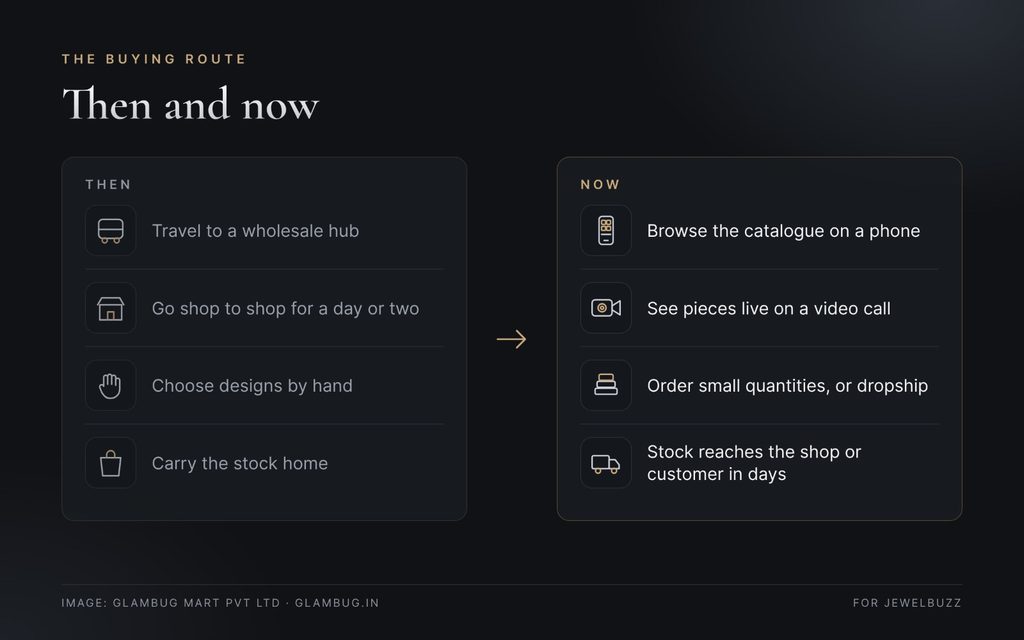
For decades, buying silver jewellery wholesale in India followed a familiar route. A retailer from a smaller town would travel to a wholesale hub, spend a day or two going from shop to shop, choose designs by hand, settle the price by weight, and carry the stock home. The model worked, but it favoured buyers with time, travel budgets and the capital to hold inventory.
That route is now changing quickly.
A New Kind Of Buyer
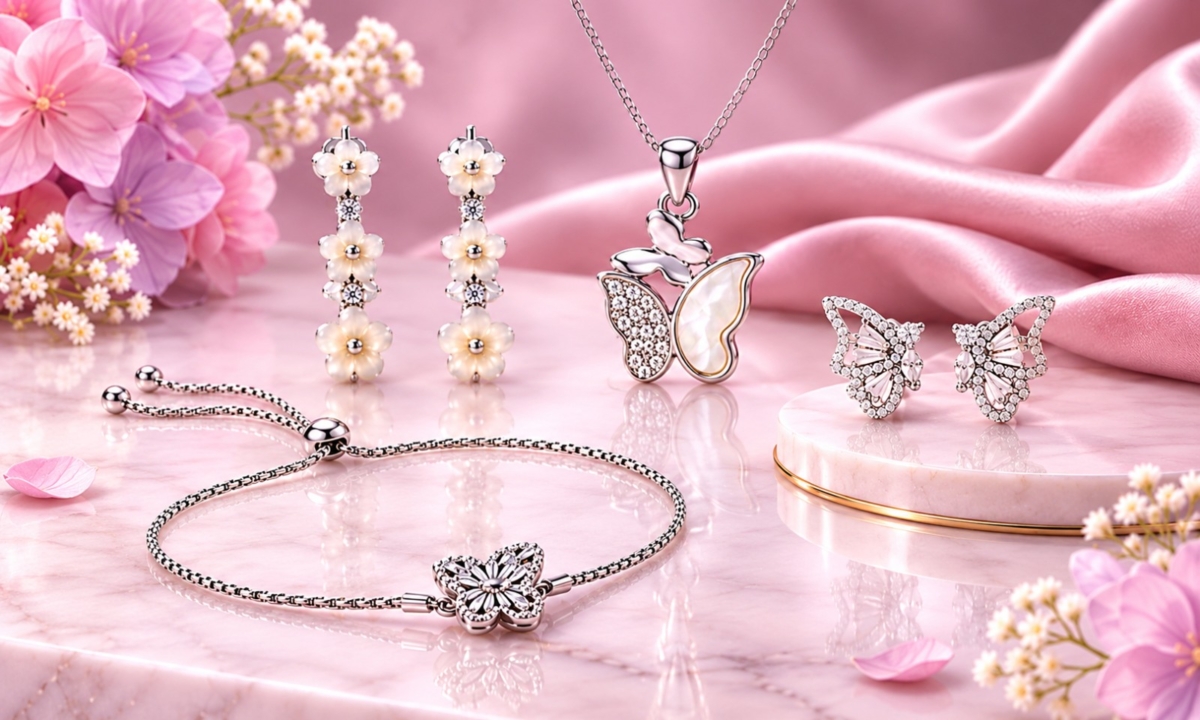
925 sterling silver has become one of the most active categories in Indian jewellery. As gold has grown more expensive, silver has found a wider audience in everyday fashion, gifting and festive wear, especially among younger customers.
The buyers on the wholesale side have changed too. Alongside the traditional jeweller, the trade now serves Instagram and WhatsApp sellers working from home, marketplace sellers, and first-time founders building their own jewellery brands online. Many of them have never visited a wholesale market. They want to see designs on a phone, order in small quantities, and have stock reach them, or their customer, within days.
Four Shifts In How The Trade Works
1. Catalogue apps are replacing market visits. Wholesalers are moving their catalogues into B2B apps where approved buyers can see designs, weights and per-gram rates, and send an enquiry for a quotation. Pricing by weight, once negotiated at the counter, is becoming visible and consistent.
2. Video calls are replacing the showroom. For buyers who still want to see a piece before ordering, live video selection lets them check finish, size, clasps and hallmarks on camera without travelling.
3. Dropshipping is lowering the cost of entry. A growing number of small sellers start with no inventory. They list designs online, and the wholesaler packs and ships each order directly to the end customer. For a home-based reseller, this removes the biggest barrier to starting: the cost of stock.
4. Integration is replacing manual updates. Online brands on platforms such as Shopify increasingly expect a supplier’s catalogue, stock levels and order flow to connect directly to their store, rather than copying product details and updating stock by hand.
Trust Becomes The Product
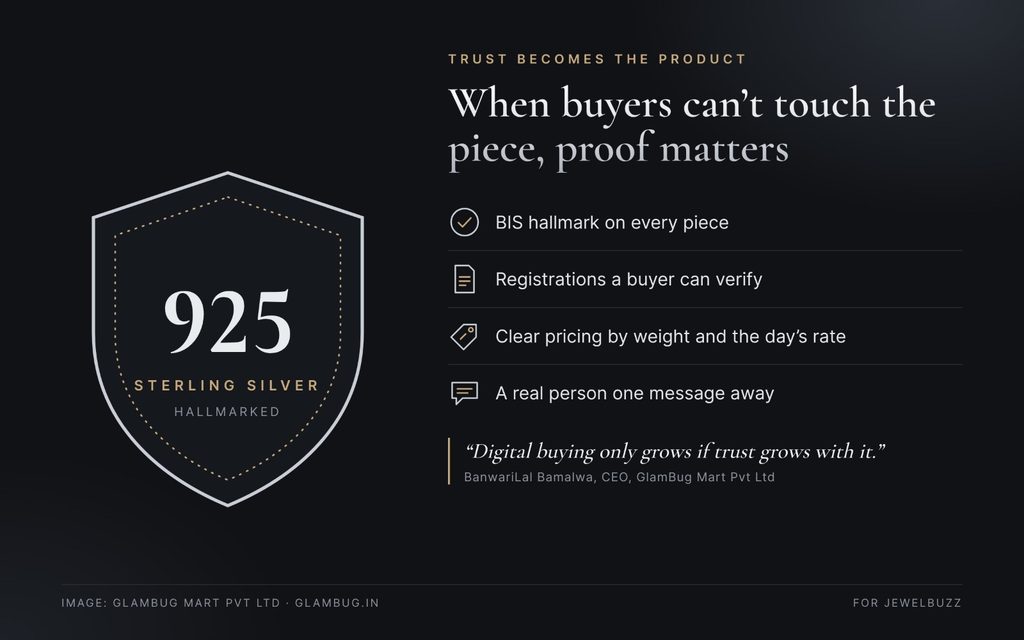
When buyers can no longer hold a piece before paying for it, trust becomes the deciding factor. Purity concerns are among the biggest worries for online jewellery shoppers and new resellers, and this is pushing hallmarking and verifiable registrations to the front of the buying decision.
Online, a buyer cannot touch the piece, so the first question is whether the silver is genuine. A supplier who openly shares their BIS registration and other credentials makes that question easy to answer. Digital buying only grows if trust grows with it.
GlamBug’s own path reflects the wider shift. The company, which imports from Italy, Turkey and Hong Kong and has held BIS hallmark registration since 2020, has over the past two years added a B2B catalogue app, video-call selection, dropshipping, a Shopify app and an API for partners, alongside its traditional wholesale business.
Our buyers changed before we did.A jeweller in a smaller town and a reseller working from home both want the same thing: to order quickly, with clear pricing and genuine silver. Technology is simply how we meet them where they already are.
The Challenges Ahead
The shift is not without friction. Silver prices can move sharply, which makes quotations harder to hold. Many traders now attach a validity window to each quote and price strictly by weight and the day’s rate. Small orders and direct shipping add packaging and logistics costs. And as more sellers enter the market, discounting can quickly erode thin margins.
Industry participants also point out that technology does not replace relationships. Many jewellers still value a call with a trusted supplier, and the most successful digital models keep a human contact a message away.
What It Means For The Trade
Digital wholesale is not replacing the traditional jeweller. It is widening the market. The same retailer who once bought only at the counter can now reorder from an app, and sellers who could never afford a showroom can build a business on hallmarked silver.
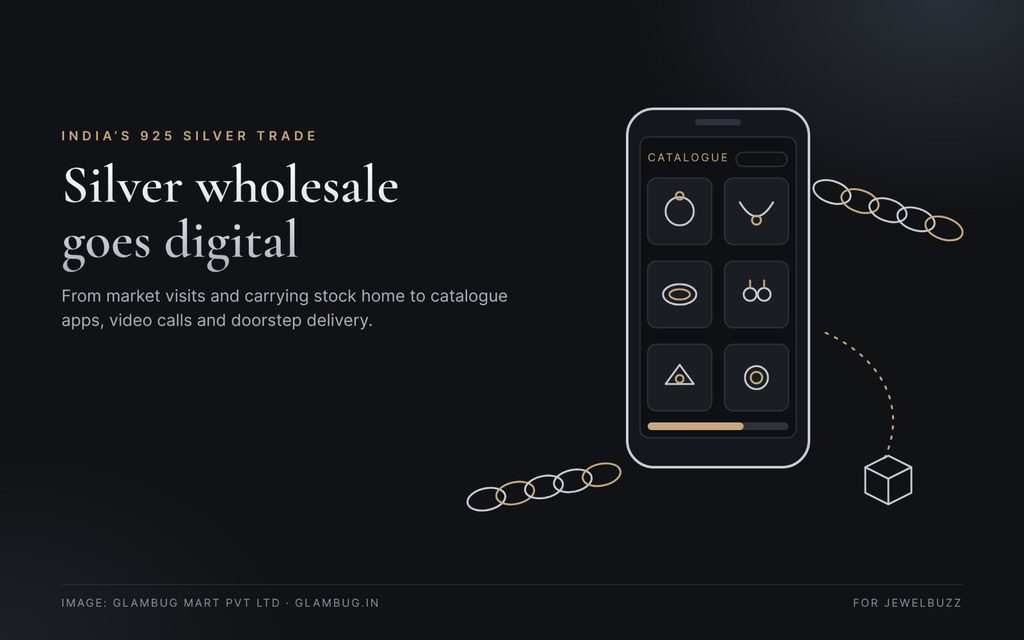
For wholesalers, the message is becoming clear: digitise the catalogue, make purity and registrations easy to verify, lower the barriers for small buyers, and connect to the platforms buyers already use. The buyers have already moved online. The trade is now catching up.


5 Solitaire Engagement Rings by Divine Solitaires for Brides with Different Personal Styles

RBI To Meet Top NBFC Chiefs; Gold Loan Repayments, Cyber Risks To Be Focus Areas

De Beers Group In Collaboration With Grandview Klein Diamond Unveils Namibia’S 176 Carat Owishi Natural Diamond In Washington, Dc
De Beers Group In Collaboration With Grandview Klein Diamond Unveils Namibia’S 176 Carat Owishi Natural Diamond In Washington, Dc
RBI To Meet Top NBFC Chiefs; Gold Loan Repayments, Cyber Risks To Be Focus Areas
5 Solitaire Engagement Rings by Divine Solitaires for Brides with Different Personal Styles
-
 DiamondBuzz5 hours ago
De Beers Group In Collaboration With Grandview Klein Diamond Unveils Namibia’S 176 Carat Owishi Natural Diamond In Washington, Dc
-
 DiamondBuzz4 hours ago
RBI To Meet Top NBFC Chiefs; Gold Loan Repayments, Cyber Risks To Be Focus Areas
-
 National News3 hours ago
5 Solitaire Engagement Rings by Divine Solitaires for Brides with Different Personal Styles
-

 National News8 hours ago
GJC Reassures Industry and Consumers; Calls For Vigilance Amid Reports Of Suspected Gold Adulteration Materials