International News
Geopolitical risks rise, but strong dollar limits gold and silver upside AUGMONT BULLION REPORT


Gold prices have established support at approximately $5000, while silver has stabilized near the $80 mark. These levels represent critical support zones amid volatile market conditions driven by competing economic narratives.
Currency Strength and Safe-Haven Positioning
The U.S. dollar has strengthened substantially, breaking above the 100 index level. This appreciation reflects investor preference for dollar-denominated assets as geopolitical uncertainty intensifies in the Middle East. The greenback’s strength can be attributed to two primary factors:
- Energy Independence Advantage: The U.S. maintains structural advantages as a net crude exporter, positioning it more favorably than other developed economies heavily dependent on imported oil.
- Geopolitical Risk Premium: Recent military escalation, including the largest U.S. military strikes against Iranian targets and continued blockade of the Strait of Hormuz, has reinforced the dollar’s safe-haven status.
Macroeconomic Constraints on Precious Metals
Economic Growth Slowdown
Recent data revisions indicate Q4 2025 annualized GDP growth decelerated to 0.7%, introducing genuine concerns regarding economic momentum. This slowdown conflicts with traditional precious metals demand narratives and undermines the typical inverse relationship between economic growth and precious metals investment.
Inflation and Monetary Policy Expectations
The Personal Consumption Expenditures (PCE) inflation rate has moderated to 2.8% annually, yet crude oil prices exceeding $100 per barrel threaten to reverse disinflationary momentum. The Federal Reserve has postponed anticipated interest rate cuts to September 2026, a significant shift that disadvantages non-yielding assets such as precious metals and gold.
Oil Price Dynamics and Regional Economic Impact
Inflationary Pressures from Energy Markets
Crude oil prices climbing above $100 per barrel present a dual challenge: they sustain inflation concerns while simultaneously supporting dollar strength as investors seek U.S. assets. Market participants have effectively eliminated expectations for multiple Federal Reserve rate cuts in 2026, recognizing the inflationary implications of elevated oil prices.
Asymmetric Economic Exposure
The geopolitical conflict between the U.S. and Iran creates asymmetric economic consequences:
- Vulnerable economies: Japan and the eurozone face severe economic headwinds due to heavy reliance on crude imports
- Insulated markets: The United States maintains relative insulation, having functioned as a net crude exporter for nearly a decade
Policy interventions, including President Trump’s partial 30-day waiver on sanctioned Russian oil purchases, represent attempts to moderate price escalation, though effectiveness remains uncertain.
Physical Markets and Retail Demand Deterioration
Indian Bullion Market Dynamics
Indian bullion dealers have extended discount offerings to unprecedented levels, reaching $83 per ounce over domestic official pricing (inclusive of 6% import and 3% sales levies)—the highest discount observed since July 2016, compared to $28 the previous week. This dramatic expansion in dealer discounts reflects profound weakening in retail demand.
Jewelry Sector Weakness
The jewelry sector exhibits particular vulnerability, with jewelers demonstrating minimal purchasing activity as they prioritize year-end financial accounting. Weak retail demand transmission throughout distribution channels suggests limited near-term support for precious metals prices at current levels.
The convergence of dollar strength, delayed rate-cut expectations, elevated oil prices, and weakening physical demand creates a challenging environment for precious metals. While geopolitical instability typically supports precious metals valuations, the current macroeconomic framework—characterized by economic deceleration, monetary policy tightening bias, and currency appreciation—has effectively neutralized traditional safe-haven appeal in favor of dollar accumulation and higher-yielding alternatives.
Gold is currently holding a critical support level near $5,000 (~ Rs.156,000), which remains an important technical floor for the market. A decisive break below this level could trigger further downside, with the next key support emerging around $4,850 (~ Rs.150,000). Conversely, if prices manage to stabilize and rebound from current levels, gold could regain upward momentum and potentially move toward $5,200 (~ Rs.164,000), followed by $5,250 (~ Rs.165,000) in the near term).
Source: AUGMONT BULLION REPORT


International News
Gold Prices On Track To Reach $4,900/oz By End 2026 :Goldman Sachs
Goldman’s $4,900/oz Forecast Assumes Central Bank Demand Averages 50 Tonnes Per Month In 2026 and 40 Tonnes Per Month In 2027

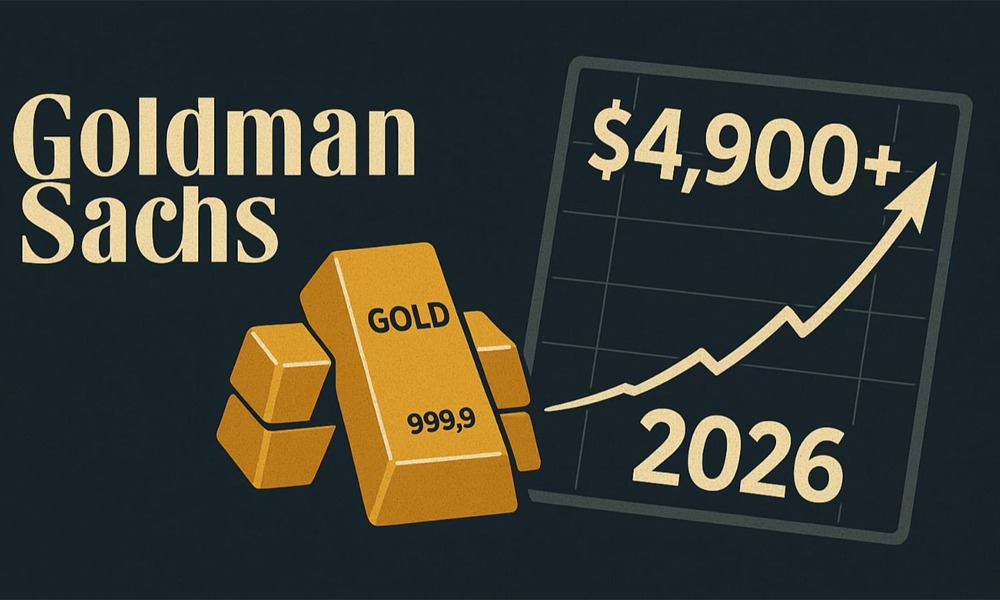
Gold prices are on track to reach $4,900 per ounce by the end of 2026, driven by aggressive central bank purchases—led by undisclosed buying from China—and recovering exchange-traded fund (ETF) demand, Goldman Sachs said in a research note.
The bank maintained its bullish base-case target for bullion while warning that positioning in options markets could amplify price volatility in both directions. Central banks accumulated an estimated 44 tonnes of gold in July, well above the pre-2022 monthly average of 17 tonnes, according to Goldman Sachs’ nowcast model. On a three-month seasonally adjusted basis, central bank buying stood at 91 tonnes per month.
China was the primary driver, with Goldman estimating the People’s Bank of China bought 35 tonnes in July—roughly 75% more than official public disclosures indicated.
To account for unreported sovereign purchases, Goldman’s model tracks physical bullion flows through London’s over-the-counter (OTC) market into custodian vaults. The Bank of England’s central bank holdings alone rose by 63 tonnes in July, exceeding outflows from the Federal Reserve Bank of New York.
Price Risks and Volatility
Goldman’s $4,900/oz forecast assumes central bank demand averages 50 tonnes per month in 2026 and 40 tonnes per month in 2027, alongside steady Federal Reserve policy and a rebound in private ETF inflows.
However, analysts noted that elevated demand for gold call options—used by investors to hedge against macroeconomic and geopolitical risks—creates mechanical upside and downside risks:
Bullish Case: Continued strong ETF inflows combined with existing call option positioning could force options dealers to buy underlying metal to hedge short exposure, pushing prices “well above” $4,900.
Bearish Case: If the Federal Reserve resumes interest rate hikes, unwinding hedge positions and triggering ETF outflows, gold could drop to $4,440/oz by end-2026. Goldman noted that ongoing central bank buying would limit further downside.
Goldman expects the Federal Reserve to remain on hold through 2026 as inflation cools, removing a key interest rate headwind for the non-yielding asset.


-

 ShowBuzz5 hours ago
SSI 2026 SETS A BIGGER STAGE FOR SILVER
-

 ShowBuzz9 hours ago
Silver Trends To Watch At SSI Delhi 2026
-

 ShowBuzz9 hours ago
Silver Show Of India- Delhi 3rd Edition Unveiled At Yashobhoomi, Delhi
-

 ShowBuzz12 hours ago
GJIIF 2026 Sets New Benchmarks As India’s Biggest-Ever Jewellery Trade Show Opens In Chennai