
By Invitation
Diamonds: Natural, grown, and their needs for differentiation in the global jewellery market
Exploring the Rise of Natural and Lab-Grown Diamonds: Key Factors Shaping Differentiation in the Global Jewelry Market


The debate between lab grown diamonds and naturals doesn’t seem to die down. Natural diamonds have had an unfettered rule in the global fine jewellery business for centuries until technological advancement allowed lab-grown diamonds, hitherto used in machine tools and cutting, found their way successfully into the fashion and jewellery space purely based on two reasons : perceived identical appearance and a staggeringly low price. Their entry into the market created a space for affordable jewellery, but they are not designed or are equipped to take over the natural diamond market. That’s because they are different and can be scientifically identified as such.
Far from disrupting the prominence of natural diamonds, LGDs have emerged as a complementary force, addressing distinct consumer needs while broadening the appeal of diamond jewelry. But, let’s understand the purpose and appeal of each category.
Natural diamonds continue to hold an unparalleled allure, deeply rooted in their rarity, geological history, and cultural heritage. They symbolize luxury, timelessness, and emotional significance, often marking milestone moments like engagements, weddings, and the creation of family heirlooms. Spending billions of years to be formed under the earth’s surface, natural diamonds command admiration from customers who associate lasting happiness and joy with the person they are buying it for, be it a self-purchase or a gift. Its journey of formation itself carries that value which, thanks to rising awareness, is of great value to its target audience irrespective of age barriers. Such consumers prioritize provenance, ethical sourcing, and origin determination, which reinforce the enduring appeal and exclusivity of natural diamonds.
On the other hand, lab-grown diamonds have carved out their own niche in the global jewelry market, starting with eco-conscious Millennials and Gen Z consumers in the United States. These synthetic diamonds appeal to buyers seeking sustainable and affordable alternatives. In India, a global hub for jewelry, the demand for LGDs is still at its nascent stage, because consumers are still understanding the product. Hence, there is a slow but steady growth in demand driven by their cost-effectiveness and the growing adoption of Western fashion sensibilities. Offering flexibility in design, LGDs are well-suited for trendy, everyday jewelry that embraces unconventional materials such as silver, tungsten, and titanium. They provide consumers with the freedom to explore unique styles while aligning with contemporary values of affordability and sustainability.
The distinction between natural and lab-grown diamonds is not merely academic—it is vital to maintaining consumer trust. Nomenclature is of paramount importance in this regard, as there are several ways to identify a lab-grown diamond. Since they are created in a controlled environment, their origin is different from those built by nature, and hence, must be positioned accordingly to extend confidence to customers of either segment. Thus, while both have their own value propositions, transparency in branding and communication is essential. Lab-grown diamonds should be presented as a distinct category, emphasizing their origin and purpose, rather than being combined with natural diamonds.
As the diamond industry evolves, embracing the differences between natural and lab-grown diamonds is key to unlocking their full potential. Each caters to specific consumer preferences—natural diamonds for their legacy and emotional resonance, and lab-grown diamonds for their modern, versatile appeal. Retailers and stakeholders must adopt tailored marketing strategies and far better quality in certification and grading standards to give consumers exactly what they bought their products for. While the entire supply chain needs to be strongly educated to firstly identify the differences and sell the right jewellery, retailers especially need to refine marketing messages to effectively communicate these unique value propositions. This can be done by conducting awareness workshops for end-consumers and often showcasing both varieties to them just for knowledge. All in all, by fostering transparency, differentiation, and synergy within the supply chain, the industry can ensure the sustainable growth of both segments, securing a bright future for diamond jewelry on a global scale.





By Invitation
From Prompt To Pendant: How AI Is Turning Jewellery Buyers Into Designers
By Dr Sandip P. Dhurat

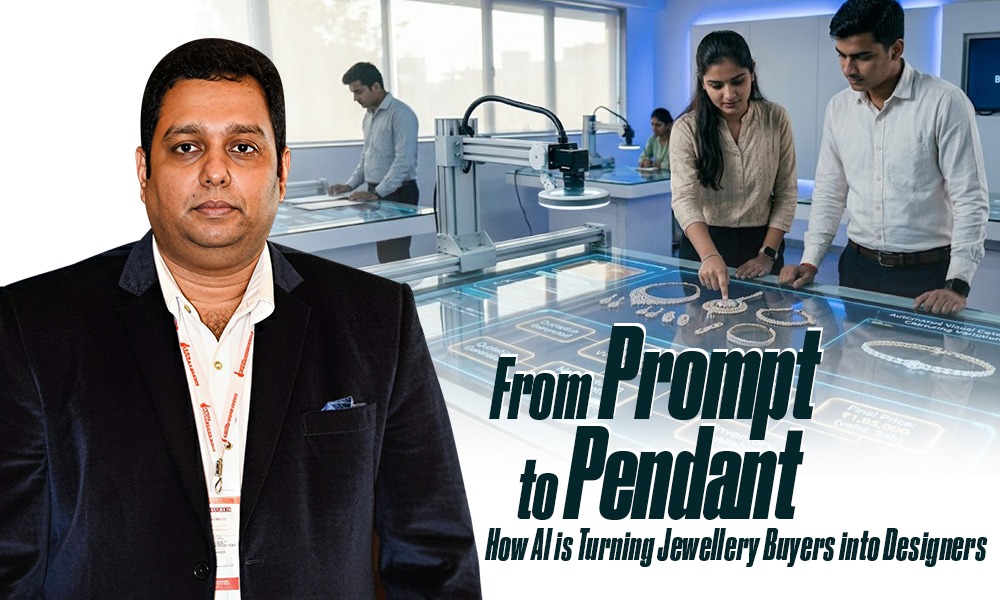
Not long ago, jewellery design was largely a one-way conversation. Consumers browsed catalogues, visited stores, or selected pieces from showcases. If they wanted something custom-made, they relied on the jeweller’s sketches, imagination, and expertise.
Today, a new collaborator has entered the room: Artificial Intelligence.
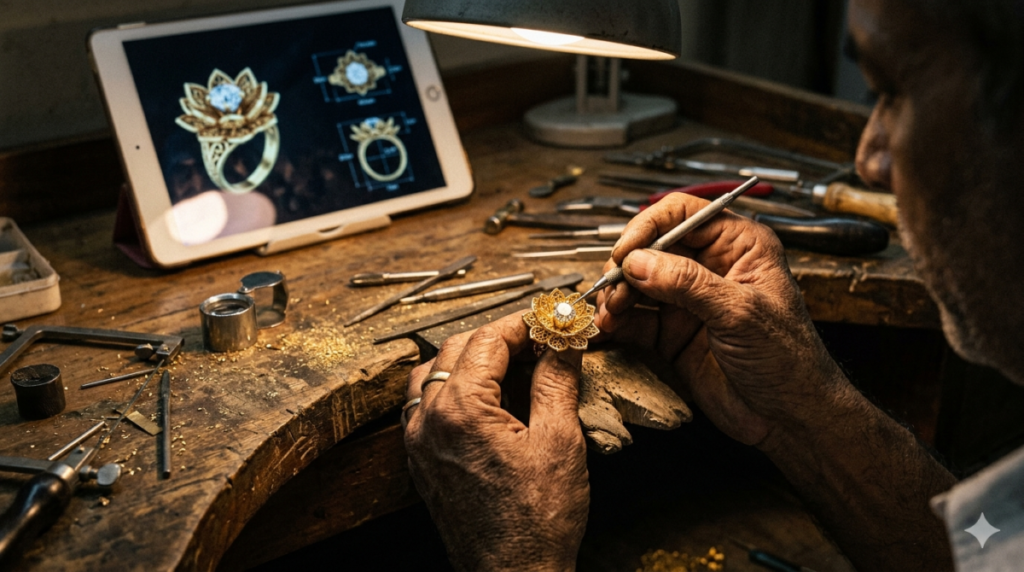
Across age groups, consumers are experimenting with AI-powered image generators and design applications to create jewellery concepts that reflect their personal tastes. A few words typed into a prompt—”an emerald engagement ring inspired by lotus petals” or “a contemporary mangalsutra with geometric motifs”—can generate multiple design possibilities within seconds.
What happens next is perhaps the most interesting part of the story.Instead of ordering these pieces online, many consumers are taking their AI-generated designs to the one person they trust most: their family jeweller.
The new wave of customisation
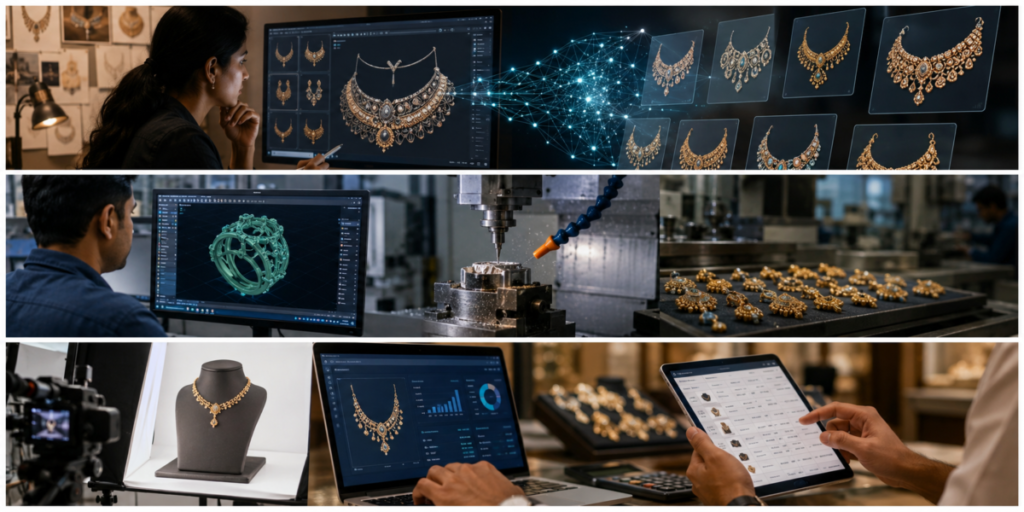
For decades, customization in jewellery was often limited to engraving names, changing gemstones, or making minor design alterations. AI is expanding that possibility dramatically.
Consumers are no longer arriving at jewellery stores with vague ideas. They are walking in with detailed visual references generated on their smartphones. Some have experimented with dozens of versions before settling on a favourite. Others blend elements from different designs to create something entirely unique.
In a sense, AI is democratizing the design process. It allows consumers to participate creatively, even if they have no formal design background.
For younger buyers especially, this level of involvement is appealing. They want jewellery that feels personal, expressive, and different from what everyone else is wearing. AI gives them a playground where they can explore possibilities before making a purchase.
Role of traditional family jeweller
If AI can generate designs so easily, does that diminish the role of the jeweller?Quite the opposite.
While AI can create attractive images, it cannot determine whether a design is structurally sound, comfortable to wear, practical to manufacture, or durable enough for daily use. A ring that looks spectacular on a screen may be impossible to cast. A delicate bracelet generated by AI may not withstand regular wear.
This is where the expertise of the jeweller becomes invaluable.
Family jewellers are increasingly acting as interpreters between digital imagination and physical reality. They assess AI-generated concepts, refine proportions, suggest technical modifications, and ensure that the final piece balances aesthetics with craftsmanship.
Many jewellers describe the process as similar to working with a client-provided sketch—except the sketch is now more sophisticated and visually detailed.
The trust factor remains unchanged. Consumers may discover designs through AI, but they still want someone they know to guide the process and stand behind the finished product.
New collaboration trend
The relationship between customer and jeweller is evolving from buyer-and-seller to co-creators.
Consider a young couple designing an engagement ring. Instead of selecting from existing collections, they use AI to explore various combinations of settings, gemstones, and motifs. They then sit down with their jeweller to discuss feasibility, budget, stone availability, and craftsmanship.
The final piece is neither entirely AI-designed nor solely jeweller-designed. It is the outcome of a collaborative journey.
This shift creates opportunities for jewellers to engage customers more deeply. Conversations become richer because customers arrive with visual ideas rather than abstract descriptions.
In many cases, the design process becomes part of the emotional value of the jewellery itself.
The opportunity
The trend presents several advantages for jewellers willing to embrace it.
First, AI-generated concepts can serve as conversation starters. Instead of spending significant time understanding a customer’s vision from scratch, jewellers can begin with a visual reference and refine it together.
Second, it can increase demand for bespoke jewellery. Consumers who might never have considered custom design are discovering how accessible it has become.
Third, it opens the door to a new generation of buyers who value individuality over mass-produced designs.
Rather than competing with AI, jewellers can position themselves as the experts who transform digital concepts into heirloom-worthy creations.
Despite all the excitement around AI, jewellery remains an intensely human product.
A necklace gifted on a wedding day, a ring marking an engagement, or a bracelet passed down through generations carries emotions that no algorithm can replicate. AI may help generate ideas, but it cannot understand family traditions, cultural significance, sentimental stories, or the subtle nuances of personal taste.
Consumers are discovering designs through technology, but they are still seeking reassurance, expertise, and craftsmanship from people they trust.
Perhaps that is the real story behind this trend.
AI is not replacing the jeweller. It is empowering consumers to participate in the creative process while making the jeweller’s role even more valuable. The screen may provide the inspiration, but it is the skilled hand of the jeweller that transforms a digital concept into a treasured piece of jewellery.
In the years ahead, the most successful jewellers may not be those who resist AI, but those who embrace it as another tool in the ongoing art of personalization—where technology sparks the idea, and craftsmanship gives it life.


-
 National News1 day ago
Palmonas Unveils The Palmonas X Tanya Ghavri Collection
-

 BrandBuzz1 day ago
De Beers India Introduces ‘Love, From Hubby’, A New Ritual For A Second Season Of Love
-

 National News1 day ago
Precious Metals Prices Remain Broadly Steady
-

 National News2 days ago
Maharashtra Industries Minister unveils GJC Diwali Edition 2026 at JWCC, Mumbai
