
National News
Gold faces selling pressure, MCX Gold sees single day drop of Rs 11000
Price drop highlights the fragility of safe-haven premiums in the face of a strengthening US dollar and shifting treasury yields.

The gold faced selling pressure on Thursday, reversing gains seen in the previous two sessions. 24 Karat gold dropped by Rs 109 to around Rs 16,237 per gram, while 22 Karat gold fell by Rs 100 to about Rs 14,885 per gram, reflecting the broader correction in international gold prices.
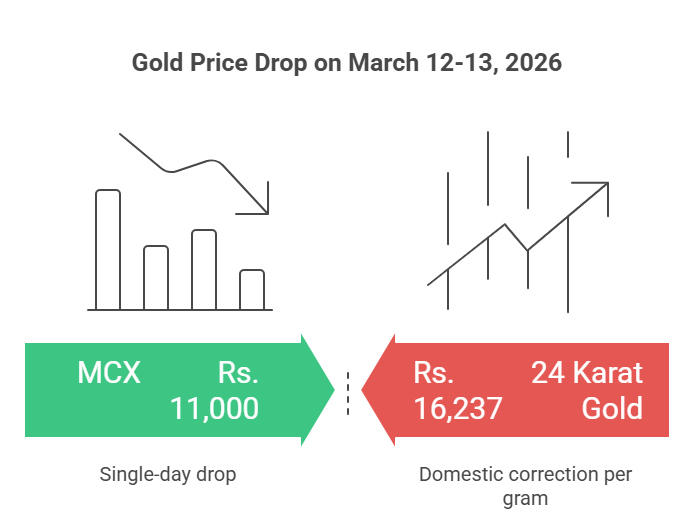
The dramatic fluctuation in gold prices observed on March 12-13, 2026, serves as a quintessential case study in market volatility and the interplay of macroeconomic indicators. With a single-day drop of approximately Rs.11,000 on the Multi Commodity Exchange (MCX) and a domestic correction bringing 24 Karat gold to roughly Rs.16,237 per gram, the event highlights the fragility of safe-haven premiums in the face of a strengthening US dollar and shifting treasury yields. This essay analyzes the catalysts behind this correction and evaluates the strategic implications for investors.
Macroeconomic Catalysts: The Dollar-Yield Nexus The primary driver of the recent sell-off, despite heightened geopolitical tensions in the Middle East, is the inverse correlation between the US dollar and bullion. As US bond yields rose, the opportunity cost of holding non-yielding assets like gold increased. In management theory, this represents a “liquidity preference shift.” Investors moved away from the “insurance” of gold to capitalize on the higher risk-adjusted returns of debt instruments, bolstered by a robust greenback.
Furthermore, the domestic drop of Rs.11,000 in India—a market characterized by high price sensitivity—indicates a correction of previous “overheating.” As international spot prices weighed against $5,180 per ounce, the Indian market, which often carries a premium due to import duties and local demand, saw a rapid unwinding of long positions.
Geopolitical Friction vs. Inflationary Hedges A paradox in the current market is the simultaneous rise of crude oil prices above $100 per barrel due to the US-Iran conflict. Traditionally, such escalations drive gold upward as an inflation hedge. However, the current decline suggests that market participants are currently prioritizing “monetary certainty” (the dollar) over “geopolitical risk insurance” (gold).
From a management perspective, this reflects a shift in the Beta of gold. While it remains a hedge against inflation, its sensitivity to interest rate projections and currency strength has momentarily eclipsed its role as a conflict-driven safe haven. The selling pressure on Thursday suggests that the market had already priced in much of the geopolitical risk, leading to a “sell the news” phenomenon.
Strategic Outlook: Will Gold Reclaim Losses? The question of a recovery depends on two pivotal factors: technical support levels and the trajectory of the Federal Reserve’s monetary policy. Historically, gold sees strong “dip-buying” from institutional investors and central banks when prices retreat to psychological support levels. In the Indian context, a drop of this magnitude often triggers a surge in physical demand, which can provide a floor for MCX prices.
If crude oil continues its trajectory above $100, the resulting inflationary pressure will eventually force a re-evaluation of gold. In the short term, however, the “Direct Fall” signals a period of consolidation. Management professionals should view this not as a collapse of value, but as a necessary correction that aligns the asset with current yield realities.


National News
MCX Gold Silver August Futures Decline
The Precious Metal Dropped As Much As 0.8% To Near $4,040 An Bounce, Erasing A Modest Gain In The Previous Session

The MCX gold August futures contract dipped 0.56% to Rs 1,42,100 per 10 grams, while the MCX silver September futures dropped 1.42% to Rs 2,18,025 per kg.In the global markets too, gold dipped days before a possibly divisive decision on US Federal Reserve interest rates, while an uncertain halt in Middle East tensions soothed inflation fears.
The precious metal dropped as much as 0.8% to near $4,040 an ounce, erasing a modest gain in the previous session. Traders are looking at the Federal Reserve’s rate decision Wednesday, with policymakers remain divided between June’s tamer-than-expected inflation data and the latest jump in oil prices that accompanied a flare-up in fighting between the US and Iran.
Gold ETFs showed mixed movements during the session. Edelweiss Gold ETF slipped by 1.36% to Rs 141.45, while Groww Gold ETF fell 1.43% to Rs 13.82. On the positive side, Motilal Oswal Gold ETF gained 0.51% to reach Rs 142.30, and Angel One Gold ETF rose by 0.60% to Rs 13.38.


-

 JB Insights2 hours ago
Fiona Diamonds: Combining AI, Sustainability, Customization and Allure Of LGD
-

 National News11 minutes ago
MCX Gold Silver August Futures Decline
-

 JB Insights1 hour ago
Legacy, Loyalty & Local Insight: How Karan Kothari Jewellers Is Shaping Vidarbha’s Jewellery Narrative
-

 JB Insights2 hours ago
Reimagining Luxury Jewellery Retail: How Technology Is Empowering The New-Age Indian Consumer
