

National News
GJEPC Congratulates Commerce Department Officials on Landmark India–EU FTA
Industry body lauds leadership of Commerce Ministry officials for steering historic trade agreement with far-reaching impact on export sectors

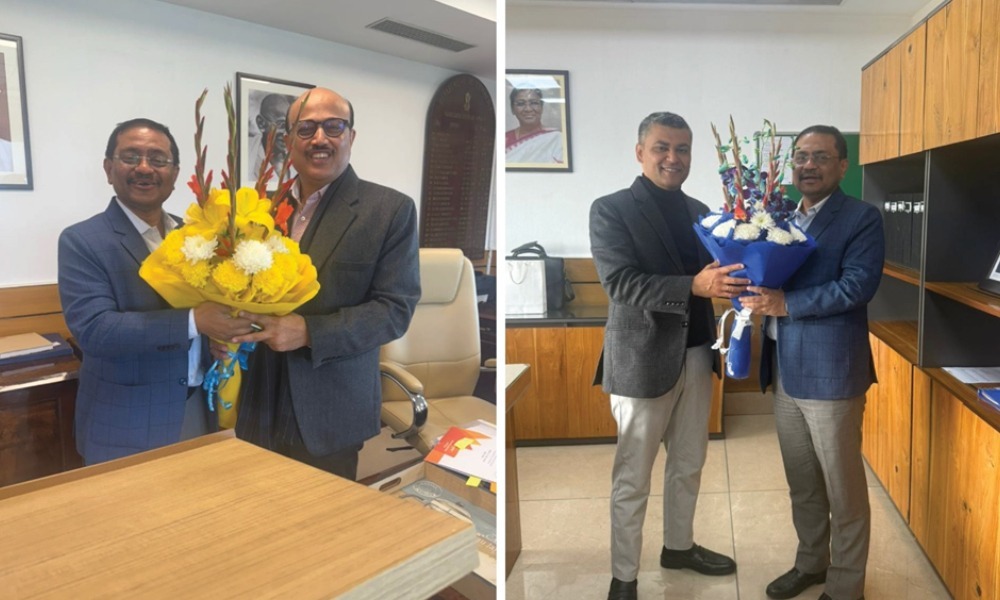
The Gem & Jewellery Export Promotion Council (GJEPC) extended its congratulations to senior officials of the Department of Commerce following the successful conclusion of the landmark India–EU Free Trade Agreement, described as the “mother of all trade deals.”
On 29 January in New Delhi, Sabyasachi Ray, Executive Director, GJEPC, met Rajesh Agarwal, Commerce Secretary, Department of Commerce, Ministry of Commerce and Industry, along with Saket Kumar, Joint Secretary, Department of Commerce, Ministry of Commerce and Industry. During the meeting, Sabyasachi Ray congratulated the officials for their pivotal role in steering the complex negotiations that culminated in the signing of the comprehensive trade pact.
He acknowledged the direct involvement and leadership of the Commerce Department officials in advancing discussions related to market access, tariff rationalisation, and trade facilitation. He highlighted that their efforts were instrumental in addressing long-standing concerns of Indian exporters and in creating a more competitive framework for bilateral trade with the European Union.
The interaction also provided an opportunity to reflect on the strategic importance of the India–EU FTA for India’s export-oriented industries, particularly the gems and jewellery sector. The agreement is expected to enhance market access, improve ease of doing business, and strengthen India’s position in global value chains, while opening new growth avenues for exporters across multiple sectors.
source : GJEPC





For generations, the “locker of the house”—the family’s ancestral gold— was a sacred reserve of last resort. To pledge a wife’s mangalsutra or a grandmother’s bangles was a mark of deep financial shame, the ultimate signal of a family in distress.
But a fundamental shift in the Indian psyche is turning that social taboo into a sophisticated financial strategy. As gold prices hit historic highs, what was once “idle” jewelry is being recast as a high-octane asset class, driving triple-digit growth across the sector and attracting a new breed of affluent borrower.
The shift is most visible in the scale of borrowing. Historically, the gold loan market was dominated by the small borrower, with loans under Rs.2.5 lakh ($3,000) making up 60% of the market.
New data from CRIF High Mark reveals a sharp reversal:
- FY2025: Small-ticket loans dipped to 51% of the market.
- Current Fiscal (8 Months): Small-ticket loans have cratered to just 40%.
The vacuum is being filled by entrepreneurs and high-net-worth individuals (HNIs) who are using gold as collateral to secure single-digit interest rates for business expansion, often bypassing more expensive unsecured loans.
According to a Morgan Stanley note in Oct 2025, India holds about 34,600 tonnes of gold, valued at approximately ₹550 lakh crore. In comparison, the value of gold loans in India stands at around ₹15 lakh crore, against which nearly ₹25 lakh crore worth of gold is pledged.
Why Monetization Failed Where Loans Succeeded
The trend represents a private sector victory where government policy stumbled. In 2015, the Reserve Bank of India (RBI) launched the Gold Monetization Scheme to bring an estimated 25,000 tonnes of privately held gold into the formal economy.
The policy failed largely due to sentimental barriers. To earn interest, owners had to melt their jewelry into bullion, effectively destroying the artistic value and ancestral craftsmanship of heirlooms.
A Structural Change
Banking analysts suggest this is not a temporary spike, but a structural realignment in how India perceives wealth. The modern borrower is increasingly pragmatic, prioritizing the cost of capital over the stigma of the pawnshop.
As banks and NBFCs digitize the process—offering doorstep pick-up and instant credit—the traditional local moneylender is being replaced by fintech-driven platforms and institutional vaults.
The family gold is finally stepping out of the shadows—returning not as ornamentation, but as a powerful line of credit.



Jos Alukkas introduces Augmented Reality Feature ‘Virtual Try-On’ experience on Online Store

MMTC-PAMP Marks Navratras with Launch of 50g 999.9+ Pure Silver Vaishno Devi Coin

As gold prices hit historic highs, gold loans surge

Malabar Gold & Diamonds Announces Major Expansion with ₹1,580 Crore Investment, set to open 20 new showrooms in March 2026

Precious Metals Face Macro Headwinds Amid Persistent Inflation and Geopolitical Uncertainty: AUGMONT BULLION REPORT

GJC announces 9th Edition of GJS April 2026
-
 National News6 hours ago
Malabar Gold & Diamonds Announces Major Expansion with ₹1,580 Crore Investment, set to open 20 new showrooms in March 2026
-
 International News6 days ago
Precious Metals Face Macro Headwinds Amid Persistent Inflation and Geopolitical Uncertainty: AUGMONT BULLION REPORT
-

 International News6 hours ago
Gold, silver struggle amid Fed, oil uncertainty AUGMONT BULLION REPORT
-
 National News1 day ago
GJC announces 9th Edition of GJS April 2026
