

National News
GJEPC briefs Shaktikanta Das, Hon’ble Principal Secretary to PM, on US Tariff Impact


India’s gem and jewellery sector has formally presented its key demands to the Government of India, urging for relief from US tariffs amid escalating trade tensions. GJEPC’s industry representation to the Gol encapsulates key areas requiring immediate attention under the proposed Bilateral Trade Agreement (BTA).
The delegation included Shaunak Parikh Vice Chairman, GJEPC: Shri Anoop Mehta, Co-Convener Diamond Panel, GJEPC and President, Bharat Diamond Bourse (BDB) Adil Kotwal, President, Seepz Gem &Jewellery Manufacturers Association (SGJMA) and Sabyasachi Ray. Executive Director, GJEPC.It has requested the inclusion of diamonds and coloured gemstones of the US Government’s Ad Valorem Reciprocal Tariff Notification. The move aims to safeguard polished diamonds from heightened duties. Additionally, the Council recommends capping total import duties on jewellery entering the US at 10% inclusive of any ad valorem component.
To address the broader trade imbalance, GJEPC has proposed that granted reciprocal concessions for gold and silver bullion imports India as those extended to under CEPA .India is open to providing duty concessions of 6-10% for US jewellery exports to the Indian market under the BTA, contributing to a more balanced tariff.
GJEPC suggests that gem and jewellery duty relief be fast-tracked under the Early Harvest component of the BTA. With only a three-month grace period in place before reciprocal tariffs kick in, there is growing concern that failure to act swiftly could bring the industry to a standstill.


National News
GJEPC addresses issue of Termination of IEEPA-Based Reciprocal Tariffs
GJEPC informed all exporter members of an important interim development concerning U.S. import duties applicable to Indian exports, particularly in the gem and jewellery sector.

The Gem & Jewellery Export Promotion Council (GJEPC) informed all exporter members of an important interim development concerning U.S. import duties applicable to Indian exports, particularly in the gem and jewellery sector.
A letter issued by Sabyasachi Ray, Executive Director, GJEPC, addressed the Termination of IEEPA-Based Reciprocal Tariffs and outlined key implications for exporters.
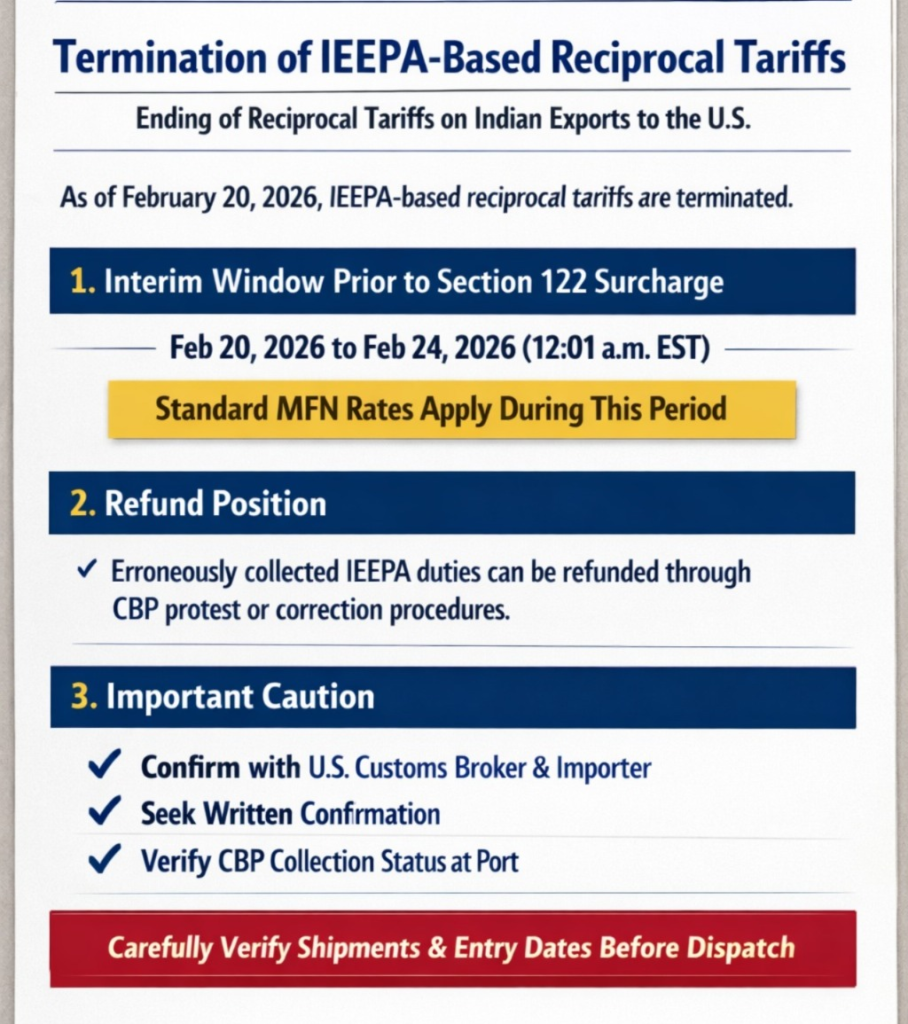
Termination of IEEPA-Based Reciprocal Tariffs
Pursuant to the Executive Order dated February 20, 2026, titled “Ending Certain Tariff Actions”, the additional ad valorem duties imposed under IEEPA, including the reciprocal tariff framework under Executive Order 14257, shall no longer remain in effect and are directed to be terminated as soon as practicable.
Accordingly, entries made on or after February 20, 2026 should not be subject to the earlier IEEPA-based reciprocal tariffs.
1. Interim Window Prior to Section 122 Surcharge
A separate Presidential Proclamation dated February 20, 2026 imposes a temporary 10% surcharge under Section 122 of the Trade Act of 1974, effective 12:01 a.m. EST on February 24, 2026.
Therefore, between: February 20, 2026 – before 12:01 a.m. EST on February 24, 2026 imports into the United States should be subject only to ordinarily applicable HTSUS (MFN) rates, without the earlier reciprocal tariff, and prior to the commencement of the Section 122 surcharge.
For products such as cut and polished diamonds (where the MFN rate is ordinarily 0%), this period represents a limited operational window.
2. Refund Position (If Collected in Error or Due to Implementation Lag)
In cases where reciprocal IEEPA duties are collected due to implementation lag, such duties should be eligible for refund through the standard:
- U.S. Customs and Border Protection (CBP) protest mechanism under 19 U.S.C. §1514, or
- Post-summary correction procedures, as applicable.
However, exporters should note that there is no assurance that the refund process will not be time-consuming.
3. Important Caution for Exporters
While GJEPC is actively engaging with U.S. customs authorities and keeping customs at Bharat Diamond Bourse informed, members are strongly advised to:
- Seek confirmation from their U.S. customs broker and trade counsel
- Obtain written confirmation from their U.S. buyer/importer regarding entry treatment
- Confirm that CBP has ceased collection of the reciprocal tariff at the port of entry
Given the evolving implementation environment, entry-level verification is critical.
Members are encouraged to carefully assess:
- Shipment timing
- Entry dates
- Applicable HTS classification
before dispatching consignments, wherever applicable.
source: GJEPC



-

 National News16 hours ago
GJEPC addresses issue of Termination of IEEPA-Based Reciprocal Tariffs
-

 National News17 hours ago
WGC India gold market update: Price strength fuels demand Looking ahead
-

 International News19 hours ago
IGI approves an investment of up to $150,000 in Saudi Arabia
-

 National News18 hours ago
India’s polished diamond exports dip by 3.6 per cent yoy in January 2026
