By Invitation
Owner vs. Staff
The Contradiction At The Heart Of Every Jewellery Store

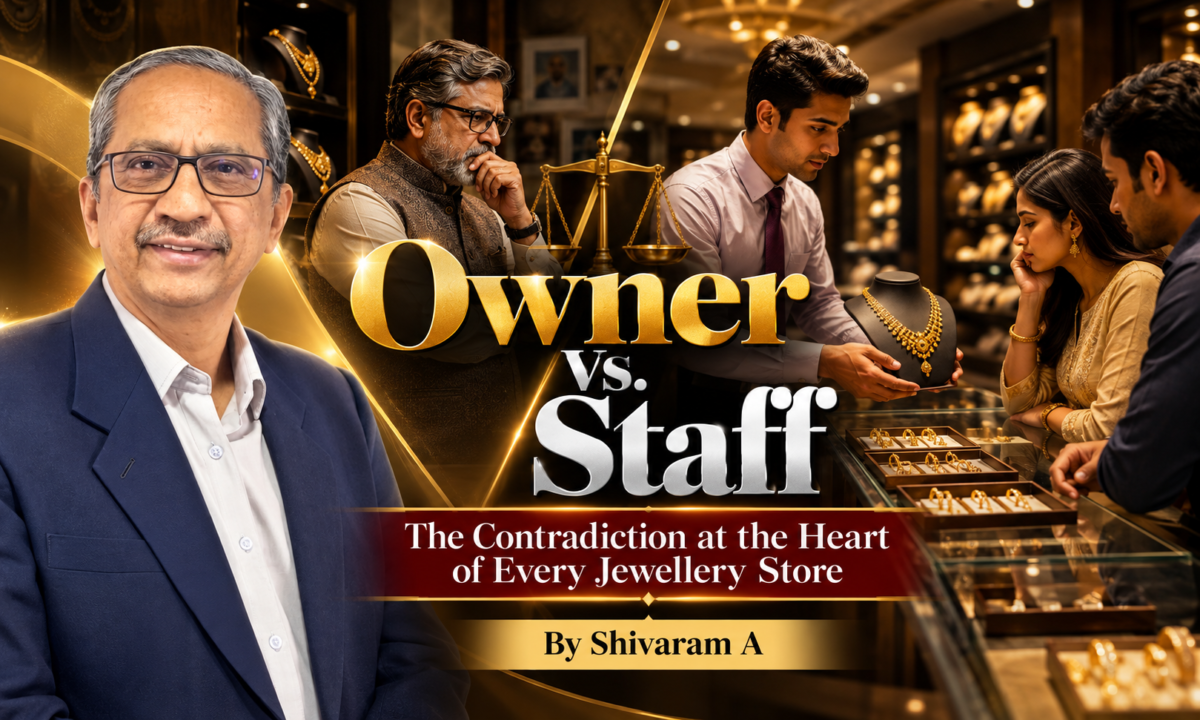
By Shivaram A
The Core Issue
The owner carries the entire risk of the business — investment, gold stock, working capital, loans, everything is in their name. The long-term asset also belongs to the owner — reputation, brand, the customer base built over years, often meant to pass to the next generation. But the moment that matters most — when the customer is standing at the counter, when trust is being built or broken — that moment is entirely controlled by the staff.
The person with the most risk is not present at the decisive moment. And the person with the least to lose holds the most power in that moment. This structural mismatch creates frustration on both sides — and it’s rarely discussed openly.
Making the Conflict Explicit
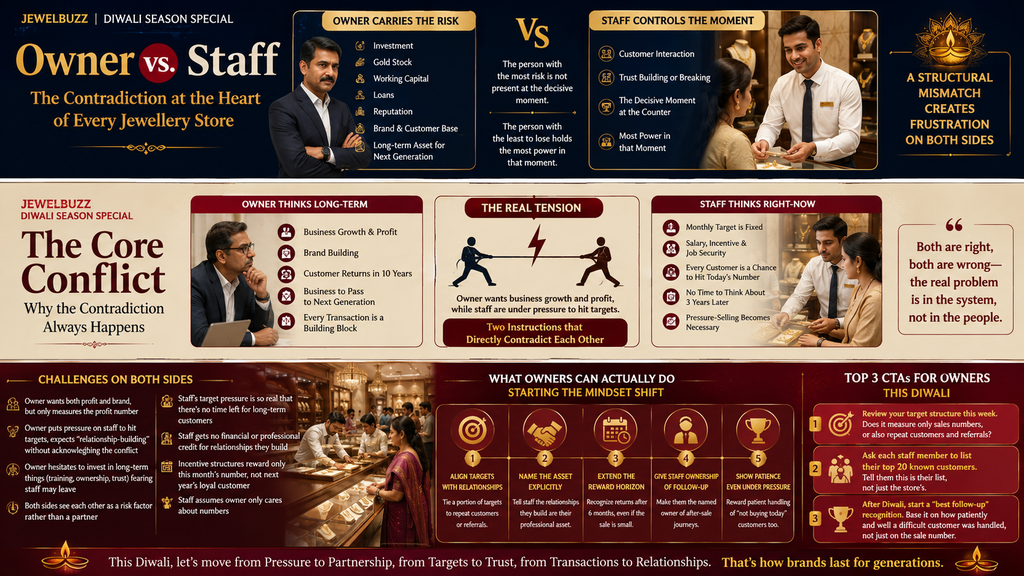
The real tension is this: the owner wants business growth and profit, while staff are under pressure to hit targets.
The owner thinks long-term — how does the brand grow, how does a customer come back after ten years, how does the business pass to the next generation. For the owner, every transaction is a building block toward something bigger.
The staff’s reality is completely different. Their monthly target is fixed. Their salary, incentive, and sometimes even job security depend on how much they sold this month, this Diwali. For staff, every customer is a chance to hit today’s number — right now, this moment. They cannot afford to think about whether this customer comes back in three years, because their performance is reviewed at month-end, not three years later.

So when the owner says “build the relationship, be patient,” and in the same breath increases the target by 20%, these two instructions directly contradict each other. Staff are not confused about what they should ideally do — they understand it perfectly. But they don’t have the choice. The target has to be met, so pressure-selling becomes necessary — even if it means pushing a customer slightly, or using lines like “buy today, rate will go up tomorrow” that create small cracks in trust.
These cracks don’t show up immediately. But after Diwali, when that customer doesn’t return a second time, the owner assumes it’s the staff’s fault. The staff believes the owner set an unrealistic target. Both are right, and both are wrong — because the real problem is in the system, not in the people.
The Challenges on Both Sides
- Owner wants both profit and brand, but only measures the profit number
- Owner puts pressure on staff to hit targets, then also expects “relationship-building” — without acknowledging the two often can’t coexist
- Owner hesitates to invest in long-term things (training, ownership, trust) due to fear that staff will leave anyway
- Staff’s target pressure is so real that there’s no time left to think about the long-term customer
- Staff gets no financial or professional credit for the relationships they build
- Incentive structures reward only this month’s number, not next year’s loyal customer
- Both sides see each other as a risk factor rather than a partner — the owner assumes staff will eventually leave, staff assumes the owner only cares about numbers
What Owners Can Actually Do — Starting the Mindset Shift
- Stop treating targets and relationships as separate — align them. Don’t set targets purely on sales numbers. Tie a small portion of the target to repeat customers or referrals, so staff know that long-term customers count too.
- Name the asset explicitly. Tell staff directly: the relationship you’re building with a customer is your professional asset, not just the store’s. This has to be shown in practice, not just said out loud.
- Extend the reward horizon. Don’t reward only Diwali-week sales — when a customer returns six months later and asks for that staff member by name, recognize that, even if the sale itself is small.
- Give staff ownership of the follow-up. Make each staff member the named owner of their customers’ after-sale journey — repairs, exchanges, the next occasion. This helps them feel the relationship is theirs, not just a transaction.
- Show patience even under pressure. If Diwali week only rewards closed sales, staff will only chase closing. If a staff member who handles a “not buying today” customer well is also appreciated, that’s when the mindset actually starts to shift — because staff notices what the owner actually rewards, not just what they say.
Top 3 CTAs for owners this Diwali
- Review your target structure this week. Does it only measure sales numbers, or does it also give weight to repeat customers and referrals? If not, try a small adjustment starting this Diwali.
- Ask each staff member to list their top 20 known customers. Tell them this is their list, not just the store’s. This builds a sense of ownership.
- After Diwali, start a “best follow-up” recognition. Base it not on the sale number, but on how patiently and well a difficult customer was handled. Staff need to see that patience is rewarded too, not just closing.
Shivaram A
Retail Gurukul




By Invitation
The Jewellery Store Of 2035: Creating More Jobs, Not Fewer By Dr. Sandip P. Dhurat
Every Major Technological Revolution Has Been Accompanied By The Same fear.
When computers entered offices, people believed clerical jobs would disappear. When online banking became popular, many predicted the end of bank branches. When e-commerce emerged, traditional retail was expected to collapse.
Yet history tells a more nuanced story.
Technology certainly changes jobs. Some tasks become automated. Others become faster. But at the same time entirely new professions emerge, industries expand, and customer expectations evolve. Employment doesn’t simply disappear—it transforms.
Today, the jewellery industry finds itself at a similar crossroads.
Artificial Intelligence has become one of the most discussed technologies in business. Some jewellers see immense opportunity, while others wonder whether machines will eventually replace designers, craftsmen or sales professionals.
I believe we are asking the wrong question.The question should not be, “Will AI replace jobs?”
The better question is, “How can AI help the jewellery industry create more value?”
Because wherever businesses create more value, employment follows.
This is particularly relevant for jewellery because it has never been a commodity business.A customer buying cement compares price.A customer buying steel compares specifications.
A customer buying jewellery compares emotions.
Every ornament carries a story. It may celebrate an engagement, commemorate an anniversary, become part of a daughter’s wedding, or preserve the memory of a loved one. Jewellery is purchased during some of life’s most meaningful moments. The transaction may involve gold, diamonds or gemstones, but the purchase is ultimately based on confidence and trust.
This is where human expertise remains irreplaceable.
Artificial Intelligence can suggest hundreds of pendant designs within minutes.It cannot understand why one customer rejects every design until it resembles the necklace worn by her grandmother.
It cannot recognise the hesitation of a young groom who is quietly trying to stay within his budget while wanting to impress his fiancée.It cannot appreciate why an elderly customer wants an old family ornament repaired rather than replaced.
These moments define the jewellery business.
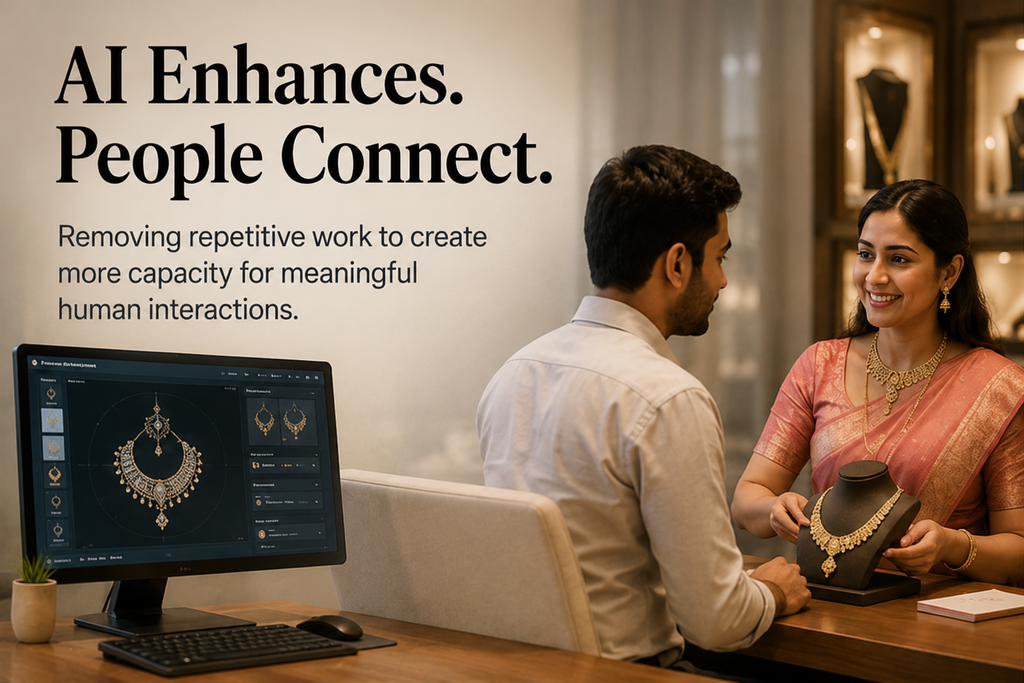
They also explain why employment in this industry will continue to depend on people.Where AI makes the biggest difference is not in replacing these human interactions but in removing the repetitive work that surrounds them.
Design exploration, visualisation, documentation, customer communication, inventory assistance, multilingual content generation, catalogue preparation, marketing drafts and administrative activities can all become significantly faster.
This improvement in productivity creates something extremely valuable for every business—capacity.
Capacity is often misunderstood.
When a jeweller spends less time preparing design variations, that time does not simply disappear. It becomes available for meeting additional customers, developing personalised collections, exploring export markets, strengthening after-sales services and creating stronger relationships with existing clients.
Growth begins with capacity.Employment begins with growth.
Economists have long recognised that productivity improvements often create what is known as the “expansion effect.” As businesses become more efficient, they frequently serve larger markets rather than merely reducing their workforce. This has been observed across manufacturing, banking, healthcare, software and retail.
The jewellery industry is well positioned to experience the same phenomenon.Consider India’s thousands of family-owned jewellery businesses.
Many possess exceptional craftsmanship but operate with limited manpower. Owners often perform multiple roles simultaneously—meeting customers, reviewing designs, coordinating with artisans, managing suppliers, overseeing marketing and handling administrative responsibilities.
Technology can reduce this burden.But reducing workload should not be mistaken for reducing employment.Instead, it allows businesses to redirect human effort toward activities that generate greater value.
For example, personalised consultation is likely to become one of the fastest-growing services in premium jewellery retail.
Customers increasingly expect jewellery designed around their personalities, family stories, cultural preferences and occasions rather than selecting products directly from a showcase.
Meeting these expectations requires people.It requires consultants who understand customer psychology.It requires designers capable of refining ideas into wearable creations.It requires craftsmen who transform concepts into reality.It requires professionals who communicate effectively across languages and cultures as Indian jewellers expand globally.
These are not disappearing professions.They are becoming more important.
Another significant opportunity lies in preserving India’s extraordinary jewellery heritage.
Our country possesses centuries of craftsmanship—from Temple Jewellery of South India to Kundan and Meenakari of Rajasthan, Jadau of Gujarat, Filigree work from Odisha and countless regional traditions.
As experienced artisans retire, there is a genuine risk that specialised knowledge may gradually disappear.
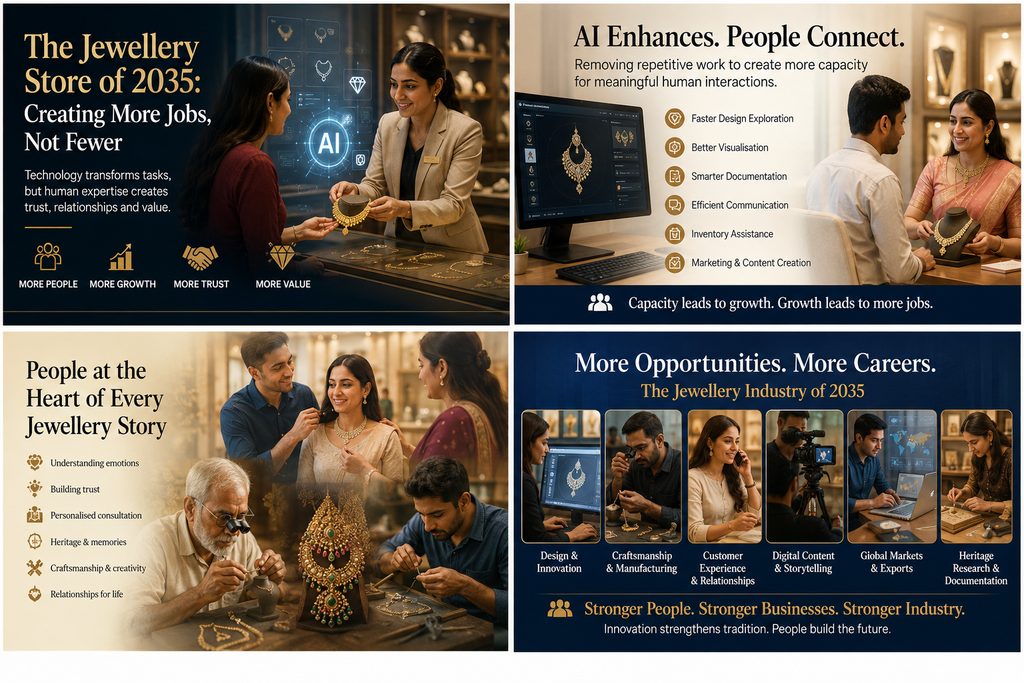
Digital technologies can help document these styles, organise historical references, preserve manufacturing techniques and make traditional inspiration accessible to future generations.
This itself creates employment for researchers, designers, historians and digital archivists working alongside master craftsmen.
Similarly, jewellery marketing is entering an entirely new era.Customers no longer discover jewellery exclusively through showroom visits.
They encounter brands through educational videos, personalised communication, virtual consultations, interactive catalogues and digital storytelling.
Behind every one of these customer experiences stands a skilled professional.
Content creators.Visual communication specialists.Customer relationship managers.Digital merchandising experts.Community engagement professionals.
None of these roles were common in the jewellery industry twenty years ago.Many will become essential during the next decade.
Perhaps the greatest opportunity lies in India’s MSME ecosystem.Unlike many industries dominated by multinational corporations, jewellery remains deeply rooted in family enterprises.
Technology has the potential to level the playing field.
A jeweller in Kolhapur, Rajkot, Thrissur, Jaipur or Coimbatore can now reach customers across India and internationally without establishing expensive physical showrooms.
This democratisation of opportunity enables smaller businesses to compete through craftsmanship, personalisation and service rather than advertising budgets alone.
When small businesses become competitive, they expand.When they expand, they recruit.
Employment grows.The responsibility now extends beyond businesses.
Educational institutions, jewellery associations and skill development organisations must prepare the next generation for careers that combine traditional craftsmanship with digital capabilities.
The future jewellery professional will require knowledge that extends beyond gemology and manufacturing.
They will need to understand customer behaviour, intellectual property, digital commerce, sustainability, international markets, visual communication and the responsible use of emerging technologies.
This is not because jewellery is becoming less human.It is because customers are expecting more human attention than ever before.
The future jewellery store will still be built upon trust.It will still depend upon relationships nurtured over decades.
It will still celebrate craftsmanship passed from one generation to the next.The difference is that technology will increasingly work behind the scenes, allowing people to spend less time on routine activities and more time doing what has always made the jewellery industry exceptional—building relationships, creating memories and earning trust.
The jewellery store of 2035 will therefore not be defined by fewer people.
It will be defined by more capable people.More specialised careers.More opportunities for young professionals.More global customers.
And a stronger ecosystem where innovation strengthens tradition rather than replacing it.
That, in my view, is the true promise of the future—not artificial intelligence replacing jewellers, but human intelligence creating new opportunities because of it.



Kangana Ranaut Unveils PNG Jewellers New Showroom In Ayodhya~

GGJS 2026 Concludes With High-Volume Trade and Strategic Focus On Next-Gen Leadership

The Solitaire Festival Of India Concludes; Bumper Prize Winner At Ranka Jewellers Wins XUV 7XO
GGJS 2026 Concludes With High-Volume Trade and Strategic Focus On Next-Gen Leadership

ABARAN Commemorates The 125th Birth Anniversary Of Founder Shri Burde Sadananda Kamath With Special Gold Coin Launch

MCX Gold Silver Futures See Dip
-
 National News2 hours ago
GGJS 2026 Concludes With High-Volume Trade and Strategic Focus On Next-Gen Leadership
-
 National News6 hours ago
ABARAN Commemorates The 125th Birth Anniversary Of Founder Shri Burde Sadananda Kamath With Special Gold Coin Launch
-
 National News6 hours ago
MCX Gold Silver Futures See Dip
-
 National News3 days ago
P N Gadgil Jewellers Limited – Quarterly Update Q2FY27