By Invitation
EMERALDS : Radiating Greens – Captivating Hearts


Akash Talesara
VP: Design & Merchandising, Asian Star Group
Green is an emerging jewellery trend
Conjures imagery of vibrant and captivating pieces that prominently feature green gemstones. Emeralds have catapulted back into the limelight, stealing canter stage once again, all credits to Nita Ambani’s dazzling necklace at the recent Ambani pre-wedding extravaganza in Jamnagar. The event not only showcased extravagant celebrations but also showcased a myriad of premium handcrafted jewellery that had social media buzzing. Among the myriad gemstones adorning the guests, it was the emerald-studded pieces that garnered the most attention, igniting a fresh wave of interest in this timeless gemstone.
Nita Ambani, radiant as the mother of the groom, donned a custom Kanchipuram silk saree by the celebrated Manish Malhotra. Yet, it was her show-stopping jewellery that truly stole the show – an emerald and diamond necklace, adorned with pairs of emeralds and culminating in two sizable chunks of the mesmerizing green gemstone. The choice of emeralds, not only by Nita but also by her daughter Isha Ambani, underscores the enduring allure and timeless elegance of this precious stone.
History of emerald gemstones
The resurgence of emerald jewellery isn’t just a passing trend; it reflects evolving tastes in the precious jewellery industry. Emeralds, with their rich history dating back to at least 330 BC in Egypt, have remained one of the world’s most coveted gemstones. Their rarity, attributed to highly specific geological conditions, contributes to their mystique. As a variety of the beryl mineral, emeralds owe their striking green color to chromium impurities, setting them apart from other gemstones.
Interestingly, emeralds are approximately 20 times rarer than diamonds, making them a symbol of exclusivity and luxury. While diamonds undergo extensive grading processes, emeralds often display visible inclusions, which are embraced as part of their inherent beauty. These imperfections, affectionately referred to as the “garden” by the French, add character to each emerald, making it truly unique.
Resurgence of emeralds in high end jewellery
The resurgence of emerald jewellery is not merely a passing trend but a reflection of evolving tastes in the precious jewellery industry. Jewellers are increasingly incorporating emeralds into their designs, recognizing their timeless elegance and versatility. From statement necklaces to delicate earrings, emeralds are making a splash in the world of high-end jewellery, appealing to those who seek sophistication and individuality in their accessories. Emeralds exude class and elegance, making them a coveted choice for discerning jewellery enthusiasts.
While large emeralds remain rare and are often reserved for high jewellery, they are not entirely out of reach. Jewellers continue to explore innovative ways to incorporate emeralds into their designs, offering a range of options to suit different tastes and budgets.

The symbolism and significance of emeralds
Emeralds have long been associated with various symbolic meanings. In addition to representing fertility and rebirth, emeralds have been associated with love, wisdom, and intuition. They are often seen as a symbol of hope and renewal, making them popular choices for engagement rings and other meaningful jewellery.
The resurgence of emerald jewellery is a testament to its enduring appeal, offering a touch of luxury and sophistication to any ensemble. Whether worn as a symbol of love and prosperity or simply as a fashion statement, emeralds exude a timeless charm that transcends trends. As we bask in the post-Ambani wedding glow, it’s clear that emeralds are reclaiming their status as the gemstone of choice for those who appreciate the finer things in life.
As the latest trend in the precious jewellery industry, emeralds are set to shine brightly for years to come, captivating hearts with their enchanting beauty and rich history.





By Shivaram A
The Core Issue
The owner carries the entire risk of the business — investment, gold stock, working capital, loans, everything is in their name. The long-term asset also belongs to the owner — reputation, brand, the customer base built over years, often meant to pass to the next generation. But the moment that matters most — when the customer is standing at the counter, when trust is being built or broken — that moment is entirely controlled by the staff.
The person with the most risk is not present at the decisive moment. And the person with the least to lose holds the most power in that moment. This structural mismatch creates frustration on both sides — and it’s rarely discussed openly.
Making the Conflict Explicit
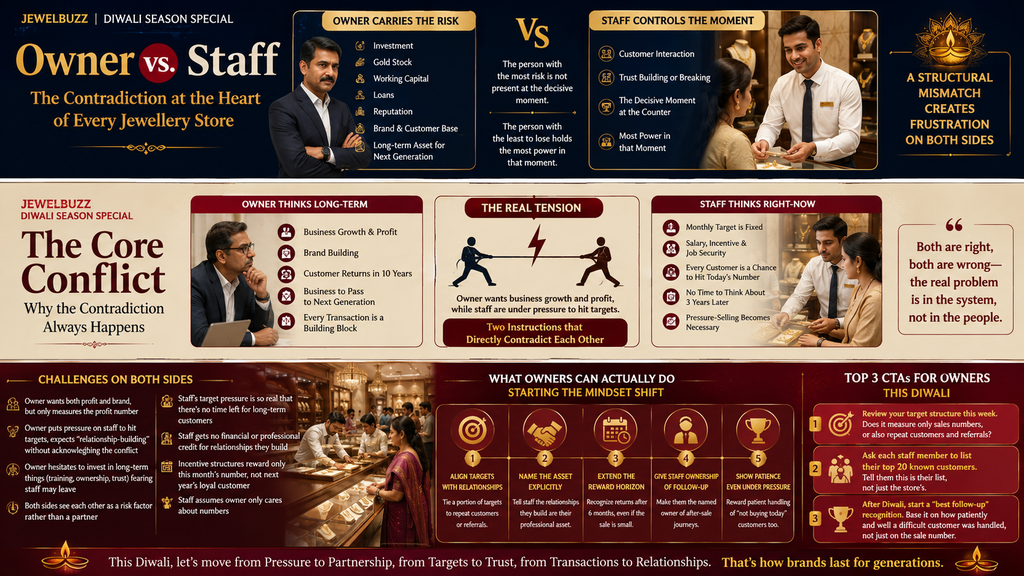
The real tension is this: the owner wants business growth and profit, while staff are under pressure to hit targets.
The owner thinks long-term — how does the brand grow, how does a customer come back after ten years, how does the business pass to the next generation. For the owner, every transaction is a building block toward something bigger.
The staff’s reality is completely different. Their monthly target is fixed. Their salary, incentive, and sometimes even job security depend on how much they sold this month, this Diwali. For staff, every customer is a chance to hit today’s number — right now, this moment. They cannot afford to think about whether this customer comes back in three years, because their performance is reviewed at month-end, not three years later.

So when the owner says “build the relationship, be patient,” and in the same breath increases the target by 20%, these two instructions directly contradict each other. Staff are not confused about what they should ideally do — they understand it perfectly. But they don’t have the choice. The target has to be met, so pressure-selling becomes necessary — even if it means pushing a customer slightly, or using lines like “buy today, rate will go up tomorrow” that create small cracks in trust.
These cracks don’t show up immediately. But after Diwali, when that customer doesn’t return a second time, the owner assumes it’s the staff’s fault. The staff believes the owner set an unrealistic target. Both are right, and both are wrong — because the real problem is in the system, not in the people.
The Challenges on Both Sides
- Owner wants both profit and brand, but only measures the profit number
- Owner puts pressure on staff to hit targets, then also expects “relationship-building” — without acknowledging the two often can’t coexist
- Owner hesitates to invest in long-term things (training, ownership, trust) due to fear that staff will leave anyway
- Staff’s target pressure is so real that there’s no time left to think about the long-term customer
- Staff gets no financial or professional credit for the relationships they build
- Incentive structures reward only this month’s number, not next year’s loyal customer
- Both sides see each other as a risk factor rather than a partner — the owner assumes staff will eventually leave, staff assumes the owner only cares about numbers
What Owners Can Actually Do — Starting the Mindset Shift
- Stop treating targets and relationships as separate — align them. Don’t set targets purely on sales numbers. Tie a small portion of the target to repeat customers or referrals, so staff know that long-term customers count too.
- Name the asset explicitly. Tell staff directly: the relationship you’re building with a customer is your professional asset, not just the store’s. This has to be shown in practice, not just said out loud.
- Extend the reward horizon. Don’t reward only Diwali-week sales — when a customer returns six months later and asks for that staff member by name, recognize that, even if the sale itself is small.
- Give staff ownership of the follow-up. Make each staff member the named owner of their customers’ after-sale journey — repairs, exchanges, the next occasion. This helps them feel the relationship is theirs, not just a transaction.
- Show patience even under pressure. If Diwali week only rewards closed sales, staff will only chase closing. If a staff member who handles a “not buying today” customer well is also appreciated, that’s when the mindset actually starts to shift — because staff notices what the owner actually rewards, not just what they say.
Top 3 CTAs for owners this Diwali
- Review your target structure this week. Does it only measure sales numbers, or does it also give weight to repeat customers and referrals? If not, try a small adjustment starting this Diwali.
- Ask each staff member to list their top 20 known customers. Tell them this is their list, not just the store’s. This builds a sense of ownership.
- After Diwali, start a “best follow-up” recognition. Base it not on the sale number, but on how patiently and well a difficult customer was handled. Staff need to see that patience is rewarded too, not just closing.
Shivaram A
Retail Gurukul


-

 TechBuzz15 hours ago
K. Srinivasan Unveils Doit Coimbatore Experience Centre
-

 GlamBuzz16 hours ago
Kalyan Jewellers’ Navratri Celebrations Bring Stars From All Industries To Thrissur
-

 National News15 hours ago
IFSCA Notifies India Good Delivery Gold Framework
-

 National News16 hours ago
World Gold Council Unveils Immersive Gold Experience At Phoenix Palladium, Lower Parel, Mumbai