DiamondBuzz
Canada Announces Tax Relief to Support Struggling Diamond Sector in Northwest Territories
Government steps in with targeted financial measures to stabilize region’s largest industry amid falling prices and market uncertainty.


The Canadian government has introduced a series of tax-relief measures aimed at supporting the diamond-mining sector in the Northwest Territories, as the industry faces mounting financial challenges. The initiative seeks to preserve economic stability in a region where diamond mining contributes approximately 20% of its GDP, with major operations including Diavik, Ekati, and Gahcho Kué.
According to the Government of the Northwest Territories, the sector is currently under pressure from low global diamond prices, inflation, supply-chain disruptions, and emerging tariff impacts. These conditions have led to significant losses for mining companies. Mountain Province, co-owner of Gahcho Kué with De Beers, reported a $56.4 million net loss in 2024, while Ekati’s owner Burgundy Diamonds lost $94.7 million and Diavik operator Rio Tinto reported a $127 million underlying loss.
To address these issues, the government will double the number of local diamond valuations in 2025 and 2026, covering associated costs to help producers move rough stones to market more efficiently. A temporary reduction in the minerals tax rate will result in $11.2 million in property tax savings for the three mines. Additionally, funds previously set aside for carbon tax contributions will be released to ease cash flow constraints.
The government will also collaborate with Indigenous governments and development corporations to offer further infrastructure and transitional support.

“This is about protecting our economy from sudden shock,” said Caroline Wawzonek, minister of finance for the Northwest Territories. “These targeted, short-term supports are not about corporate profits — they’re about maintaining stability for the workers, families, communities, and Indigenous governments that rely on [the diamond] sector. Our government’s support must be directed to ensuring that Northwest Territory-based labor and businesses are protected in this challenging operating environment.”








DiamondBuzz
Richemont and Signet Jewelers Could Join Global Diamond Consortium In Bid For De Beers
Richemont, Signet Would Connect The Consortium To Key Global Growth Vectors Spanning Luxury High Jewelry and Mass-Market Retail.


The Global Diamond Consortium (GDC)
Richemont and Signet Jewelers are reported to be in talks about joining the Global Diamond Consortium (GDC), the preferred bidder for De Beers according to a Bloomberg News report.
GDC was selected in July 2026 as one of Anglo American’s preferred bidders for De Beers as part of Anglo American’s ongoing corporate restructuring.
The potential inclusion of Richemont—owner of luxury Maisons including Cartier and Van Cleef & Arpels—and Signet Jewelers—the world’s largest retailer of diamond jewelry, operating brands such as Kay Jewelers, Zales, and Jared—would connect the consortium to key global growth vectors spanning luxury high jewelry and mass-market retail.
Strengthening the Natural Diamond Ecosystem: Participation by major luxury brands and global retail leaders reinforces commitment across the entire value chain—from responsible mining and manufacturing to consumer engagement.
Balanced Governance Structure: Discussions center on potential minority equity positions that would support long-term category growth while maintaining appropriate separation between ownership and commercial strategy.
Broad Stakeholder Participation: The consortium continues to advance talks with host governments, including discussions with the Government of Botswana regarding a potential increase in its equity share in De Beers from 15% to approximately 25%, alongside participation from private investors and southern African host nations.
Discussions between GDC, Richemont, Signet, and participating government stakeholders remain ongoing. Terms of any potential participation, including the size of equity interests, have not been finalized and remain subject to regulatory approvals and definitive documentation.


-

 TechBuzz1 day ago
K. Srinivasan Unveils Doit Coimbatore Experience Centre
-

 GlamBuzz1 day ago
Kalyan Jewellers’ Navratri Celebrations Bring Stars From All Industries To Thrissur
-
 National News1 day ago
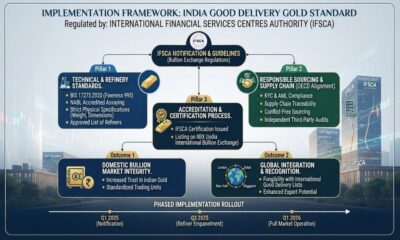
IFSCA Notifies India Good Delivery Gold Framework
-

 National News1 day ago
World Gold Council Unveils Immersive Gold Experience At Phoenix Palladium, Lower Parel, Mumbai