
JB Insights
WGC Gold Demand Trends : Gold breaks records as investors seek shelter from market turbulence

The World Gold Council’s Q3 2025 Gold Demand Trends report reveals that quarterly gold demand (including OTC) reached 1,313t, or US $146bn in value terms and was the highest quarter for demand on record.
Growth was driven primarily by investment demand which accelerated in Q3 reaching 537t (+47% y/y) and accounted for 55% of overall net gold demand. This momentum was driven by a powerful combination of an uncertain and volatile geopolitical environment, US dollar weakness and investor “FOMO” as the price climbed higher.
Investors continued to pile into physically backed gold ETFs for a third consecutive quarter, adding a further 222t with global inflows reaching US$26bn. Year-to-date, gold ETFs have added a total of 619t (US$64bn) to their holdings with North American listed funds leading the charge (346t), followed by European (148t) and Asian funds (118t).
Bar and coin investment rose 17% y/y, totalling 316t, with growth in almost all markets but with significant contributions from India (92t), China, (74t).
On the other hand, gold jewellery demand was weighed down by 50 record gold prices this year, seeing a 19% y/y decline in consumption for Q3. While the two largest consumer markets – India and China – both saw a quarter-on-quarter uplift, largely due to seasonal factors, the y/y picture across both markets remained weak.
Central banks picked up the pace in Q3 with net purchases totalling 220t in the third quarter, up 28% on Q2 and 10% y/y, despite the record-high gold price. On a year-to-date basis, net buying totalled 634t, trailing behind the exceptional highs of the last three years, but comfortably above pre-2022 levels.
Total gold supply reached a quarterly record of 1,313t, up 3% y/y. Mine production increased by 2% y/y to 977t while recycling was up 6% y/y at 344t, staying relatively stable given the soaring gold price.

Louise Street, Senior Markets Analyst at the World Gold Council, commented:
“Gold’s climb towards US$4,000/oz in the third quarter underscores the strength and persistence of the factors that have been driving demand throughout the year. Heightened geopolitical tensions, stubborn inflationary pressures and uncertainty around global trade policy have all fuelled appetite for safe-haven assets as investors look to build resilience in their portfolios.
“The outlook for gold remains optimistic, as continued US dollar weakness, lower interest rate expectations, and the threat of stagflation could further propel investment demand. Gold has set record after record this year, and the current environment suggests there could be more upside gains for gold. Our research indicates the market is not yet saturated, and the strategic case to hold gold remains firmly in place.”
Sachin Jain, Regional CEO, India, World Gold Council said:
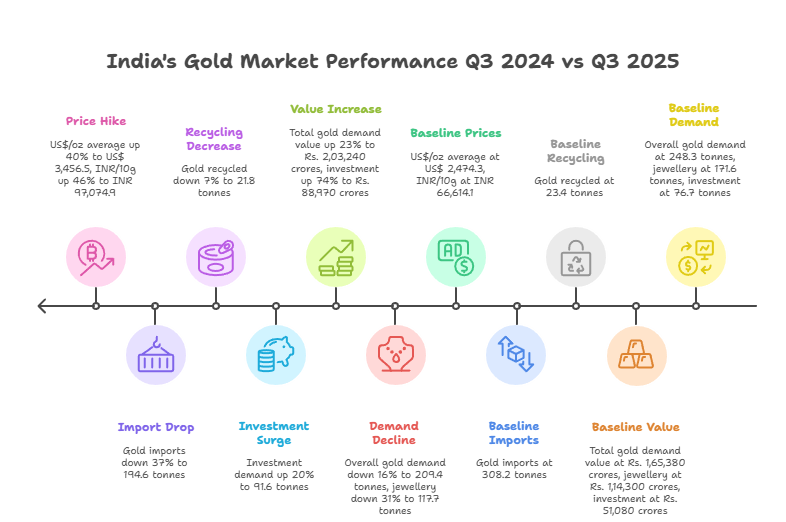
“India’s gold market in Q3 2025 showcased its inherent resilience and the significant impact of evolving price dynamics. While total gold value surged impressively by 23% to Rs. 2,03,240 crores, gold demand volumes saw a 16% decline to 209.4 tonnes. This robust growth in value, driven by high average prices, strongly reaffirms gold’s enduring appeal as a safe-haven asset. Investment demand, showed remarkable strength, increasing 20% in volume to 91.6 tonnes and a significant 74% in value to Rs. 88,970 crores.

This highlights a deepening strategic commitment among Indian consumers to gold as a long-term store of value. While jewellery demand saw a 31% volume decrease to 117.7 tonnes, its value remained largely stable at Rs. 1,14,270 crores. This indicates that despite higher prices, gold’s intrinsic cultural significance continues to drive purchases, with consumers adapting to the new price levels.
On the supply side, gold imports were 194.6 tonnes, down 37%, while recycling saw a modest 7% decline to 21.8 tonnes, suggesting consumers are holding onto their prized asset. Looking ahead, the current festive and wedding seasons are pivotal for the yellow metal. Gold’s unique cultural significance means festivals traditionally drive strong buying interest. Despite prevailing high prices, consumer sentiment remains positive, and retailers are well-prepared. We anticipate robust demand across all categories, from traditional jewellery to investment products, as the market gears up for a vibrant festive and wedding season. With total gold demand from January to September at approximately 462.4 tonnes, we anticipate full-year demand between 600 and 700 tonnes, more towards higher end of range.“
Gold Demand Trends Q3 2025 India Fact Sheet: India Gold Demand Statistics for Q3 2025 (July – September)
- Demand for gold in India for Q3 2025 was at 209.4 tonnes, down by 16% as compared to overall Q3 demand for 2024 (248.3 tonnes)
- India’s Q3 2025 gold demand value was Rs. 2,03,240 crores, up by 23% as compared to Q3 2024 (Rs.1,65,380 crores)
- Total Jewellery demand in India for Q3 2025 decreased by 31% to 117.7 tonnes as compared to Q3 2024 (171.6 tonnes)
- The value of jewellery demand remained rather unchanged at Rs. 1,14,270 crores, compared to Rs. 1,14,300 crores recorded in Q3 2024
- Total Investment demand for Q3 2025 was at 91.6 tonnes, increased by 20% in comparison to Q3 2024 (76.7 tonnes)
- In value terms, gold Investment demand in Q3 2025 was Rs. 88,970 crores, up by 74% from Q3 2024 (Rs. 51,080 crores)
- Total gold recycled in India in Q3 2025 was 21.8 tonnes, down by 7% compared to 23.4 tonnes in Q3 2024.
- Total gold imports in India in Q3 2025 was 194.6 tonnes, down by 37% compared to 308.2 tonnes in Q3 2024.
- US$/oz average quarterly price in Q3 2025 was US$ 3,456.5 in comparison to US$ 2,474.3 in Q3 2024.
- INR/10g average quarterly price in Q3 2025 was INR 97,074.9 in comparison to INR 66,614.1 in Q3 2024 (without import duty and GST)




JB Insights
US Holiday Sales Will See 5.5% Growth For 2026 : Mastercard Economics Institute
This Resilience Reflects A Robust Labor Market, Rising Household Wealth, and Broad-Based Consumer Demand Across Income Cohorts. Overall, The 2026 Holiday Season Showcases An Adaptable U.S. Consumer Using Digital and AI Tools To Maximize Value While Continuing To Drive Broader Economic Momentum.

The Mastercard Economics Institute (MEI) forecasts a strong 2026 U.S. holiday shopping season (November 1–December 24), projecting retail sales excluding gas and autos to grow 5.5% year-over-year (YoY). This resilience reflects a robust labor market, rising household wealth, and broad-based consumer demand across income cohorts.
Key Drivers and Growth Channels
- Channel Performance: E-commerce continues to lead with an expected 11% YoY growth, but in-store sales are set to grow 3.6%—their strongest pace since 2022. This highlights the critical role of omnichannel strategies.
- Inflation Dynamics: Inflation accounts for 2.8 percentage points of the total 5.5% growth. Unlike last year’s tariff pressures, current price increases are driven by elevated energy/diesel costs and the massive AI infrastructure buildout.
- Calendar Shifts: A late Thanksgiving compresses the shopping window, pushing retailers toward early promotions. Additionally, Cyber Monday falling in November will shift significant online volume into the month.
The Role of Artificial Intelligence
AI is reshaping both prices and consumer behavior:
- Tech Inflation: High demand for memory chips and data infrastructure components has driven a 12.2% YoY increase in prices for info-processing equipment. Consequently, the consumer electronics category is projected to post outsized nominal sales growth (+10.7% YoY).
- AI Power Users: Consumers with paid AI subscriptions demonstrate distinct “optimization” habits. Data shows these users plan early, shop across a wider variety of boutique and specialty merchants, and aggressively target promotions during Thanksgiving weekend before transitioning to experience and hospitality spending in December.
Last-Minute Shopping Behavior
The final rush to Christmas offers key operational insights for retailers:
- In-Person and Malls: The final week before Christmas sees heavy physical store foot traffic, especially in enclosed shopping malls where consumers can complete multi-category purchases. Climate also plays a role: warmer-state residents (e.g., Florida, Nevada) are far more likely to make last-minute in-store runs than those in colder states.
- Transaction Value Trends: Average order values for children’s items peak near Black Friday, while premium categories—such as jewelry, cosmetics, luxury handbags, and department stores—see transaction values climb steadily from December 15, peaking on Christmas Eve as procrastinating shoppers pay a premium for convenience.
AI tools lower search costs for consumers, making price transparency higher than ever. Retailers must capture early November demand through targeted promotions before comparison tools push shoppers toward alternative or boutique brands.
Last-minute shoppers are price-inelastic and seeking speed. Malls and physical stores should maximize inventory for high-margin, rush-gift items (jewelry, cosmetics, designer goods, gift cards) in the final 10 days, leveraging store availability over promotional discounting.
Overall, the 2026 holiday season showcases an adaptable U.S. consumer using digital and AI tools to maximize value while continuing to drive broader economic momentum.



Kangana Ranaut Unveils PNG Jewellers New Showroom In Ayodhya~

GGJS 2026 Concludes With High-Volume Trade and Strategic Focus On Next-Gen Leadership

The Solitaire Festival Of India Concludes; Bumper Prize Winner At Ranka Jewellers Wins XUV 7XO
GGJS 2026 Concludes With High-Volume Trade and Strategic Focus On Next-Gen Leadership

ABARAN Commemorates The 125th Birth Anniversary Of Founder Shri Burde Sadananda Kamath With Special Gold Coin Launch

MCX Gold Silver Futures See Dip
-
 National News3 hours ago
GGJS 2026 Concludes With High-Volume Trade and Strategic Focus On Next-Gen Leadership
-
 National News8 hours ago
ABARAN Commemorates The 125th Birth Anniversary Of Founder Shri Burde Sadananda Kamath With Special Gold Coin Launch
-
 National News8 hours ago
MCX Gold Silver Futures See Dip
-
 National News3 days ago
P N Gadgil Jewellers Limited – Quarterly Update Q2FY27
