
By Invitation
Gold Rush or Emotional Reset? What this festive season taught us
By Rahul Desai, MD & CEO, International Institute of Gemology (IIG)

Every year, around this time, the gold prices somehow skyrocketed and there is always this question and concern in the air. However, around this time, there is one more thing that happens. India turns radiant, not just with lights, but with gold.
This Festive season (comprising Diwali and Dhanteras both), consumers spent an estimated ₹1 lakh crore on gold and silver ahead of Diwali. That’s not a typo, that’s 1,00,000 crore rupees.
And what’s remarkable is that this surge came despite record-high gold prices. You can’t explain that with charts or commodity logic alone. Because in India, gold isn’t a commodity, it’s an emotion. This is what makes India’s gold economy unique. It’s driven not by speculation, but by sentiment that converts into sustainable demand.

Gold as Emotion: The Invisible Economy
Gold in India isn’t just bought; it’s believed in. When families step into stores, even though they are thinking in ounces and grams, they are also thinking of blessings, milestones, continuity…. Most of them see this purchase as multipliers. They believe what they buy will return in 10x.
Even this year, as prices soared, consumers didn’t stop, they adjusted. Some bought lighter designs, smaller pieces, or silver alternatives. But, the desire remained the same; only the form changed. That’s emotional economics at work, something no spreadsheet can fully capture.
Gold as Investment
From an investment lens, gold remains one of the few assets that sits between emotion and economics. It hedges inflation. It stores value. It brings comfort when markets turn volatile. And while the urban investor sees diversification, the rural household sees gold as security.
The point is, both are right.
Gold has always been the bridge between sentiment and strategy. It’s the one asset class where the heart and the head both find common ground.
But if we’re going to treat gold as a real investment vehicle, we must start with awareness.
Education: The New Currency of the Gold Economy
Here’s where I believe the real opportunity lies. The next big differentiator in India’s gold and jewellery ecosystem won’t just be price, it will be education. The more we train, the more we transform. Training jewellers on transparency. Educating consumers on hallmarking and value. Empowering retailers to merge digital convenience with human trust. These are the small hinges that move big doors.
Because when people are informed, they don’t just buy gold, they build an ecosystem of trust.
At institutions like IIG and others, we’re seeing how education bridges the gap between tradition and transformation. A well-trained workforce and a well-informed consumer are what make this market sustainable.
What the Festive season Data Really Shows
If you read the Mint report carefully, there’s a quiet story beneath the numbers. Gold sales value rose 25%, but volumes fell around 10-15%. Silver saw a 35-40% spike, as buyers looked for accessible alternatives.
That tells me something powerful: The emotion remains constant, but the behaviour is evolving. Buyers didn’t walk away, they adapted/shifted to lighter designs, explored silver, or embraced modern 9k alternatives. That kind of flexibility defines a mature market. It proves that emotion and strategy can coexist. Consumers are becoming smarter, selective, design-driven, and even sustainability-conscious. They’re no longer buying just metal, they’re buying meaning. Gold’s emotional power will always endure, but the way we engage with it will keep evolving.
Gold’s role as a hedge remains strong. It continues to protect against inflation and currency volatility. But in India, its deeper purpose lies in how it converts sentiment into financial security. As someone who has spent decades watching markets and teaching the minds behind them, I can tell you this: The smartest players in the coming decade won’t just be those who sell more gold, but those who understand why people buy it, and strategize accordingly.




By Shivaram A
The Core Issue
The owner carries the entire risk of the business — investment, gold stock, working capital, loans, everything is in their name. The long-term asset also belongs to the owner — reputation, brand, the customer base built over years, often meant to pass to the next generation. But the moment that matters most — when the customer is standing at the counter, when trust is being built or broken — that moment is entirely controlled by the staff.
The person with the most risk is not present at the decisive moment. And the person with the least to lose holds the most power in that moment. This structural mismatch creates frustration on both sides — and it’s rarely discussed openly.
Making the Conflict Explicit
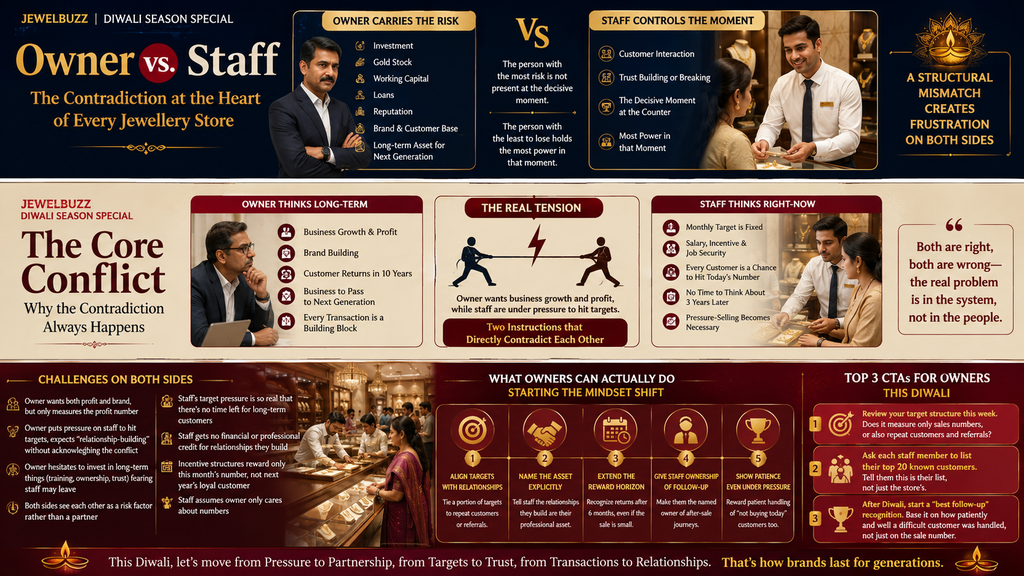
The real tension is this: the owner wants business growth and profit, while staff are under pressure to hit targets.
The owner thinks long-term — how does the brand grow, how does a customer come back after ten years, how does the business pass to the next generation. For the owner, every transaction is a building block toward something bigger.
The staff’s reality is completely different. Their monthly target is fixed. Their salary, incentive, and sometimes even job security depend on how much they sold this month, this Diwali. For staff, every customer is a chance to hit today’s number — right now, this moment. They cannot afford to think about whether this customer comes back in three years, because their performance is reviewed at month-end, not three years later.

So when the owner says “build the relationship, be patient,” and in the same breath increases the target by 20%, these two instructions directly contradict each other. Staff are not confused about what they should ideally do — they understand it perfectly. But they don’t have the choice. The target has to be met, so pressure-selling becomes necessary — even if it means pushing a customer slightly, or using lines like “buy today, rate will go up tomorrow” that create small cracks in trust.
These cracks don’t show up immediately. But after Diwali, when that customer doesn’t return a second time, the owner assumes it’s the staff’s fault. The staff believes the owner set an unrealistic target. Both are right, and both are wrong — because the real problem is in the system, not in the people.
The Challenges on Both Sides
- Owner wants both profit and brand, but only measures the profit number
- Owner puts pressure on staff to hit targets, then also expects “relationship-building” — without acknowledging the two often can’t coexist
- Owner hesitates to invest in long-term things (training, ownership, trust) due to fear that staff will leave anyway
- Staff’s target pressure is so real that there’s no time left to think about the long-term customer
- Staff gets no financial or professional credit for the relationships they build
- Incentive structures reward only this month’s number, not next year’s loyal customer
- Both sides see each other as a risk factor rather than a partner — the owner assumes staff will eventually leave, staff assumes the owner only cares about numbers
What Owners Can Actually Do — Starting the Mindset Shift
- Stop treating targets and relationships as separate — align them. Don’t set targets purely on sales numbers. Tie a small portion of the target to repeat customers or referrals, so staff know that long-term customers count too.
- Name the asset explicitly. Tell staff directly: the relationship you’re building with a customer is your professional asset, not just the store’s. This has to be shown in practice, not just said out loud.
- Extend the reward horizon. Don’t reward only Diwali-week sales — when a customer returns six months later and asks for that staff member by name, recognize that, even if the sale itself is small.
- Give staff ownership of the follow-up. Make each staff member the named owner of their customers’ after-sale journey — repairs, exchanges, the next occasion. This helps them feel the relationship is theirs, not just a transaction.
- Show patience even under pressure. If Diwali week only rewards closed sales, staff will only chase closing. If a staff member who handles a “not buying today” customer well is also appreciated, that’s when the mindset actually starts to shift — because staff notices what the owner actually rewards, not just what they say.
Top 3 CTAs for owners this Diwali
- Review your target structure this week. Does it only measure sales numbers, or does it also give weight to repeat customers and referrals? If not, try a small adjustment starting this Diwali.
- Ask each staff member to list their top 20 known customers. Tell them this is their list, not just the store’s. This builds a sense of ownership.
- After Diwali, start a “best follow-up” recognition. Base it not on the sale number, but on how patiently and well a difficult customer was handled. Staff need to see that patience is rewarded too, not just closing.
Shivaram A
Retail Gurukul


-

 TechBuzz1 day ago
K. Srinivasan Unveils Doit Coimbatore Experience Centre
-

 GlamBuzz2 days ago
Kalyan Jewellers’ Navratri Celebrations Bring Stars From All Industries To Thrissur
-

 National News1 day ago
IFSCA Notifies India Good Delivery Gold Framework
-

 National News2 days ago
World Gold Council Unveils Immersive Gold Experience At Phoenix Palladium, Lower Parel, Mumbai
