By Invitation
The Whisper of 24KT: Redefining Diamond Jewellery in India
By Akash Talesara,President sales and Business Development- SKY GOLD LTD


Light, luminous, and meticulously crafted—jewellery today speaks in subtle brilliance. It is no longer just about tradition or display; it is deeply personal, reflecting one’s identity, emotions, and a desire for effortless luxury. At Sky Gold & Diamonds, this transformation takes center stage with India’s first-ever 24KT diamond jewellery collection. By uniting the brilliance of diamonds with gold in its purest form, the brand creates pieces that feel weightless yet profoundly precious.
Purity has always been a defining part of Sky Gold’s DNA. Gold, in its 24KT form, represents perfection—an ideal that, when paired with diamonds, results in creations that are visually stunning and emotionally resonant.
Crafting the Impossible
Designing with 24KT gold presents a formidable challenge. Its softness makes diamond-setting an intricate art, demanding precision and mastery. To perfect this craft, Sky Gold collaborated with international experts, master jewellers, and metallurgical specialists from Italy and Hong Kong. Months of experimentation and countless trials led to a deep understanding of the material’s nuances. The journey required patience, science, and artistry—each attempt bringing them closer to redefining fine jewellery while honouring the natural beauty of gold.


Through this process, the brand discovered that perfection takes time. Every misstep revealed the rhythm of the metal, teaching lessons in patience and precision. Balancing purity with durability became the ultimate test—ensuring diamonds remained secure without compromising the integrity of 24KT gold required innovation and persistence. The result is jewellery that feels ethereal yet enduring, glowing with quiet confidence.
The Era of Lightweight Luxury
As gold prices soar, lightweight diamond jewellery is shaping the future of modern luxury. Today’s consumers seek pieces that are versatile—graceful, minimal, and effortlessly beautiful. This evolving demand has influenced Sky Gold’s design language, which seamlessly blends India’s artistic heritage with contemporary silhouettes and subtle sophistication.
Innovation with a Heart
Behind this collection lies advanced R&D and cutting-edge technology. Sky Gold’s workshops employ high-precision CAD systems, laser tools, and 3D modelling to enhance detail while preserving the human touch of artisanal craftsmanship. Technology may provide precision, but the soul of each piece remains handcrafted. Artisans infuse emotion into every curve and setting—because while machines can replicate form, only human hands can shape feeling.
Jewellery as Legacy
Gold has always symbolized trust and enduring value. When paired with diamonds, it transcends material wealth to become a vessel of memory and meaning—something passed down not just as inheritance, but as emotion. Today’s consumers view jewellery differently; it is no longer reserved for grand occasions. Instead, people choose pieces that mirror their individuality—a powerful shift that defines the new era of fine jewellery.


Sky9 line unveiled at DShow, Goa
At the DShow in Goa Sky Gold & Diamonds unveiled new expressions of lightweight diamond artistry under its Sky9 line—designed for modern collectors who believe that true luxury should feel as light as it looks. Visitors experienced exclusive previews of designs that embody purity, innovation, and emotion at their finest.
With India’s first 24KT diamond jewellery collection, Sky Gold & Diamonds is not merely setting a new benchmark—it is shaping the very future of fine jewellery.
The brand’s philosophy remains clear and timeless: “Our goal isn’t to chase trends. It is to craft pieces that outlast them—jewellery that celebrates purity and the beauty of what is real.”







By Shivaram A
The Core Issue
The owner carries the entire risk of the business — investment, gold stock, working capital, loans, everything is in their name. The long-term asset also belongs to the owner — reputation, brand, the customer base built over years, often meant to pass to the next generation. But the moment that matters most — when the customer is standing at the counter, when trust is being built or broken — that moment is entirely controlled by the staff.
The person with the most risk is not present at the decisive moment. And the person with the least to lose holds the most power in that moment. This structural mismatch creates frustration on both sides — and it’s rarely discussed openly.
Making the Conflict Explicit
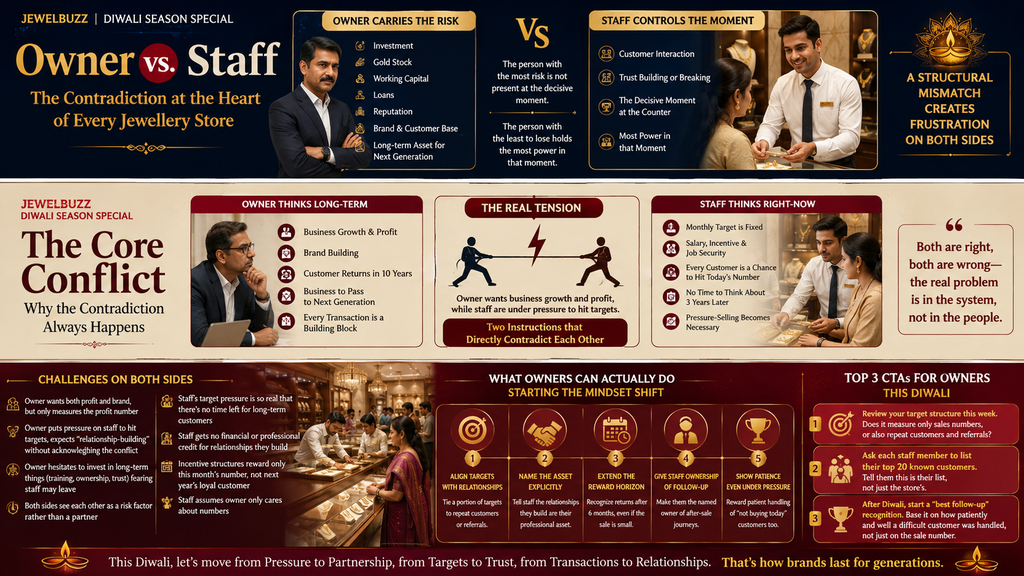
The real tension is this: the owner wants business growth and profit, while staff are under pressure to hit targets.
The owner thinks long-term — how does the brand grow, how does a customer come back after ten years, how does the business pass to the next generation. For the owner, every transaction is a building block toward something bigger.
The staff’s reality is completely different. Their monthly target is fixed. Their salary, incentive, and sometimes even job security depend on how much they sold this month, this Diwali. For staff, every customer is a chance to hit today’s number — right now, this moment. They cannot afford to think about whether this customer comes back in three years, because their performance is reviewed at month-end, not three years later.

So when the owner says “build the relationship, be patient,” and in the same breath increases the target by 20%, these two instructions directly contradict each other. Staff are not confused about what they should ideally do — they understand it perfectly. But they don’t have the choice. The target has to be met, so pressure-selling becomes necessary — even if it means pushing a customer slightly, or using lines like “buy today, rate will go up tomorrow” that create small cracks in trust.
These cracks don’t show up immediately. But after Diwali, when that customer doesn’t return a second time, the owner assumes it’s the staff’s fault. The staff believes the owner set an unrealistic target. Both are right, and both are wrong — because the real problem is in the system, not in the people.
The Challenges on Both Sides
- Owner wants both profit and brand, but only measures the profit number
- Owner puts pressure on staff to hit targets, then also expects “relationship-building” — without acknowledging the two often can’t coexist
- Owner hesitates to invest in long-term things (training, ownership, trust) due to fear that staff will leave anyway
- Staff’s target pressure is so real that there’s no time left to think about the long-term customer
- Staff gets no financial or professional credit for the relationships they build
- Incentive structures reward only this month’s number, not next year’s loyal customer
- Both sides see each other as a risk factor rather than a partner — the owner assumes staff will eventually leave, staff assumes the owner only cares about numbers
What Owners Can Actually Do — Starting the Mindset Shift
- Stop treating targets and relationships as separate — align them. Don’t set targets purely on sales numbers. Tie a small portion of the target to repeat customers or referrals, so staff know that long-term customers count too.
- Name the asset explicitly. Tell staff directly: the relationship you’re building with a customer is your professional asset, not just the store’s. This has to be shown in practice, not just said out loud.
- Extend the reward horizon. Don’t reward only Diwali-week sales — when a customer returns six months later and asks for that staff member by name, recognize that, even if the sale itself is small.
- Give staff ownership of the follow-up. Make each staff member the named owner of their customers’ after-sale journey — repairs, exchanges, the next occasion. This helps them feel the relationship is theirs, not just a transaction.
- Show patience even under pressure. If Diwali week only rewards closed sales, staff will only chase closing. If a staff member who handles a “not buying today” customer well is also appreciated, that’s when the mindset actually starts to shift — because staff notices what the owner actually rewards, not just what they say.
Top 3 CTAs for owners this Diwali
- Review your target structure this week. Does it only measure sales numbers, or does it also give weight to repeat customers and referrals? If not, try a small adjustment starting this Diwali.
- Ask each staff member to list their top 20 known customers. Tell them this is their list, not just the store’s. This builds a sense of ownership.
- After Diwali, start a “best follow-up” recognition. Base it not on the sale number, but on how patiently and well a difficult customer was handled. Staff need to see that patience is rewarded too, not just closing.
Shivaram A
Retail Gurukul



Qatar Diamond Exchange Partners With London Diamond Bourse To Expand Global Reach and Industry Collaboration

Reva Diamonds Opens Its 7th Exclusive Showroom At Elpro Mall, Chinchwad

Sovereign Bond Yields and The Strategic Pivot To Gold


-

 JB Insights2 weeks ago
Dhanteras Shopping Guide 2026:Gold, Silver, Diamonds & Festive Jewellery Trends To Watch
-

 BrandBuzz2 weeks ago
The Solenne Collection: A Celebration Of Diwali By Bharti Bangur Fine Jewels
-

 BrandBuzz2 weeks ago
From Diya Puja To Diwali Soirées: Jewellery Designed To Go Beyond The Festive Season
-

 National News2 weeks ago
Indriya, Aditya Birla Jewellery Unveiled India’s Largest Sustainable Jewellery Rangavalli