

DiamondBuzz
Tariff refunds on horizon for US diamond importers after court victory
Diamond importers in the United States may receive tariff refunds after a ruling by the U.S. Court of International Trade overturning duties under the International Emergency Economic Powers Act.


In a major win for diamond traders, US importers stand to reclaim tariffs paid under the now-defunct IEEPA regime, following a pivotal U.S. Court of International Trade ruling on March 4. The decision mandates U.S. Customs and Border Protection (CBP) to refund all IEEPA duties collected before the Supreme Court’s February 20 declaration of their illegality—complete with interest.
- Streamlined Refund Process: Importers can apply via CBP’s ACE Portal starting mid-April, uploading summaries of IEEPA duties paid. Described as efficient, it targets diamond entries amid broader refunds for 53 million across 330,000 importers in all sectors.
- CBP Caution on Delays: Expect significant processing backlogs due to the massive volume, though diamonds form a fraction—traders urged to prepare documentation early for smoother navigation.
- Unaffected New Tariffs: The ruling spares President Trump’s fresh 10% reciprocal tariffs, imposed post-ruling. Analysts predict a hike to the 15% legal cap as early as this week, signaling ongoing trade tensions.
- Backstory on IEEPA Tariffs: Trump’s original levies, enacted under the 1977 International Emergency Economic Powers Act after declaring a “national emergency” last April, aimed to counter foreign practices but were struck down for overreach.
Strategic Implications
The combination of refunds due and ongoing tariffs creates a nuanced strategic environment for diamond importers:
- Short-term: Cash flow relief from IEEPA refunds (when received) may offset some of the ongoing tariff burden
- Pricing: Forward contracts and retail pricing must account for the new (and potentially higher) tariff baseline
- Sourcing: Country-of-origin strategies may need to be reviewed if tariff rates vary by origin under the new regime
- Compliance: Accurate record-keeping for the refund process is essential and should not be deferred
This development offers financial relief to cash-strapped diamond firms, potentially injecting liquidity into a volatile market. However, persistent tariffs underscore the need for vigilant compliance and lobbying. Importers should monitor CBP updates closely.


DiamondBuzz
Alrosa reports 88% jump in its FY2025 profits on cost cutting, gold diversification
Alrosa reports 88% jump in its FY2025 profits on cost cutting, gold diversification

In FY2025, Alrosa demonstrated that adversity can serve as a catalyst for strategic reinvention. The Russian state-controlled diamond miner reported an 88% surge in net profit — rising to RUB 36.2bn ($468m) from RUB 21.2bn ($248m) the prior year — a remarkable recovery driven by rigorous cost restructuring, operational efficiency gains, currency tailwinds from a weaker ruble, and a deliberate pivot toward portfolio diversification.
The turnaround is best understood against the backdrop of FY2024, when sweeping G7 sanctions imposed in March 2024 triggered a 75% collapse in net profit. Rather than remain exposed to a single commodity facing simultaneous geopolitical headwinds and secular demand shifts, Alrosa’s leadership pursued a three-pronged response: rationalize the core business, adapt distribution channels, and hedge through strategic diversification.

On the operational front, the company shuttered unprofitable diamond mines and redirected capital toward higher-margin assets — a textbook application of portfolio pruning under constraint. The results were evident in EBITDA, which expanded 26% year-on-year to RUB 57.8bn ($748m), even as revenue declined modestly by 1.7% to RUB 235.1bn ($3.04bn). Production fell 10% to 29.7 million carats, and sales volumes contracted 20% to 26.2 million carats, with the balance stockpiled — a deliberate supply management decision consistent with broader industry efforts to stabilize pricing.
Simultaneously, Alrosa reconfigured its go-to-market strategy, redirecting rough diamond sales toward India, China, and other non-sanctioning markets. This channel realignment, while operationally complex, preserved revenue continuity and demonstrated the company’s capacity to execute under geopolitical duress.
Perhaps the most strategically significant development is Alrosa’s entry into gold. The company committed RUB 8.3bn ($105m) to the Degdekan Project, expected to yield 3.3 tonnes of gold annually by 2030, while simultaneously exploring gold extraction potential from tailings at its Mirny mine. This diversification represents a considered hedge against diamond market cyclicality — moving Alrosa from a single-commodity miner toward a more resilient, multi-asset natural resources business.
The structural challenges facing the diamond industry remain formidable. As the company acknowledged, geopolitical uncertainty, shifting consumer preferences, and persistent midstream inventory overhang continue to suppress pricing power. The imbalance between supply and demand is unlikely to resolve quickly.
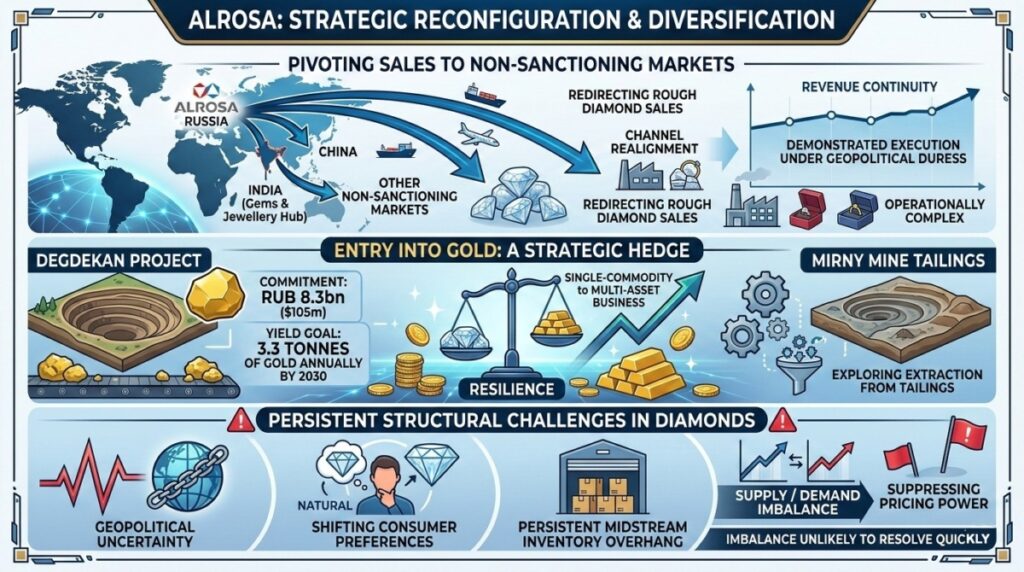
Yet Alrosa’s FY2025 performance offers a compelling case study in strategic adaptation: by combining cost discipline, market diversification, and forward-looking capital allocation, the company transformed a sanctions-induced crisis into an opportunity to fundamentally reposition its business for long-term resilience.



Alrosa reports 88% jump in its FY2025 profits on cost cutting, gold diversification

Tariff refunds on horizon for US diamond importers after court victory

MCX gold rate falls below Rs.1.61 lakh, silver slips 1% on strong dollar
Alrosa reports 88% jump in its FY2025 profits on cost cutting, gold diversification
Tariff refunds on horizon for US diamond importers after court victory

From Pune’s Tech Corridors to Punjab’s Fashion Capital – Gargi by PNGS Marks a Landmark Double Debut
-
 DiamondBuzz27 minutes ago
Alrosa reports 88% jump in its FY2025 profits on cost cutting, gold diversification
-
 National News5 hours ago
From Pune’s Tech Corridors to Punjab’s Fashion Capital – Gargi by PNGS Marks a Landmark Double Debut
-
 National News3 hours ago
MCX gold rate falls below Rs.1.61 lakh, silver slips 1% on strong dollar
-

 National News6 hours ago
Kisna Diamond and Gold Jewellery changes its name to ‘Radha Diamond and Gold Jewellery’ for a day to honour womanhood on Women’s Day
