
DiamondBuzz
Alrosa reports 88% jump in its FY2025 profits on cost cutting, gold diversification
Alrosa reports 88% jump in its FY2025 profits on cost cutting, gold diversification

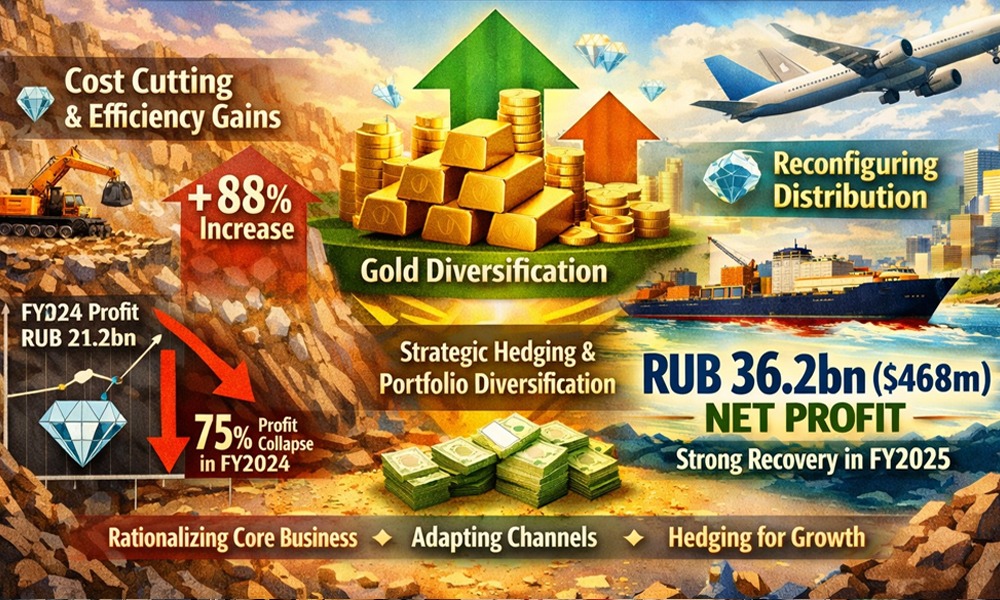
In FY2025, Alrosa demonstrated that adversity can serve as a catalyst for strategic reinvention. The Russian state-controlled diamond miner reported an 88% surge in net profit — rising to RUB 36.2bn ($468m) from RUB 21.2bn ($248m) the prior year — a remarkable recovery driven by rigorous cost restructuring, operational efficiency gains, currency tailwinds from a weaker ruble, and a deliberate pivot toward portfolio diversification.
The turnaround is best understood against the backdrop of FY2024, when sweeping G7 sanctions imposed in March 2024 triggered a 75% collapse in net profit. Rather than remain exposed to a single commodity facing simultaneous geopolitical headwinds and secular demand shifts, Alrosa’s leadership pursued a three-pronged response: rationalize the core business, adapt distribution channels, and hedge through strategic diversification.

On the operational front, the company shuttered unprofitable diamond mines and redirected capital toward higher-margin assets — a textbook application of portfolio pruning under constraint. The results were evident in EBITDA, which expanded 26% year-on-year to RUB 57.8bn ($748m), even as revenue declined modestly by 1.7% to RUB 235.1bn ($3.04bn). Production fell 10% to 29.7 million carats, and sales volumes contracted 20% to 26.2 million carats, with the balance stockpiled — a deliberate supply management decision consistent with broader industry efforts to stabilize pricing.
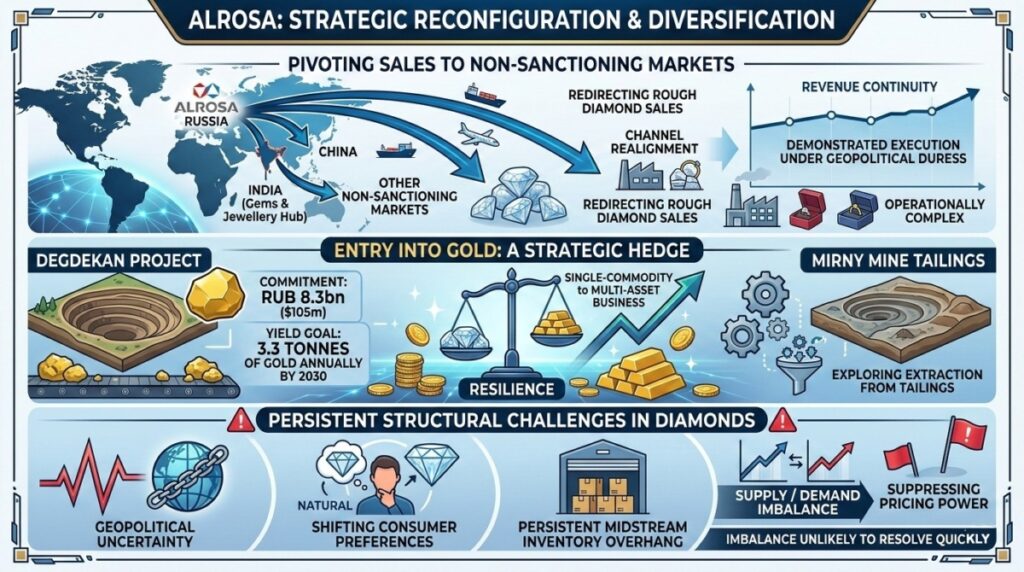
Simultaneously, Alrosa reconfigured its go-to-market strategy, redirecting rough diamond sales toward India, China, and other non-sanctioning markets. This channel realignment, while operationally complex, preserved revenue continuity and demonstrated the company’s capacity to execute under geopolitical duress.
Perhaps the most strategically significant development is Alrosa’s entry into gold. The company committed RUB 8.3bn ($105m) to the Degdekan Project, expected to yield 3.3 tonnes of gold annually by 2030, while simultaneously exploring gold extraction potential from tailings at its Mirny mine. This diversification represents a considered hedge against diamond market cyclicality — moving Alrosa from a single-commodity miner toward a more resilient, multi-asset natural resources business.
The structural challenges facing the diamond industry remain formidable. As the company acknowledged, geopolitical uncertainty, shifting consumer preferences, and persistent midstream inventory overhang continue to suppress pricing power. The imbalance between supply and demand is unlikely to resolve quickly.
Yet Alrosa’s FY2025 performance offers a compelling case study in strategic adaptation: by combining cost discipline, market diversification, and forward-looking capital allocation, the company transformed a sanctions-induced crisis into an opportunity to fundamentally reposition its business for long-term resilience.


DiamondBuzz
De Beers Group Sets Out Portfolio and Organisational Actions to Support Long-Term Value Creation
Company outlines strategic cost optimisation, portfolio streamlining and operational changes to strengthen resilience while positioning for long-term growth in the natural diamond industry.


De Beers Group is advancing delivery of its business streamlining by setting out a number of planned portfolio and organisational changes to ensure an efficient cost base that strengthens resilience in the near-term while enhancing future competitiveness and retaining optionality as industry conditions improve.
Since 2024, De Beers has been streamlining its business in line with its Origins strategy to reduce costs, divest non-core assets and prioritise investment in activities that create the most value. Significant progress has been made, with more than $100 million of annual overhead costs removed from the business, the sale or closure of a number of non-core assets and significant capital and cost reconfigurations to asset expansion projects.
Simultaneously, De Beers has reinvested in natural diamond category marketing to support the industry’s efforts to grow natural diamond demand, launching new large-scale campaigns and collaborating with key stakeholders across the value chain to foster industry-wide investment. Global consumer demand for natural diamond jewellery returned to growth in 2025, while natural diamond sales increased across US independent jewellers in 2025 and into Q1 2026, led by higher value diamonds and those promoted by De Beers’ Desert Diamonds marketing campaign.
On the supply side, global rough diamond production is now decreasing, with several producers closing mines during 2026. Whilst the increasing rarity of diamonds and the emerging signs of improvement in consumer demand are likely to support longer-term value creation, rough diamond trading conditions are expected to remain challenging in the near-term due to cyclical and industry-specific factors.
Consistent with recent actions to improve business resilience, De Beers intends to pause production at the Venetia mine in South Africa for two years to reduce costs while also rephasing capital expenditure on its underground project. This will involve critical infrastructure investment to enhance the capacity and efficiency of the mine, with the intention to support future production growth as business and industry conditions improve.
De Beers is engaging with stakeholders in accordance with relevant requirements and the company’s values as it moves through this process, and will both support impacted employees and continue to invest in its community and Social and Labour Plan commitments.
This proposed action at Venetia Mine follows the decision earlier this year to pause the Tuzo Phase 3 expansion project at the Gahcho Kué Mine in Canada.
In parallel, De Beers plans to reconfigure its global operating model to refocus and prioritise resources on the core operational businesses and reduce its central corporate cost base.
Al Cook, CEO of De Beers Group, said:

“In line with our commitment to focus and streamline our business, we are making a number of changes to De Beers to ensure greater business resilience in the near-term, while supporting long-term value creation. We recognise the protracted challenging conditions as the diamond industry evolves, though we are encouraged by signs of consumer demand growth in the US and beyond, particularly in higher quality diamonds.
Global rough diamond supply is falling, bringing more support to the market. The changes we are making to our business are focused on underpinning our efficiency now and into the future, favourably positioning De Beers in its leadership role.”
De Beers Group will maintain current production levels through its other operations, and previous production guidance remains unchanged.



Regal Jewellers appoints Vijay Sethupathi and Simran as brand ambassadors for Tamil Nadu

Fluorescent Diamonds: GIA to Introduce Clearer Guidance

India’s Consul General to Dubai, Shri V V Reddy, Interacts with BDB Committee
Fluorescent Diamonds: GIA to Introduce Clearer Guidance
Regal Jewellers appoints Vijay Sethupathi and Simran as brand ambassadors for Tamil Nadu
India’s Consul General to Dubai, Shri V V Reddy, Interacts with BDB Committee
-
 International News11 hours ago
Fluorescent Diamonds: GIA to Introduce Clearer Guidance
-
 GlamBuzz11 hours ago
Regal Jewellers appoints Vijay Sethupathi and Simran as brand ambassadors for Tamil Nadu
-
 National News12 hours ago
India’s Consul General to Dubai, Shri V V Reddy, Interacts with BDB Committee
-

 National News12 hours ago
Shankesh Jewellers Ltd. Unveils New Corporate Office at Kalbadevi Road, Mumbai
